

WHO, Pakistan partner for nationwide measles, rubella vaccination drive next month

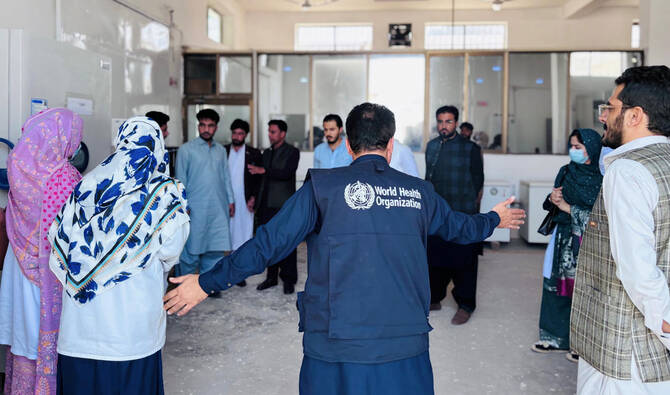
The handout photograph released by the World Healh Organization Pakistan on October 30, 2025, shows Health workers attend a training session for the measles and rubella campaign in Balochistan province, Pakistan. (WHO)
Short Url
Updated 31 October 2025
Follow

WHO, Pakistan partner for nationwide measles, rubella vaccination drive next month

  • 140,000 health workers are being trained for the inoculation drive from Nov. 17 to Nov. 29
  • Over 57 percent of this year’s 16,000 measles cases were reported among unvaccinated children

ISLAMABAD: The World Health Organization (WHO) on Thursday announced a partnership with Pakistan to train more than 140,000 health workers for a nationwide measles and rubella vaccination drive scheduled from Nov. 17 to 29.

Measles is a highly contagious viral illness causing fever, cough, runny nose and a red rash that can lead to serious complications in children. Rubella, also known as German measles, is a milder version but can cause severe birth defects if contracted during pregnancy.

The vaccination campaign aims to protect 35.4 million children aged six years to 59 months and address an immunity gap that could leave over 6.7 million children under the age of five years at high risk of infection next year.

“The scientific evidence is clear: vaccines save lives and protect our children from life-threatening diseases like measles and rubella,” WHO quoted their representative in Pakistan, Dr. Luo Dapeng, as saying.

“Together, we can prevent needless suffering and leave no child behind, no matter where they live or who they are.”

The training 140,000 health workers in microplanning, safe injection practices, community engagement and management of adverse events is being funded by global vaccine alliance Gavi through the WHO.

“In 2025, Pakistan registered an incidence rate of 80 measles cases per million, which is four times higher than the WHO threshold for measles outbreaks to be classified as ‘large and disruptive’,” the WHO noted.

It highlighted that over 57 percent of the more than 16,000 measles cases reported in 2025, as of Sept. 30, were among children who had never received a vaccine dose.

Dr. Soofia Yunus, director general of Pakistan’s Federal Directorate of Immunization, said that protecting children from these diseases was a “national priority.”

“This campaign is a massive undertaking to ensure a healthier, more resilient future for our nation,” WHO quoted her as saying.

“The Government of Pakistan is committed to reaching every child and preventing tragic deaths associated with complications due to measles.”


Pakistan invites Saudi investment in motorway project on sidelines of OIC meeting

Updated 5 sec ago
Follow

Pakistan invites Saudi investment in motorway project on sidelines of OIC meeting

  • Proposed M-10 motorway to link Karachi Port with Hyderabad, says official statement
  • Pakistani and Saudi ministers meet in Istanbul, discuss maritime links, connectivity

ISLAMABAD: Pakistan has invited Saudi Arabia to invest in a proposed motorway linking Karachi Port to Hyderabad, according to an official statement issued on Saturday following talks between the two countries on the sidelines of an Organization of Islamic Cooperation (OIC) meeting in Istanbul.

The meeting between Pakistan’s Communications Minister Abdul Aleem Khan and Saudi Minister for Transport and Logistics Saleh bin Nasser Al-Jasser took place during the OIC gathering, where member states discussed transport integration, logistics and regional trade connectivity.

“During the discussions, Federal Minister Abdul Aleem Khan formally invited the Saudi Government to invest in the M-10 Motorway, featuring a new alignment from Karachi Port to Hyderabad,” the statement said.

“He emphasized that Pakistan is keen on fostering Public-Private Partnerships (PPP) with Saudi Arabia to modernize its transport sector,” it added.

The statement said the discussions focused on enhancing bilateral cooperation in transport, maritime affairs and regional connectivity, with Islamabad seeking to strengthen trade corridors and upgrade port-linked infrastructure.

Al-Jasser expressed interest in modernizing Pakistan’s communications sector and highlighted the importance of digitalization and road surveillance systems, the statement said, adding that both sides also discussed expanding flight operations between the two countries.

The talks were held amid Pakistan’s push for greater international investment.

The country seeks to position itself as a transregional trade hub and it is working to strengthen its supporting infrastructure, including its southern seaports and road and rail network for the efficient movement of goods.