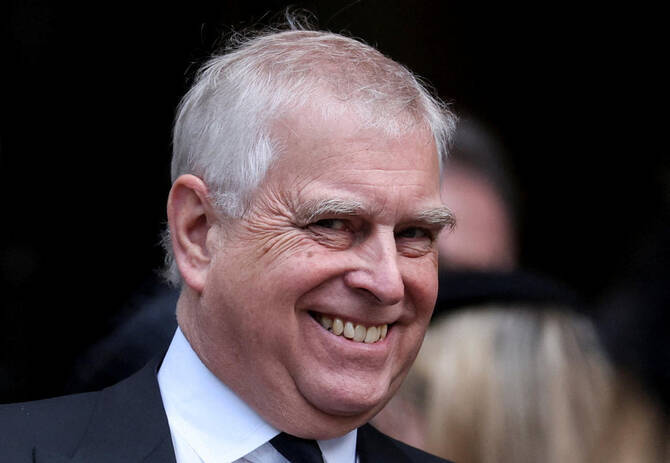
King Charles III strips Prince Andrew of titles and evicts him from royal residence

King Charles III is stripping his brother Prince Andrew of his remaining titles and evicting him from his royal residence, Buckingham Palace said. (Reuters/File)
Short Url
Updated 31 October 2025
Follow

King Charles III strips Prince Andrew of titles and evicts him from royal residence

  • Buckingham Palace said the king “initiated a formal process to remove the Style, Titles and Honours of Prince Andrew“
  • “These censures are deemed necessary, notwithstanding the fact that he continues to deny the allegations against him,” the palace said

LONDON: King Charles III on Thursday stripped his disgraced brother Prince Andrew of his remaining titles and evicted him from his royal residence after weeks of pressure to act over his relationship with sex offender Jeffrey Epstein.
Buckingham Palace said the king “initiated a formal process to remove the Style, Titles and Honours of Prince Andrew.”
After the king’s rare move, Andrew will be known as Andrew Mountbatten Windsor and not as a prince, and he will move from his Royal Lodge residence into “private accommodation.”
It is almost unprecedented for a British prince or princess to be stripped of that title. It last happened in 1919, when Prince Ernest Augustus, who was a UK royal and also a prince of Hanover, had his British title removed for siding with Germany during World War I.
Demand had been growing on the palace to oust the prince from Royal Lodge after he surrendered his use of the title Duke of York earlier this month over new revelations about his friendship with Epstein and renewed sexual abuse allegations by one of Epstein’s victims, Virginia Roberts Giuffre, whose posthumous memoir hit bookstores last week.
But the king went even further to punish him for serious lapses of judgment by removing the title of prince that he has held since birth as a child of a monarch, the late Queen Elizabeth II.
“These censures are deemed necessary, notwithstanding the fact that he continues to deny the allegations against him,” the palace said. “Their Majesties wish to make clear that their thoughts and utmost sympathies have been, and will remain with, the victims and survivors of any and all forms of abuse.”
Giuffre’s brother declared victory for his sister, who died by suicide in April at the age of 41.
“Today, an ordinary American girl from an ordinary American family, brought down a British prince with her truth and extraordinary courage,” her brother Skye Roberts said in a statement.
Andrew faced a new round of public opprobrium after emails emerged earlier this month showing he had remained in contact with Epstein longer than he previously admitted.
That news was followed by publication of “Nobody’s Girl,” by Giuffre, who alleged she had sex with Andrew when she was 17. The book detailed three alleged sexual encounters with Andrew, who she said acted as if he believed “having sex with me was his birthright.”
Andrew, 65, has long denied Giuffre’s claims, but stepped down from royal duties after a disastrous November 2019 BBC interview in which he attempted to rebut her allegations.
Andrew paid millions in an out-of-court settlement in 2022 after Giuffre filed a civil suit against him in New York. While he didn’t admit wrongdoing, he acknowledged Giuffre’s suffering as a victim of sex trafficking.
Although Charles was involved in discussions with Andrew before he announced he would relinquish his dukedom two weeks ago, the king had largely managed to steer clear of the scandal until this week.
After attending an event at Lichfield Cathedral on Monday, the king was heckled by a man who shouted questions about how long he had known about his brother and Epstein and then asked: “Have you asked the police to cover up for Andrew?”
The king did not respond and it wasn’t clear if he even heard the man, who was shouted down by others and eventually pulled from sight.
But video of the incident made the evening news and was the source of embarrassing headlines the next morning.
The move by the king means Andrew will no longer be a prince or be known as His Royal Highness, the Duke of York, Earl of Inverness or Baron Killyleagh — all titles he held until now. Also gone are honors that include Order of the Garter and status as Knight Grand Cross of the Victorian Order.
Andrew is expected to move to a property on the king’s Sandringham estate near the northeast coast and receive private financial support from his brother.
His ex-wife, Sarah Ferguson, who had been living with him in the 30-room mansion, will have to find a new home.


What Bangladesh’s election means for India, China and Pakistan ties

Bangladesh Nationalist Party supporters gather for a rally ahead of the upcoming national election, in Sylhet on Jan. 22, 2026.
Updated 8 sec ago
Follow

What Bangladesh’s election means for India, China and Pakistan ties

  • Bangladeshis will vote on Feb. 12, almost two years after the 2024 student-led uprising
  • After nearly 2 years of tensions, experts expect a thaw with India under elected government

DHAKA: As Bangladesh prepares to hold its first elections since the 2024 ouster of Sheikh Hasina, its longest-serving prime minister, the outcome will define Dhaka’s relations with the most important regional powers — China, India, and Pakistan.

Nearly 128 million Bangladeshis will head to the polls on Feb. 12 to bring in new leadership after an 18-month rule of the current caretaker administration.

The interim government, led by Nobel laureate Muhammad Yunus, took control following a student-led uprising that ended 15 years in power of Hasina and her Awami League party.

The two main parties out of the 51 competing for power are the Bangladesh Nationalist Party and Jamaat-e-Islami. The Awami League, which for decades has had close ties with India, was excluded from the election ballot over its role in the deadly crackdown on the 2024 student-led protests, in which 1,400 people were killed.

While Bangladesh’s relationship India has deteriorated since the fall of Hasina, who has been in self-exile in New Delhi, the period of diplomatic strain is expected to ease when the new government takes office.

“Whoever comes to power in Bangladesh, due to domestic pressure in the country, relationships with India need a resetting,” Humayun Kabir, former ambassador to the US, told Arab News.

“It’s anticipated that India will also engage with the new government, but they will protect their interests, and we also have to do the same. It’s most likely that the India-Bangladesh relationship will be normalized under the new, elected, government.”

Since 2024, India has suspended key transshipment access that allowed Bangladeshi exports to go via Indian ports and airports. It also put on hold most normal visa services for Bangladeshis, who were among its largest groups of medical tourists.

From Hasina’s heavy pro-India orientation, the interim government has tried to rebalance Bangladesh’s foreign policy toward the two other key regional players — China and Pakistan — who at the same time are India’s main rivals. 

If New Delhi regains its importance, it should not deal a blow to the newly expanded relations with Pakistan, with whom Bangladesh has recently increased exchanges, especially economic, and last month resumed direct flights — after a 14-year gap.

Since the relations have been expanded under the caretaker government, Prof. Delwar Hossain from the International Relations Department at Dhaka University forecast that they would only further improve, no matter who comes to power, and there is no likelihood of a sudden change.

“For Pakistan, any political coalition — whether BNP or Jamaat — will be positive. The BNP has a long history of having good relations with Pakistan during their rule ... Jamaat also has a strong and very positive influence in Pakistan,” he said.

“For Pakistan, the new regime or new government is not the issue. The issue is what the (India) policy of the new government would be and to what extent it would actually support Pakistan’s view.”

Both the BNP and Jamaat have repeatedly said they wanted friendly relations with India, and Hossain expected that they would, at the same time, continue the balanced approach introduced by the caretaker administration.

“India is a reality as a neighbor. At the same time, India is also showing interest in mending relations or adopting a more cooperative approach after the vote, with the government that will be elected ... I think there will be pragmatism from both sides,” he said.

“I don’t see there is a long-term threat to Bangladesh-India relations ... When China and Pakistan were trying to create a trilateral cooperative system or some kind of coalition — China, Bangladesh and Pakistan — we have seen that Bangladesh opted out. It seems that Bangladesh is going to continue its policy of maintaining a balance among these great powers.”

Bangladesh’s relations with China have not changed since the ouster of Hasina, whose government signed several economic agreements with Beijing. Yunus’s administration has continued this cooperation, and China was among the very few countries he officially visited during his term.

During the visit, he secured about $2.1 billion in Chinese investments, loans and grants, including funding for infrastructure like Mongla Port and a special economic zone in Chattogram — Bangladesh’s largest port. China has also eased visa rules for Bangladeshi businesspeople, medical travelers and tourists.

According to Munshi Faiz Ahmed, Bangladesh’s former ambassador to Beijing, China’s importance for Bangladesh cannot be substituted by any other country, especially as over the past few years it has emerged not only as its key investor, but also the largest trade partner.

In the fiscal year 2024-25, Bangladesh’s trade with China was over $21.3 billion, according to National Board of Revenue data. With India, it was about $11.5 billion.

The trade — especially import — dependence on Beijing started long before the regime change. In terms of trade volume, China overtook India already in 2018.

“Even when people thought that we had very close relations with India, our relations with China continued to grow in terms of trade and commerce ... Our trade with China has surpassed India’s, and China is a much bigger investor in Bangladesh’s development projects,” Ahmed said.

“Bangladesh will continue to cooperate with China for a long time to come because what China can provide, no other country can.”