

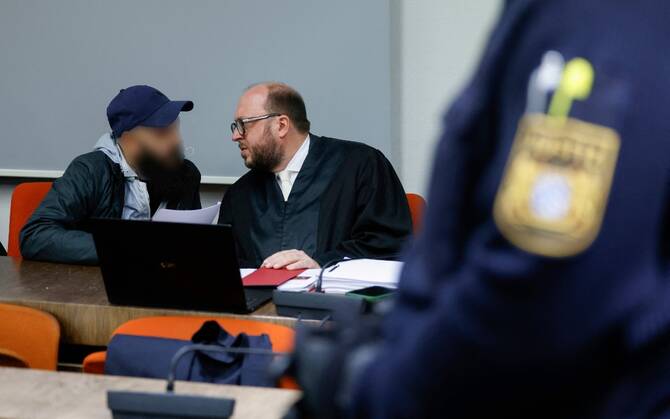

MUNICH: A Munich court on Thursday sentenced a German-Russian national to six years jail for spying for Moscow and plotting sabotage acts to undermine Germany’s support for Ukraine.
The suspect, named as Dieter Schmidt, was found guilty of helping to plan attacks on railway lines and military infrastructure in Germany, allegedly on behalf of Russian intelligence.
German authorities have repeatedly raised the alarm about such agents, supposedly recruited via social media to carry out tasks such as taking photos of sensitive sites, since Russia’s invasion of Ukraine in 2022.
Prosecutors accused Schmidt of scouting targets for potential attacks, including US military bases, a loading station and a tool manufacturing company.
He allegedly took photos and videos of sites that he passed on to a Russian intelligence contact.
“We have come to the conclusion that the charges are essentially accurate,” presiding judge Jochen Boesl said on handing down the verdict.
Schmidt had denied all charges against him. But he was also found guilty of membership of a foreign terrorist organization — the self-proclaimed “People’s Republic of Donetsk,” a pro-Russian militia in eastern Ukraine.
The defendant is said to have been active in the organization between 2014 and 2016, when he came into contact with his Russian intelligence accomplice.
Two more German-Russian dual nationals, named as Alexander J. and Alex D., were given suspended sentences of 12 months and six months respectively for supporting Schmidt’s activities.
Schmidt was born in Siberia in 1984 and came to Germany with his family in 1998, according to Sueddeutsche Zeitung newspaper.
After his arrest, his first words were that he wanted a visit from Russian consular officials, the newspaper reported.
From October 2023, prosecutors said Schmidt “exchanged information” with his Russian contact about possible sabotage operations.
- ‘Hybrid’ warfare -
The operations were allegedly intended to “undermine the military support provided by Germany to Ukraine” as it has sought to repel Russian forces.
The suspect “declared his willingness to carry out explosive and arson attacks on military infrastructure and industrial sites” and to sabotage railway lines used to transport military goods, prosecutors said.
Berlin has been on high alert for sabotage plots since Russia’s full-scale invasion of Ukraine.
It has repeatedly accused Moscow of conducting “hybrid” warfare — a largely unconventional warfare that can involve sabotage, disinformation campaigns and other disruptive attacks.
A court in Frankfurt on Thursday announced that three more men — a Ukrianian, an Armenian and a Russian — will go on trial from December on charges of spying for Moscow.
They are accused of tailing a former Ukrainian soldier on behalf of Russian intelligence services as part of a potential assassination plot.
In May, three Ukrainians were arrested for allegedly plotting sabotage attacks on goods traffic for Russia.
Low-level agents are also thought to have been behind a plot that led to the explosion of parcels at two DHL logistics facilities in Germany and Britain in July last year.
Sinan Selen, head of Germany’s domestic intelligence agency, warned in August that “our country is the target of a wide range of Russian actions: in addition to low-level agents, these increasingly include cyberattacks, disinformation and tangible sabotage.”
Such acts are intended to stir up fear, uncertainty and doubt about democracy, he said.


