

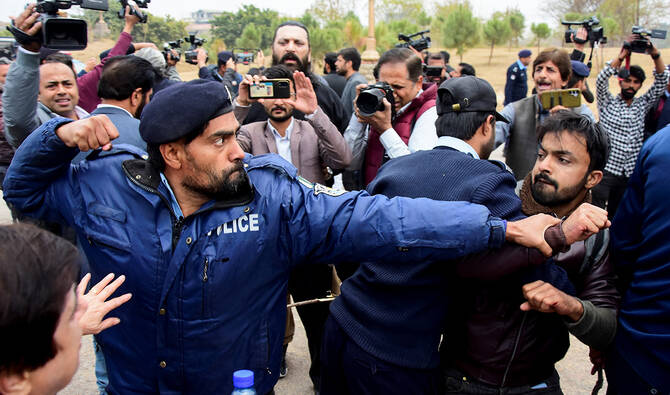

ISLAMABAD: Violations against journalists in Pakistan jumped nearly 60 percent over the past year, a media watchdog said on Thursday, warning of a "worsening environment" for press freedom under Prime Minister Shehbaz Sharif’s government.
The findings are part of the Annual State of Impunity Report 2025 by Freedom Network, a Pakistan-based media rights and civil liberties organization that monitors and advocates for press freedom, journalist safety, and digital rights across the country. The report has been produced with support from International Media Support (IMS) and was released ahead of the UN-designated International Day to End Impunity for Crimes against Journalists on November 2.
Freedom Network documented at least 142 cases of violations against journalists and media professionals between November 2024 and September 2025, a nearly 60 percent rise from the previous year. In the watchdog's framework, “violations” include physical assaults, legal cases, harassment and censorship against journalists and media workers, covering both physical and non-physical threats to press freedom.
The report noted that 36 legal cases were filed against 30 journalists under Pakistan’s Prevention of Electronic Crimes Act (PECA) and Pakistan Penal Code, many in Punjab province, the country's most populous and richest region. The government amended PECA in early 2025 to make its punitive provisions harsher, prompting concern from rights groups that it is being used to target dissenting voices online. The government denies this.
“The use of legal framework to crack down on free expression is a tool the federal government is now using excessively, targeting critical voices,” Freedom Network Executive Director Iqbal Khattak was quoted as saying in the report.
“Pakistan cannot afford to silence critical media, which is equally important in a democratic dispensation.”
The watchdog said the post-election climate after the February 2024 general polls had “made almost every region in Pakistan unsafe for journalism,” with attacks reported across all provinces and territories.
Punjab and Islamabad emerged as the most dangerous places for journalists, accounting for 28 percent each of all recorded violations, followed by Khyber Pakhtunkhwa, Sindh, Balochistan, and Azad Jammu and Kashmir. No incidents were reported from the northern Gilgit-Baltistan region.
Television journalists were the most frequently targeted, followed by those working in print and digital outlets.
Freedom Network said the surge in threats and cases has created “a hostile environment for media,” urging authorities to strengthen protections and end impunity for attacks on journalists.
The findings of the watchdog, it said, “indicate a worsening environment of freedom of expression and safety of journalists in the country under Prime Minister Shehbaz Sharif government.”


