

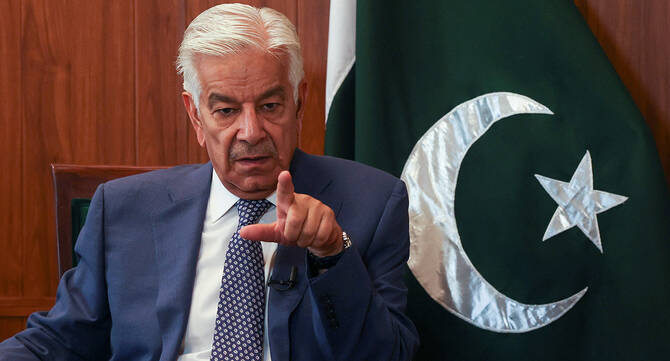

ISLAMABAD: Pakistan’s Defense Minister con Tuesday blamed New Delhi for a deadlock in Pakistan-Afghanistan peace talks in Istanbul, which have failed to bear results despite four long rounds of negotiations.
Pakistani and Afghan delegations have been holding talks since Saturday in Istanbul after the two countries engaged in the worst fighting in decades, leaving dozens dead and several wounded this month.
Clashes erupted after Pakistan conducted airstrikes near Kabul as it went after Pakistani Taliban militants, which Islamabad alleges operate from sanctuaries in Afghanistan. Kabul denies the allegation.
Speaking about a deadlock in talks, Asif said Pakistan and Afghan negotiators reached at least five verbal agreements in recent talks, but Kabul intervened each time and the deal was delayed.
“The government right now in Kabul, it has been penetrated by India and India has started a proxy war against Pakistan through Kabul,” he told a private news channel, claiming New Delhi wants to “compensate through Kabul for the humiliation it suffered on its western border” in May.
Asif’s comment was a reference to a four-day Pakistan-India military standoff in May, during which both sides attacked each other with fighter jets, artillery and drones. There was no immediate reaction from New Delhi or Kabul to his statement.
The Pakistani defense minister praised the Taliban representatives for negotiating “very hard” with the Pakistani side but said they expressed their “helplessness” each time they spoke to authorities in Kabul over phone.
“I believe India aims to engage Pakistan in a low-intensity war and Kabul is realizing that plan,” he added.
Pakistan has long accused Kabul of allowing its soil and India of backing militant groups, including the Tehreek-e-Taliban Pakistan (TTP), for attacks against Pakistan. Kabul and New Delhi have consistently denied this.
Islamabad this month conducted air strikes inside Afghanistan against what it called were militants affiliated with the TTP. The Taliban responded with attacks on Pakistani military posts along the length of the 2,600-km (1,600-mile) contested border.
The two sides agreed to a ceasefire in Doha on Oct. 19, mediated by Türkiye and Qatar, and agreed to hold talks in Istanbul on Oct. 25 to hammer out a lasting truce. Pakistan has sought assurances from Afghanistan that it would not let militants, especially the TTP, operate from its territory and carry out cross-border attacks. Kabul wants Islamabad to respect its territorial sovereignty and refrain from carrying out strikes inside its borders.
A Pakistani security official said on Tuesday that Islamabad is making a “last-ditch effort” to convince the Afghan Taliban to take decisive action against militants targeting Pakistani civilians and security forces.
“Pakistan and the hosts want to resolve these complex issues in a very thoughtful and serious manner,” he said, accusing Kabul of failing the talks in Istanbul.
“A last-ditch effort is still underway, despite the Taliban’s stubbornness, to somehow resolve this issue through logic and talks and the talks are moving toward a final round.”


