

Rebuilding lives: Saudi initiative gives fresh hope to amputees

1 / 6
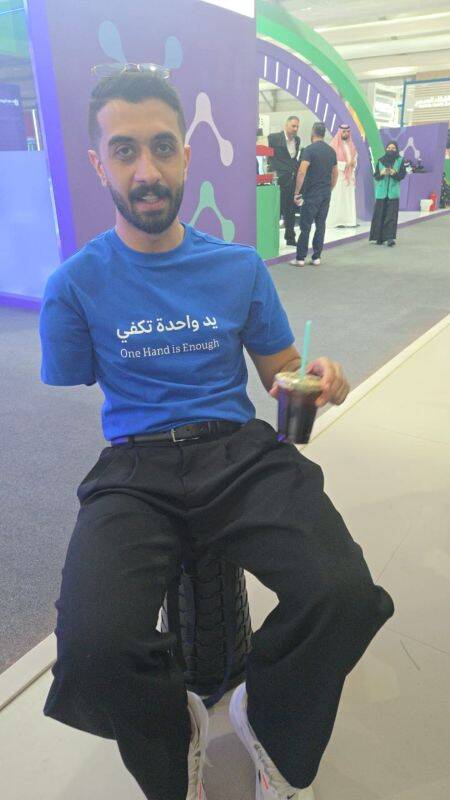
Baitureh Health Association for the Care of Amputees has quickly become one of Saudi Arabia’s most impactful humanitarian initiatives. (Supplied)
2 / 6
Baitureh Health Association for the Care of Amputees has quickly become one of Saudi Arabia’s most impactful humanitarian initiatives. (Supplied)
3 / 6
Baitureh Health Association for the Care of Amputees has quickly become one of Saudi Arabia’s most impactful humanitarian initiatives. (Supplied)
4 / 6
Baitureh Health Association for the Care of Amputees has quickly become one of Saudi Arabia’s most impactful humanitarian initiatives. (Supplied)
5 / 6
Baitureh Health Association for the Care of Amputees has quickly become one of Saudi Arabia’s most impactful humanitarian initiatives. (Supplied)
6 / 6
Baitureh Health Association for the Care of Amputees has quickly become one of Saudi Arabia’s most impactful humanitarian initiatives. (Supplied)
Short Url
Updated 08 December 2025
Follow

Rebuilding lives: Saudi initiative gives fresh hope to amputees

  • Baitureh Health Association has provided life-changing support to more than 1,000 people
  • Prosthetic limbs can cost up to $76,000

MAKKAH: The Baitureh Health Association for the Care of Amputees has quickly become one of Saudi Arabia’s most impactful humanitarian initiatives, transforming support for people with lost limbs.

Established in 2020, the association deals with people’s physical, psychological and social needs and fills a long-standing gap in the national health system.

CEO Badr bin Alyan told Arab News that the initiative was created in response to a growing need, driven by amputations linked to accidents, blood disorders, occupational injuries and other causes.

Its operations were “based on service integration rather than fragmentation, enabling beneficiaries to return to their lives with confidence, ability and independence,” he said.

This holistic process covers everything from initial evaluations to psychological and physical rehabilitation, family support, prosthetic fitting and ongoing maintenance.

Its psychological support programs include group sessions led by certified mentors who have undergone similar experiences, as well as field visits to support patients before and after amputation.

More than 1,000 people across the Kingdom have so far benefitted from the association’s work, about 10 percent of them children, whom Alyan said were “the most sensitive and the most in need of intensive psychological and family support.”

Its specialist programs for children — My First Step and Therapeutic Entertainment — help young people adapt to prosthetics, overcome trauma and build confidence in a safe and supportive setting.

The association has completed more than 300 prosthetic fittings, including silicone cosmetic limbs, mechanical, hydraulic, electronic and 3D-printed models. 

Alyan said the type of prosthetic selected depended on a number of factors, such as age, lifestyle, type of amputation, activity level and psychological readiness.

Children also have to undergo frequent adjustments to their new limbs to account for their growth.

Each prosthetic cost between SR20,000 ($5,300) and SR285,000, Alyan said.

The association funds its work through sponsorships, community contributions and strategic partnerships.

Despite its success, Alyan said there were still challenges to be faced, including the lack of a consolidated base for the provision of psychological support and therapy services and prosthetics development and maintenance.

There was also a shortage of local experts, he said.

In response, the association set up a rehabilitation center, which Alyan said would help to localize prosthetics manufacturing, reduce costs and accelerate fitting processes and create opportunities for local experts to develop their knowledge and experience.

But providing prosthetics was only part of the association’s work, he said.

“Rebuilding a human life is the deeper goal.”


Arab identity, heritage in focus at Riyadh’s Arab Narrative Days event

Updated 08 December 2025
Follow

Arab identity, heritage in focus at Riyadh’s Arab Narrative Days event

  • Event highlights evolution of Arabic language, culture and civilization
  • ALECSO partnership strengthens knowledge programs aimed at preserving heritage

RIYADH: Prince Turki Al-Faisal, chairman of the King Faisal Center for Research and Islamic Studies, inaugurated the third Al-Marwiyah Al-Arabiyah, or Arab Narrative Days, event in Riyadh on Sunday.

The two-day event, with the theme “From Orientalist Narrative to Arab Narrative,” aims to reconstruct the Arab narrative within a critical framework and reclaim the strengths of Arab and Islamic culture.

It also highlights the aspects that have shaped Arab civilization, culture and identity, while shedding light on history and society.

Prince Turki said in his opening remarks that the Arab aesthetic was born from “the silence of the desert and the clarity of its horizon,” where beauty first emerged as sound, script and orientation converged to shape early Arab consciousness.

The chairman addressed the foundational moment when the Arabic language rose to prominence with the revelation. He added that this transformation began with the descent of the Holy Qur’an, when the Arabs were captivated by its eloquence, and with the growing importance of writing, as “Arabic calligraphy became the vessel of the Divine Word, giving rise to the journey of Arab Islamic art.”

He highlighted that the center has upheld this vision since its inception, transforming its treasures and collections into an “Arabic narrative” visible through art and knowledge, the Saudi Press Agency reported.

Prince Turki said that cooperation with the Arab League Educational, Cultural and Scientific Organization reflects this approach and establishes a knowledge partnership that restores attention to the Arabic narrative through the “Arab Narrative” programs.

Mohamed Ould Amar, director-general of ALECSO, commended the center’s role as a beacon of scientific research in the Arab world.

He added that organizing the Arab Narrative Days aligns with the organization’s vision of preserving Arab heritage and reinforcing its presence in modern consciousness.

Amar said that the project is a pivotal step in rebuilding the Arab narrative on critical foundations, restoring the cultural presence of Arabs throughout their scientific and intellectual history, and linking creativity, language, identity and the paths of modernization.

The third edition extends the first edition of Arab Narrative Days, held in February 2023, which focused on critiquing classical narration and tracing the journey of science to and from the Arabs, highlighting that restoring the civilizational role begins with the nation’s awareness of its history and identity.

It also builds on the second edition, held in May 2024, which reinterpreted the culture of the desert as the primary memory where language, imagination and values were formed, drawing on the legacy of Bedouin studies and the efforts of pioneers in documenting desert life and its cultural layers.