Pakistan PM meets Saudi crown prince, eyes enhancing ‘historic’ trade, investment partnership with Riyadh

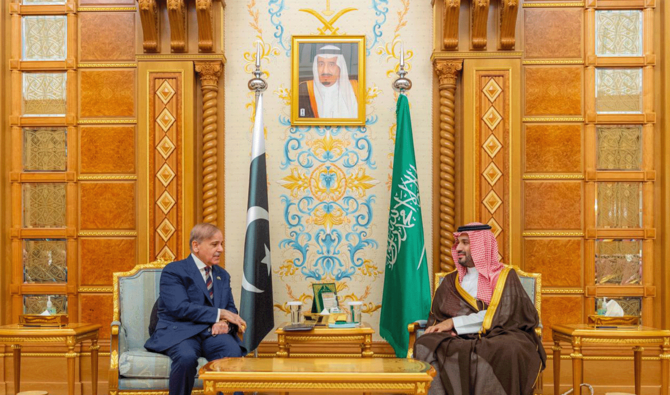
Prime Minister of Pakistan, Shehbaz Sharif (left), in conversation with Crown Prince of Saudi Arabia, Mohammad bin Salman, in Riyadh, Saudi Arabia, on October 27, 2025. (Government of Pakistan)
Short Url
Updated 28 October 2025
Follow

Pakistan PM meets Saudi crown prince, eyes enhancing ‘historic’ trade, investment partnership with Riyadh

  • Shehbaz Sharif meets Crown Prince Mohammed bin Salman on sidelines of Future Investment Initiative conference in Riyadh
  • Senior cabinet members from both countries, Pakistan Army Chief Syed Asim Munir, attend Sharif’s meeting with crown prince

ISLAMABAD: Prime Minister Shehbaz Sharif met Saudi Crown Prince Mohammed bin Salman in Riyadh during which they discussed expanding the two countries’ “historic and time-tested” partnership in trade, investment and economic cooperation, the Pakistani premier said on Tuesday. 

Sharif met the Saudi crown prince on the sidelines of the Future Investment Initiative (FII) conference in Riyadh on Monday. The Pakistani prime minister arrived in Riyadh the same day leading a high-level delegation to attend the FII conference, which brings together prominent global investors and leaders. Discussions during the summit will revolve around global challenges and opportunities such as innovation, sustainability, economic inclusion and geopolitical shifts. 

The Pakistani prime minister and Crown Prince Mohammed bin Salman’s meeting was attended by senior cabinet members from both countries as well as Pakistani Army Chief Field Marshal Syed Asim Munir, according to a statement released by Sharif’s office on Monday night. 

“We reaffirmed the enduring strength of the Pakistan–Saudi Arabia brotherly bonds and discussed ways to further expand this historic and time-tested partnership in trade, investment, and economic cooperation,” Sharif wrote on social media platform X. 

He lauded the Saudi crown prince for his “personal commitment and resolute support” in advancing the two countries’ shared vision for deeper collaboration and prosperity. 

Pakistan and Saudi Arabia last month signed a historic strategic defense agreement, according to which an attack against one country will be treated as an attack against both, formalizing their decades-old security ties.

Pakistan and Saudi Arabia have long enjoyed close ties but have sought to broaden cooperation in recent years. The two countries signed memorandums of understanding worth $2.8 billion across multiple sectors last year in an effort to deepen their economic, trade and investment partnership. 

Islamabad and Riyadh share longstanding ties rooted in faith, mutual respect and strategic cooperation, with Saudi Arabia remaining Pakistan’s key political and economic partner. The Kingdom also hosts over 2.5 million Pakistani expatriates, the largest source of remittances for Pakistan’s $407 billion economy.


Pakistan, Saudi Arabia explore joint investment push in high-growth regions

Updated 29 min 10 sec ago
Follow

Pakistan, Saudi Arabia explore joint investment push in high-growth regions

  • Both sides discuss combining Pakistan’s production capacity with Saudi capital and regional market access
  • Government says Saudi side expressed interest in corporate farming in Pakistan, particularly in rice sector

KARACHI: Pakistan and Saudi Arabia are looking to jointly tap high-growth regional markets and align production and capital strengths, according to an official statement on Wednesday, following talks between Commerce Minister Jam Kamal Khan and Saudi Investment Assistant Minister Ibrahim Al-Mubarak in the Kingdom.

The two countries have long maintained close bilateral ties that have evolved into a multidimensional strategic partnership.

In October last year, the two countries launched an Economic Cooperation Framework aimed at shifting relations beyond aid toward sustainable trade, investment and development links. The framework followed the signing of a joint security agreement a month earlier, under which aggression against one would be treated as an attack on both.

“A key focus of the discussion was the joint exploration of regional markets, particularly Central Asia, Africa, and ASEAN, identified as high-growth regions offering significant opportunities for collaboration,” according to a statement circulated by Pakistan’s commerce ministry after the meeting.

“The two sides agreed that Pakistan and Saudi Arabia, by leveraging their respective strengths, can position themselves as complementary partners — combining Pakistan’s production capabilities with Saudi Arabia’s capital strength, market access, and regional connectivity,” it added.

The Saudi side expressed interest in corporate farming in Pakistan, particularly in the rice sector, with discussions covering mechanization, storage and logistics to enable consistent, long-term exports under structured arrangements.

Talks also covered broader cooperation in agriculture and food security, including rice, fodder, meat and other agri-products, with the potential involvement of Saudi financing institutions in supporting export-linked agricultural and infrastructure projects.

Corporate farming and mechanization were discussed as long-term solutions to productivity challenges in crops such as cotton, where declining yields and high manual input costs have hurt competitiveness, the statement said.

Human resource development emerged as another area of focus, with both sides noting shortages in mid-tier skills such as nurses, caregivers, technicians and hospitality staff.

The Saudi side expressed openness to replicating vocational “train-to-deploy” models in Pakistan that link training programs directly with overseas employment opportunities.

The meeting also examined opportunities in building materials, pharmaceuticals, sports goods, footwear and light manufacturing, with both sides agreeing to pursue sector-specific workshops and business-to-business engagements to translate policy alignment into tangible trade and investment flows.