

KSrelief expands aid efforts across four nations

1 / 2
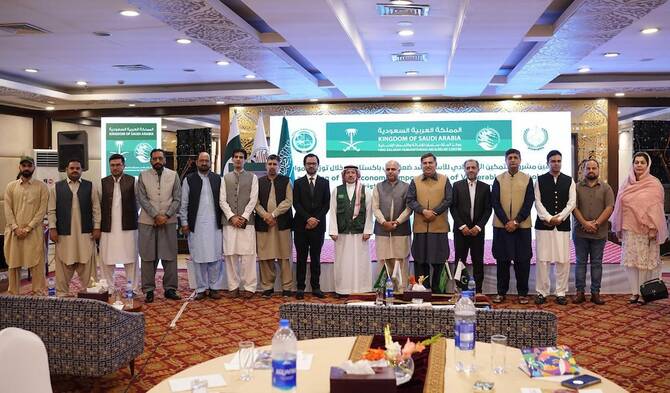
In Pakistan, KSrelief launched the Economic Empowerment Project in Peshawar to support vulnerable families. (SPA)
2 / 2
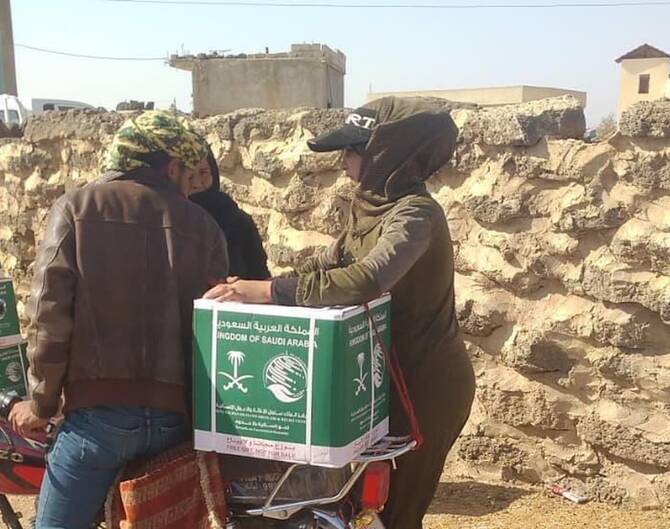
In Syria, KSrelief distributed 420 food baskets to displaced families. (SPA)
Short Url
Updated 27 October 2025
Follow

KSrelief expands aid efforts across four nations

RIYADH: Saudi aid agency KSrelief continues to make an impact by providing critical assistance to some of the world’s most vulnerable communities.

In Pakistan, the organization recently launched the Economic Empowerment Project in Peshawar to support vulnerable families.

The initiative includes distributing 2,000 goats, 25,000 poultry and 500 cattle, along with tools and training, benefiting some 2,500 families.

In the Syrian Arab Republic, the agency distributed 420 food baskets to displaced families from As-Suwayda to Daraa and 970 shelter kits in Aleppo governorate, while in Sudan it distributed 1,050 food baskets to needy and displaced families in Halfa and Abri in the Northern State.

In Afghanistan, the organization provided food aid to 350 returnee families from Iran at the Baba Jan Brigade camp in Kabul Province.

Since being established in 2015, KSrelief has carried out 3,814 projects in 109 countries at a total cost of more than $8.2 billion. Its work spans key sectors such as food security, health, education, water and sanitation, shelter and early recovery.

The agency also works closely with UN bodies and global relief organizations to empower vulnerable communities as well as promote sustainable development.


Rebuilding lives: Saudi initiative gives fresh hope to amputees

Updated 08 December 2025
Follow

Rebuilding lives: Saudi initiative gives fresh hope to amputees

  • Baitureh Health Association has provided life-changing support to more than 1,000 people
  • Prosthetic limbs can cost up to $76,000

MAKKAH: The Baitureh Health Association for the Care of Amputees has quickly become one of Saudi Arabia’s most impactful humanitarian initiatives, transforming support for people with lost limbs.

Established in 2020, the association deals with people’s physical, psychological and social needs and fills a long-standing gap in the national health system.

CEO Badr bin Alyan told Arab News that the initiative was created in response to a growing need, driven by amputations linked to accidents, blood disorders, occupational injuries and other causes.

Its operations were “based on service integration rather than fragmentation, enabling beneficiaries to return to their lives with confidence, ability and independence,” he said.

This holistic process covers everything from initial evaluations to psychological and physical rehabilitation, family support, prosthetic fitting and ongoing maintenance.

Its psychological support programs include group sessions led by certified mentors who have undergone similar experiences, as well as field visits to support patients before and after amputation.

More than 1,000 people across the Kingdom have so far benefitted from the association’s work, about 10 percent of them children, whom Alyan said were “the most sensitive and the most in need of intensive psychological and family support.”

Its specialist programs for children — My First Step and Therapeutic Entertainment — help young people adapt to prosthetics, overcome trauma and build confidence in a safe and supportive setting.

The association has completed more than 300 prosthetic fittings, including silicone cosmetic limbs, mechanical, hydraulic, electronic and 3D-printed models. 

Alyan said the type of prosthetic selected depended on a number of factors, such as age, lifestyle, type of amputation, activity level and psychological readiness.

Children also have to undergo frequent adjustments to their new limbs to account for their growth.

Each prosthetic cost between SR20,000 ($5,300) and SR285,000, Alyan said.

The association funds its work through sponsorships, community contributions and strategic partnerships.

Despite its success, Alyan said there were still challenges to be faced, including the lack of a consolidated base for the provision of psychological support and therapy services and prosthetics development and maintenance.

There was also a shortage of local experts, he said.

In response, the association set up a rehabilitation center, which Alyan said would help to localize prosthetics manufacturing, reduce costs and accelerate fitting processes and create opportunities for local experts to develop their knowledge and experience.

But providing prosthetics was only part of the association’s work, he said.

“Rebuilding a human life is the deeper goal.”