

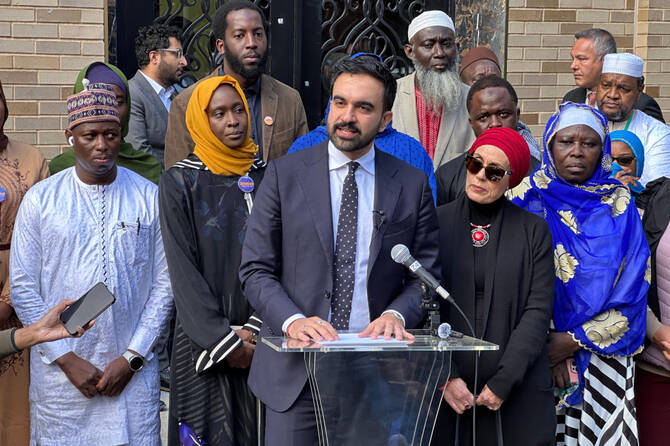

NEW YORK: Zohran Mamdani, the Democratic nominee for New York City mayor, pledged Friday to further embrace his Muslim identity in response to growing attacks by former Gov. Andrew Cuomo and his surrogates that he characterized as “racist and baseless.”
Encircled by faith leaders outside a Bronx mosque, Mamdani spoke in emotional terms about the “indignities” long faced by the city’s Muslim population, choking back tears as he described his aunt’s decision not to ride the subway after the Sept. 11 attacks because she didn’t feel safe being seen in a religious head covering.
He recounted how, when he first entered politics, an uncle gently suggested he keep his faith to himself.
“These are lessons that so many Muslim New Yorkers have been taught,” Mamdani said. “And over these last few days, these lessons have become the closing messages of Andrew Cuomo, Curtis Sliwa and Eric Adams.”
At a news conference later Friday, Cuomo accused Mamdani of “playing the victim” for political purposes and denied that Islamophobia existed on a wide scale in New York.
Throughout the race, Mamdani, a democratic socialist, has been criticized by Cuomo and others over his criticism of Israel’s government which he had accused of committing genocide against Palestinians in Gaza.
But the tone of those attacks have amped up in recent days, drawing allegations from some Democrats that Cuomo’s campaign is leaning into Islamophobia in the final stretch of the campaign.
Appearing on a conservative radio station Thursday, Cuomo appeared to laugh along at host Sid Rosenberg’s suggestion that Mamdani would “be cheering” another 9/11 attack. “That’s another problem,” Cuomo replied.
A Cuomo social media account posted, then removed, a video depicting Mamdani eating rice with his hands and describing his supporters as criminals. A campaign spokesperson said the video was posted in error.
At an event endorsing the former governor, Mayor Eric Adams invoked the possibility of terrorist attacks in New York City, seeming to suggest — without explanation — they would be more likely under a Mamdani administration.
“New York can’t be Europe. I don’t know what is wrong with people,” Adams said, standing alongside Cuomo. “You see what’s playing out in other countries because of Islamic extremism.”
At a debate earlier this week, Sliwa, the Republican candidate, falsely smeared Mamdani as a supporter of “global jihad.”
Asked about Rosenberg’s comments, Cuomo said he “didn’t take the remarks seriously at the time.”
“Of course I think it’s an offensive comment. But it did not come out of my mouth,” he added.
Messages left with Adams’ and Sliwa’s campaign were not immediately returned.
In his speech Friday, Mamdani said he was aiming his remarks not at political opponents but at his fellow Muslim New Yorkers.
“The dream of every Muslim is simply to be treated the same as any other New Yorker,” he said. “And yet for too long we have been told to ask for less than that, and to be satisfied with whatever little we receive.”
“No more,” he said.
To that end, Mamdani said he would further embrace his Muslim identity, a decision he said he consciously avoided at the start of his campaign.
“I thought that if I behaved well enough, or bit my tongue enough in the face of racist, baseless attacks, all while returning back to my central message, it would allow me to be more than just my faith,” Mamdani said. “I was wrong. No amount of redirection is ever enough.”
He continued: “I will not change who I am, how I eat, or the faith that I’m proud to call my own. But there is one thing that I will change. I will no longer look for myself in the shadows. I will find myself in the light.”
Mamdani, who won the primary in stunning fashion, has faced skepticism from some in the Democratic establishment, particularly over his criticism of Israel. On Friday, Mamdani earned the endorsement of House Minority Leader Hakeem Jeffries.
Cuomo told reporters that Mamdani’s criticism of Israel had made Jewish people afraid to leave their homes.
He also rejected Mamdani’s claim that Muslim New Yorkers have been made to feel uncomfortable in their own city.
“Don’t tell me New Yorkers are Islamophobic. They’re not,” Cuomo said.
“What he is doing is the oldest, dirtiest political trick in the book: divide people,” Cuomo said.


