WASHINGTON: Zohran Mamdani ‘s swift rise in New York City’s mayoral race has made him into a national symbol — both as a point of pride among many Muslim Americans and a political foil for the right.
His campaign has been met by a surge in anti-Muslim language directed at the Democratic nominee, who would become the city’s first Muslim mayor if elected in November.
Republican Rep. Andy Ogles of Tennessee called him “little muhammad” and urged deportation. On social media, GOP Rep. Nancy Mace of South Carolina referenced 9/11 alongside a photo of Mamdani dressed in a kurta, a loose collarless shirt common in South Asia.
Far-right activist Laura Loomer claimed without evidence that “NYC is about to see 9/11 2.0.”
On many levels, Mamdani’s run is a significant moment for the country and New York City, which endured 9/11 and the rise in Islamophobia that followed.
“He really does hold so much symbolism,” said Youssef Chouhoud, a political scientist at Christopher Newport University. The campaign is a reminder of anti-Muslim discrimination, he said, but also of Muslim Americans asserting their right “to lead this society moving forward.”
Politicians from both major parties have attacked Mamdani’s progressive politics and criticism of Israel. Conservatives have leaned more heavily into religious attacks and anti-immigrant sentiments.
President Donald Trump singled him out for censure and falsely questioned his US citizenship, echoing “birther” rhetoric he once aimed at former President Barack Obama.
At the National Conservatism Conference, multiple speakers used Mamdani’s name and religion as attack lines, with former Trump adviser Steve Bannon calling the democratic socialist a “Marxist and a jihadist.”
The rhetoric is all too familiar for many Muslim Americans, including Amani Al-Khatahtbeh, who faced slurs and death threats as the first Muslim woman to run for Congress in New Jersey in 2020.
“We’re at a crossroads,” she said via email. “On one hand, Muslims are achieving unprecedented visibility and influence in political spaces. On the other, our dehumanization has never been so normalized and widespread.”
The threat of political violence
Before his assassination last month, conservative activist Charlie Kirk wrote on social media that, “America’s largest city was attacked by radical Islam 24 years ago, and now a similar form of that pernicious force is poised to capture city hall.” On his show, Kirk called Mamdani a “Mohammedan,” an antiquated term for Muslim, and warned about “Anglo centers” like New York coming “under Mohammedan rule.”
Mamdani condemned Kirk’s killing while decrying America’s plague of political violence.
In September, a Texas man was charged with making death threats against Mamdani, including calling him a terrorist and saying “Muslims don’t belong here,” prosecutors said.
Mamdani’s campaign responded by saying these types of threats “reflect a broader climate of hate that has no place in our city.”
“We cannot and will not be intimidated by racism, Islamophobia and hate,” the statement read.
Islamophobia from 9/11 until now
Anti-Muslim bias has persisted in different forms since Sept. 11, 2001.
New York City police ran a now-disbanded Muslim surveillance program. There was furor in 2010 over plans to build a Muslim community center in lower Manhattan. Nationwide, dozens of states introduced legislation aimed at banning Islamic law.
“At its core, anti-Muslim rhetoric is the same: that Muslims don’t belong in this country, that they are perpetual foreigners, that they are a threat to American society and government,” said Eman Abdelhadi, a sociologist at the University of Chicago.
Critics of Obama, a Christian with Muslim ancestry, sought to use his connections to Islam as a political liability. As president, he spoke about his childhood years in Indonesia and his father’s Muslim family in Kenya as assets in diplomacy.
Trump amplified criticisms of Obama’s background, stoking so-called “birther” rumors by falsely questioning whether Obama was born in the US
“He’s really created this new permission structure for people to more openly voice their anti-Muslim rhetoric,” Chouhoud said.
A similar playbook is being used with Mamdani. Born in Uganda to parents of Indian descent, he has lived in New York City since he was 7 and became a US citizen in 2018. He was elected to the state Assembly in 2020.
Despite that record, Trump has echoed a false allegation denying Mamdani’s citizenship and immigration status.
Democrats and the backdrop of the Israel-Hamas war
Islamophobia and antisemitism have risen during the war in Gaza. Accusations of both have played out in the race for mayor of New York, a city home to the largest Jewish and Muslim populations in the US
Before dropping out, Mayor Eric Adams joined another Democrat, former Gov. Andrew Cuomo, in calling Mamdani “dangerous.” Cuomo accused him of “fueling antisemitism” with sharp criticism of Israel.
An outside group supporting Cuomo, who’s now running as an independent, prepared a flyer that appeared to lengthen and darken Mamdani’s beard, which Mamdani called “blatant Islamophobia.” Cuomo’s campaign disavowed it and the mailer was never sent.
Other Democrats have distanced themselves from Mamdani’s progressive platform, critiques of Israel and staunch support for Palestinian rights.
Sen. Kirsten Gillibrand of New York apologized to Mamdani after incorrectly saying he referenced “global jihad.” At issue was his refusal to condemn other people’s use of the slogan “globalize the intifada.” He later said he would discourage its use. Some see the phrase as a call for Palestinian liberation and rights, others as a call for violence against Jews.
In an emotional news conference ahead of his primary win in June, Mamdani accused his rivals of using antisemitism to score political points. “I’ve said at every opportunity there is no room for antisemitism in this city, in this country.”
Pride and hope from fellow Muslims
Despite the controversies, many American Muslims are upbeat about a possible Mamdani victory.
“The abiding emotion ... is a really deep sense of hope,” said Chouhoud, whose Brooklyn accent speaks to his New York roots.
Shahana Hanif, a Mamdani ally and the first Muslim woman elected to the New York City Council, is optimistic. She said Islamophobia is being used as a fear tactic “and it’s just not working.”
Hanan Thabet, a born-and-raised New Yorker and a Mamdani supporter, said his campaign has energized her family after two years of grief over the killing and starvation of Palestinians in Gaza.
So much so that her children — ages 10 and 8 — helped her phone bank for him. “They’re super excited to see this young energetic brown man, Muslim man, you know, potentially be our next mayor.”
As a mother, she feels like it’s “impossible to explain why it has become so socially acceptable to dehumanize Muslims and Arabs, and why our lives seem to matter the least.”
“That is what makes Zohran’s candidacy not only historic,” she said, “but necessary.”


![]()
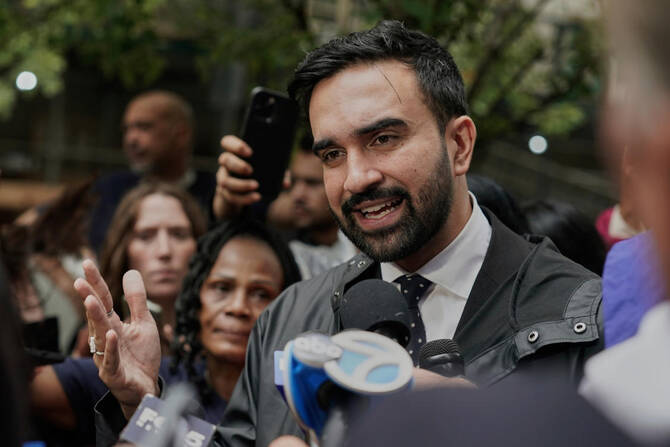
Zohran Mamdani’s rise in the New York mayoral race sparks anti-Muslim vitriol
Short Url
https://arab.news/88cuc
Zohran Mamdani’s rise in the New York mayoral race sparks anti-Muslim vitriol
- Zohran Mamdani’s rise in New York City’s mayoral race has brought him national prominence and a surge of anti-Muslim vitriol, including from elected officials and prominent conservatives

Latest updates


Recommended


© 2026 SAUDI RESEARCH & PUBLISHING COMPANY, All Rights Reserved And subject to Terms of Use Agreement.