

At UN, Pakistan voices concern over rising Islamophobia worldwide, urges respect for diversity

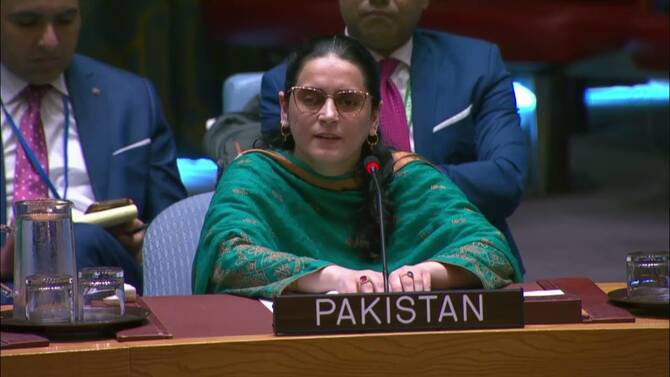
Pakistan’s UN mission counsellor, Saima Saleem, is addressing a session in New York, US, on May 23, 2025. (Pakistan at UN/File)
Short Url
Updated 24 October 2025
Follow

At UN, Pakistan voices concern over rising Islamophobia worldwide, urges respect for diversity

  • Pakistani representative says the ‘weaponization of religion’ and marginalization of minorities not only violate human rights but also endanger development and peace
  • The international community must act with solidarity and ‘moral clarity’ to counter these dangerous trends, hold perpetrators accountable, Counsellor Saima Saleem says

ISLAMABAD: Pakistan on Friday voiced concern over rising Islamophobia worldwide at an interactive dialogue at the United Nations (UN), demanding world action and urging respect for diversity.

The Interactive Dialogue with Special Rapporteur on Minority Issues is an event held within the UN General Assembly’s Third Committee, where states and experts discuss the rights and protections of minority groups.

Recent dialogues have featured discussions on rising Islamophobia, the impact of discriminatory policies for minorities in certain countries, and the need for greater protection and promotion of minority rights. 

Speaking at the dialogue, Saima Saleem, a counsellor at Pakistan’s UN mission, said that respect for diversity and protection of minorities are indispensable for achieving peace, justice and inclusive development.

“We are gravely concerned over the rising tide of Islamophobia, intolerance and right-wing extremism targeting minorities, particularly Muslims worldwide,” she was quoted as saying by Pakistan’s UN mission.

“The weaponization of religion for political ends, the vilification of entire communities, and the systematic marginalization of Muslims in some regions are deeply alarming.”

Pakistan has played a leading role in raising global awareness about Islamophobia through its diplomatic efforts, particularly at the UN and the Organization of Islamic Cooperation (OIC), highlighting that anti-Muslim sentiment not only undermines social harmony but also fuels extremism and hate crimes.

In 2022, the efforts by Islamabad, along with the OIC, led to the UN’s designation of March 15 as the International Day to Combat Islamophobia, marking a significant step toward global acknowledgment of this issue. Through these efforts, Pakistan continues to champion tolerance, coexistence and the right of Muslims everywhere to practice their faith without fear or prejudice.

Saleem said the “weaponization of religion” and systematic marginalization of minorities not only violate human rights but also endanger inclusive development and international peace.

The collective task of the international community is to transform diversity into strength, and difference into mutual respect, according to the Pakistani representative.

“The international community must act with solidarity and moral clarity to counter these dangerous trends, hold perpetrators accountable, and reaffirm that respect for diversity is a universal obligation, not a selective choice,” she said, pledging that

Islamabad would continue to play its role in promoting understanding, dialogue and peaceful coexistence among faiths and cultures.


Pakistan approves upgrades to national ID cards in push to strengthen digital ecosystem

Updated 6 sec ago
Follow

Pakistan approves upgrades to national ID cards in push to strengthen digital ecosystem

  • The amendments allow for QR-based verification, authentication controls, biometric expansion, and card format updates
  • The measures advance integrated digital governance through National Data Exchange Layer and broader digital ID ecosystem

ISLAMABAD: Pakistan has notified amendments to the National Identity Card and Pakistan Origin Card rules and introduced QR-based verification and stronger fraud controls, the National Database and Regulatory Authority (NADRA) said on Tuesday, amid efforts to strengthen the country’s digital ecosystem.

The amendments modernize Pakistan’s identity document framework by legally embedding QR-based verification, strengthening authentication controls across digital services, expanding biometric recognition and updating card formats for key citizen categories.

A core reform is the statutory introduction of the Quick Response (QR) code as a defined security and verification feature, authorizing the use of “QR code or any other technological feature” in lieu of current microchip enabling NADRA to adopt evolving verification technologies without repeated rule amendments.

This QR-enabled capability directly strengthens Pakistan’s Digital ID ecosystem and supports interoperability through the National Data Exchange Layer, according to the national database regulator.

“This establishes a robust legal basis for quick and secure verification of identity credentials in both offline and online environments,” NADRA said.

“This will also enable all citizens to carry similar card instead of currently prevalent two types of national identity cards one of which is with microchip and the other without.”

Pakistani state media reported in August that the country was developing digital identities of all its citizens to enable secure and efficient payments. The measures came as part of a broader effort to digitize the economy for greater transparency.

QR-based credentials allow rapid front-end validation of identity attributes in service delivery settings, while also enabling back-end systems to confirm authenticity and status through trusted exchanges. This is expected to improve speed, transparency and consistency of identity verification across government entities and regulated sectors, reduce manual handling, and lower the risk of fraud and impersonation, according to NADRA.

The amendments also strengthen the enforcement effect of card suspension. The Rules now clarify that where a card is suspended, all verification, authentication and related services linked to that card shall stand suspended forthwith. This closes a key risk area by ensuring that once a card is suspended, it cannot continue to be used through digital verification channels or institutional authentication processes.

“The amendments also introduce standardized identification for residents of Azad Jammu and Kashmir by requiring an inscription indicating ‘Resident of Azad Jammu and Kashmir’ in the manner specified by the Authority, thereby ensuring uniform geographic identification on the document,” NADRA said.

“Overall, these amendments strengthen the legal and technological foundations of Pakistan’s identity system by enabling secure QR-based verification, reinforcing the integrity of digital authentication services, improving biometric assurance,” it said. “They also advance readiness for integrated digital governance by supporting structured interoperability through the National Data Exchange Layer and a broader Digital ID ecosystem.”