

Rebuilding wrecked Syria vital for regional stability: UN

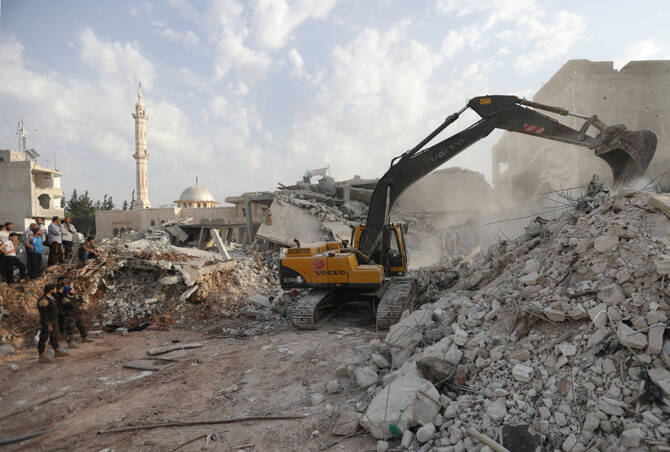
The World Bank this week estimated that Syria’s post-war reconstruction could cost up to $216 billion. (AFP file photo)
Short Url
Updated 24 October 2025
Follow

Rebuilding wrecked Syria vital for regional stability: UN

  • UNDP says Syria must be swiftly rebuilt to bring stability to the country and the wider region
  • World Bank estimates Syria’s post-war reconstruction to cost up to $216 billion

GENEVA: After 14 years of destruction, Syria must be swiftly rebuilt to bring stability to the country and the wider region, a top UN official in the war-ravaged nation told AFP.
Reconstruction is one of the most significant challenges facing Syria’s new Islamist authorities after the overthrow of longtime ruler Bashar Assad last December.
“The international community should definitely rush into rebuilding Syria,” Rawhi Afaghani, the UN Development Programme’s deputy representative in Syria, told AFP this week during a visit to Geneva.
“Being able to help the country to rebound and come out of this war and come out of this destruction is for the Syrians themselves, but also for the stability and the good of the whole region,” he said in the interview.
The Syrian civil war, which erupted in 2011 with Assad’s brutal repression of anti-government protests, killed over half a million people and devastated the country’s infrastructure.
The World Bank this week estimated that Syria’s post-war reconstruction could cost up to $216 billion.
Afaghani said he could not put a price tag on rebuilding Syria, but described the needs as “massive.”


A drone view shows widespread destruction in the Idlib countryside, Syria, on October 9, 2025. (REUTERS)

Across the country, he said governors had told him about the massive need for housing, schools, and health centers, as well as electricity and water.
Complicating the clean-up efforts are the vast quantities of unexploded ordnance littering the entire country, including within mountains of rubble that need to be cleared, he said.

‘Tensions’ 

More than one million Syrian refugees have already returned from abroad and nearly double as many have returned to their places of origin after being displaced inside the country, UN figures show.
While those returns are a good sign, Afaghani warned that they were “putting a lot of pressure on the infrastructure, on the transportation, on the education, on the bakeries.”
“People are returning to destroyed houses or houses that are actually occupied by other people,” he said.
Afaghani warned that the strain on infrastructure “could lead to community tensions.”
At the same time, he said the lack of infrastructure, services and jobs was dissuading many Syrians who want to return home from doing so.
“We thought there would be a much higher rate of return,” he acknowledged, pointing out that most of those who have returned from abroad had left often difficult conditions in neighboring Jordan and Lebanon.
From Europe, “we don’t see that massive return,” he said.
Afaghani voiced hope that swift reconstruction could usher in “a stable Syria,” which in turn would draw more returns from Europe.
“Those are high-skilled people — they can rebuild Syria,” he said.
Those returnees, he insisted, could also “be a big, good influence in the whole region from an economic perspective, and from a peace-building perspective.”


Airspace closed, flights canceled as US-Iran conflict flares

Updated 3 sec ago
Follow

Airspace closed, flights canceled as US-Iran conflict flares

  • Major carriers from the Middle East, Europe, Asia-Pacific and the US announced widespread cancelations
  • FlightAware said more than 19,000 flights had been delayed globally and more than 2,600 were canceled as of Sunday
PARIS: Thousands of flights have been delayed or canceled in the biggest disruption to global air transport since the Covid pandemic as airlines suspend services to the Middle East following the US and Israeli attacks on Iran.
Iran, Iraq, Israel, Syria, Kuwait and the United Arab Emirates all announced at least partial closures of their skies after Saturday’s strikes and Iran launching missiles at capital cities around the wealthy Gulf region.
Major carriers from the Middle East, Europe, Asia-Pacific and the United States announced widespread cancelations, leaving thousands of passengers stranded.
Notable airlines that canceled services included Emirates, Etihad, Air France, British Airways, Air India, Turkish Airlines, and Lufthansa.
According to aviation analytics company Cirium, of around 4,218 flights scheduled to land in Middle Eastern countries on Saturday, 966 (22.9 percent) were canceled, with the figure rising above 1,800 if also including outbound flights.
For Sunday, 716 flights out of 4,329 scheduled to the Middle East have been canceled, Cirium said.
Flight tracking website FlightAware meanwhile said more than 19,000 flights had been delayed globally and more than 2,600 were canceled as of 0230 GMT Sunday.
Airspace closures
Iran swiftly closed its airspace as the strikes began “until further notice,” said the spokesman of Iran’s Civil Aviation Organization, quoted by the Tasnim news agency.
Israel also closed its airspace to civilian flights, Transport Minister Miri Regev announced.
Qatar’s civil aviation authority said it had temporarily closed the Gulf state’s airspace.
Iraq shut down airspace, state media said.
The United Arab Emirates said it was closing its skies “partially and temporarily.”
Syria closed part of its airspace in the south along the border with Israel for 12 hours, the Civil Aviation Authority said.
Jordan’s air force was conducting drills to “defend the kingdom’s skies,” its military said.
Kuwait closed its airspace.
Middle East and North Africa airlines
Gulf carriers Emirates and Etihad canceled 38 percent and 30 percent of their flights respectively, Cirium said.
Qatar Airways suspended all flights from Doha. It canceled 41 percent of total flights, according to Cirium.
Syria Air, the country’s national carrier, canceled all flights until further notice.
Egypt’s national airline, EgyptAir, announced the suspension of its flights to cities across the Middle East, including Dubai, Doha, Manama, Abu Dhabi, Beirut and Baghdad among others.
European airlines
Russia’s air transport authority Rosaviatsia said all commercial flights to Israel and Iran were canceled “until further notice.”
Turkish Airlines canceled flights to Lebanon, Syria, Iraq, Iran, and Jordan until March 2.
Air France canceled its Dubai, Riyadh and Beirut flights for Saturday, and flights to Tel Aviv until Sunday.
British Airways said it was not flying to Tel Aviv and Bahrain until March 4, and canceled flights to the Jordanian capital Amman on Saturday.
Swiss International Air Lines suspended flights to and from Tel Aviv until March 7, and canceled flights from Zurich to Dubai scheduled for Saturday and Sunday.
Germany’s Lufthansa, which comprises Swiss and ITA Airways, canceled its flights to and from Tel Aviv, Beirut, Amman, Irbil and Tehran until March 7.
The airline group and its subsidiaries suspended flights to and from Dubai and Abu Dhabi until Sunday.
North America airlines
Delta Air Lines suspended New York-Tel Aviv flights until Sunday.
American Airlines “temporarily suspended” Doha-Philadelphia flights.
United flights to Tel Aviv are canceled until Monday, and flights to Dubai until Sunday.
Air Canada said it canceled flights from Canada to Israel until March 8 and to Dubai until March 3.
Asia-Pacific airlines
India’s two largest private carriers IndiGo and Air India suspended flights to all destinations in the Middle East.
Pakistan International Airlines, the flag carrier of the country that borders Iran, said it had suspended flights to the UAE, Bahrain, Doha and Kuwait.
Hong Kong’s Cathay Pacific suspended flights to Dubai and Riyadh.
Garuda Indonesia, Indonesia’s flag carrier, temporarily suspended flights to and from Doha “until further notice,” the company said in a statement Sunday.
Singapore Airlines and Singapore’s Scoot canceled six flight routes in the region until the end of Sunday, local media reported.
Philippine Airlines flights from Manila to Doha, Riyadh to Manila, and Dubai to Manila were canceled on Saturday, as well as one Doha-Manila flight on Sunday.
Other major airlines including Australia’s Qantas and Japan’s All Nippon Airways did not announce any flight cancelations.
Africa airlines
Ethiopian Airlines canceled its flights to Amman, Tel Aviv, Dammam, and Beirut.
Kenya Airways has suspended its flights to Dubai and Sharjah until further notice.