

Pakistan launches push for local vaccine production to strengthen health security, reduce imports

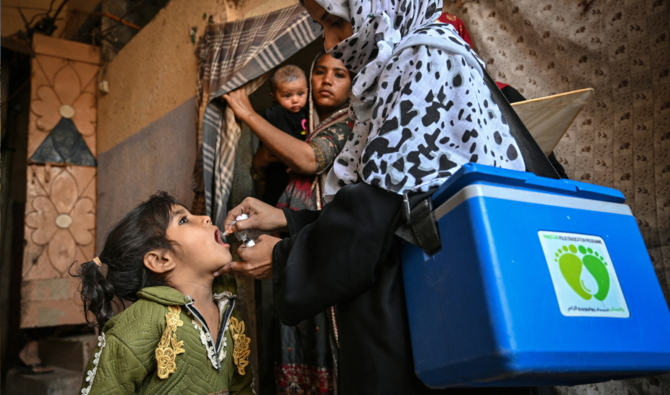
A health worker administers polio drops to a child for vaccination during a nationwide week-long poliovirus eradication campaign in Karachi, Pakistan, on May 26, 2025. (AFP/File)
Short Url
Updated 23 October 2025
Follow

Pakistan launches push for local vaccine production to strengthen health security, reduce imports

  • Government forms high-level body to expedite national vaccine policy
  • Pakistan still imports over 95 percent of vaccines, aims to cut dependence, boost biotech growth

ISLAMABAD: Pakistan has launched an initiative to locally manufacture vaccines, the government said on Thursday, as part of efforts to strengthen public-health security, lower import costs and attract investment in the country’s biotech sector.

Pakistan currently imports nearly all finished vaccines, according to WHO and UNICEF procurement data, with the National Institute of Health in Islamabad handling only small-scale “fill-and-finish” operations through foreign partnerships such as CanSinoBIO’s COVID-19 packaging in 2021. 

Public-health experts say the lack of domestic capacity leaves the country exposed to global supply shocks and drives an annual vaccine import bill exceeding US $250 million.

On Thursday, Special Assistant to the Prime Minister Haroon Akhtar Khan chaired a high-level meeting to review the draft National Vaccine Policy, identify production bottlenecks and finalize a roadmap for local manufacturing. A committee has been formed on the prime minister’s instructions to speed up the process, the Prime Minister’s Office said.

“The government is developing a comprehensive policy to promote local manufacturing of vaccines, which will not only reduce the import bill but also strengthen the national economy,” Khan said. 

He added that vaccine production would “ensure health security and economic self-reliance for Pakistan.”

The new initiative, Khan said, aims to build national resilience by developing biotech and pharmaceutical capabilities, reducing the import burden, and ensuring rapid response to future pandemics. The government is also engaging with international organizations to secure technology transfer and investment, while enhancing capacity at the National Institute of Health (NIH) and the Drug Regulatory Authority of Pakistan (DRAP).

Officials said the proposed Pakistan Vaccine Manufacturers Alliance would align public- and private-sector efforts and improve coordination with regulators. Local production, they added, could eventually help Pakistan become a regional supplier in South Asia once facilities meet WHO pre-qualification standards. 


Pakistan urges Afghan rulers to ‘rid their soil of terrorists’ at regional meeting in Tehran

Updated 14 December 2025
Follow

Pakistan urges Afghan rulers to ‘rid their soil of terrorists’ at regional meeting in Tehran

  • Iran hosts meeting of special representatives on Afghanistan from Pakistan, China, Russia, Central Asian countries
  • Pakistan alleges militants use Afghan soil to launch attacks against it, charges the Afghan Taliban deny repeatedly

ISLAMABAD: Pakistan’s special envoy on Afghanistan Mohammad Sadiq urged rulers in Kabul on Sunday to rid their soil of “terrorists,” saying the move would inspire confidence in its neighbors to engage with the country.

Sadiq, who is Pakistan’s special representative to Afghanistan, was part of a high-level meeting hosted by Iran in Tehran to discuss issues related to Afghanistan. The meeting featured Afghan affairs representatives from Pakistan, Tajikistan, Uzbekistan, Turkmenistan, China and Russia, Iranian state news agency IRNA said. 

Pakistan blames a surge in attacks on its soil on militants it says are based in Afghanistan, a charge Kabul denies. The allegations have caused tensions between the neighbors to rise, resulting in deadly border clashes in October that saw dozens of soldiers killed on both sides. 

“It is imperative that the current de facto rulers [in Afghanistan] take steps to ameliorate their suffering,” Sadiq wrote on social media platform X. 

“And the foremost step in this regard would be to rid their soil indiscriminately of all types of terrorists.”

Sadiq said he agreed with other participating countries during the meeting that the “threat of terrorism” originating from Afghanistan’s soil is a “big challenge” for the region. 

“Also made this point that only an Afghanistan that does not harbor terrorists will inspire confidence in the neighboring and regional countries to meaningfully engage with Afghanistan, helping to realize the country’s immense economic and connectivity potential,” he concluded. 

Officials from Pakistan and Afghanistan engaged in three rounds of peace talks in Türkiye, Qatar and Saudi Arabia since the October clashes but were unable to reach an agreement. 

While Pakistan has vowed it would go after militants in Afghanistan that threaten it, Kabul has said it would retaliate to any act of aggression from Islamabad.