


Arab News launches translation services in 50 languages at FIPP Media congress in Madrid

1 / 7
2 / 7
3 / 7
4 / 7
5 / 7
6 / 7
7 / 7
Short Url
Updated 04 November 2025
Follow

Arab News launches translation services in 50 languages at FIPP Media congress in Madrid

  • Using artificial intelligence, Saudi Arabia’s first English daily is now accessible to 80 percent of the world’s population
  • Embracing innovation over apprehension, Arab News is harnessing AI to empower journalists and expand global reach

MADRID: Arab News, Saudi Arabia’s first English-language daily, has launched the beta version of an artificial intelligence-powered translation service that makes its news, views, and analysis available in 50 languages.

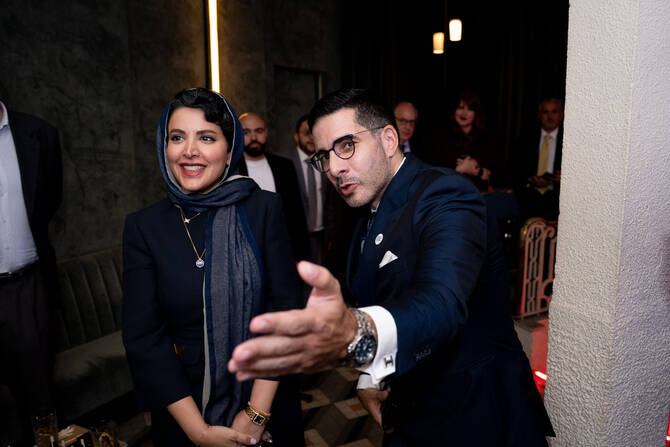
The announcement was made by Editor-in-Chief Faisal J. Abbas during a special event in Madrid, coinciding with the FIPP World Media Congress 2025 and marking the newspaper’s Golden Jubilee.

“Thanks to modern-day technology, Arab News, which launched in 1975 to be a voice for Saudi Arabia in English, will now be the voice of a changing region in 50 languages, reaching a remarkable 6.5 billion people, or 80 percent of the world population,” Abbas told a side event on Wednesday evening.

Attendees included Princess Haifa bint Abdulaziz Al-Mogrin, the Saudi ambassador to Spain, Arab and Spanish diplomats, and senior editors and executives.

Abbas, who has overseen the newspaper’s digital transformation since 2016, told attendees the project reflects both Arab News’ longstanding role as Saudi Arabia’s voice in English and the publication’s commitment to telling the story of a region undergoing rapid change.

“The idea stems from the importance of telling our story, particularly in a region where events influence the whole world and where the beating heart, Saudi Arabia, is undergoing massive transformation and reforms under Vision 2030,” he added.

The cutting-edge translation platform is powered by technology developed by CAMB.AI, a regional startup that has quickly become one of the Arab world’s most promising AI success stories on the global stage.

“The internet was created for English speakers and we decided to redesign it for the world,” said Avneesh Prakash, CEO of CAMB.AI.

“We created CAMB.AI as the most comprehensive localization AI platform in the world, building on top of our foundational AI models.”

Prakash said the technology enables “leading organizations across the world to localize their content — video, audio, text, documents, website — anything to help brands reach the global population beyond language barriers.

“Partnering with Arab News to launch in 50 languages during its 50th anniversary year demonstrates our dedication to breaking down these barriers. Arab News stands for authentic content and now with CAMB.AI technology it can reach billions of people.”

The event also featured a screening of “Rewriting Arab News.”

The documentary chronicles the newspaper’s five-decade journey, from its founding in 1975 by the brothers Mohammad and Hisham Ali Hafez in Jeddah, to its ongoing digital transformation under the paper’s parent company, the Saudi Research and Media Group.

The film, which has been shortlisted for a prestigious 2025 AIB Art and Culture Video Award, highlights how Arab News evolved from a national print publication into a globally recognized digital media platform.

The event was hosted by Juan Senor, media analyst and president of Innovation Media Consulting Group, who underscored the “threats and opportunities” AI presents to the media industry at this pivotal moment.

Senor said AI is a “huge disruption to publishing, storytelling, (and) journalism,” but where “some see a threat,” Arab News sees “an opportunity.”

Just as the publication adopted a digital-first approach, it is now embracing AI “responsibly, creatively, intelligently” with the aim of empowering journalists, instead of replacing them, he added.

“The evolution of Arab News mirrors the transformation of the Kingdom of Saudi Arabia itself. Two journeys side by side, both rooted in tradition, both driven by ambition, and both embracing change,” Senor said.

Among the attendees were Cristina Juarraz, assistant director and programming coordinator at Casa Arabe; Pedro Gonzalez, journalist and co-founder of Euronews; Ivan Moreno de Cozar y Landahl, secretary-general at Alliance Francaise Madrid; Jaime Barrientos, war reporter and Middle East expert; and Jorge Hevia Sierra, former Spanish ambassador to Saudi Arabia.

The event also drew several Arab diplomats, including Raghad A. Alsaqqa, Jordan’s ambassador to Spain; Hani Shamatli, Lebanon’s ambassador to Spain; Walid Abuabdalla, Libya’s ambassador to Spain; and Husni Abdel Wahed, Palestine’s ambassador to Spain.

Other attendees included Mohammad Alshohomi, Kuwait’s charge d’affaires ad interim in Spain; Ehab Ahmed Badawy, Egypt’s ambassador to Spain; Saleh Ahmad Salem Alzaraim Alsuwaidi, the UAE’s newly appointed ambassador; and Malek Twal, head of the Arab League’s office in Madrid.

The launch of the multilingual platform underscores Arab News’ continued expansion as a major international media outlet and pioneer in bridging cultures through journalism and innovation.

Since its founding, Arab News has built a reputation as the “voice of a changing region,” reflecting the Kingdom’s development, diplomacy, and modernization.

Abbas said the debut of the AI-powered service marks a milestone moment for the newspaper, merging technology and storytelling to share the region’s perspectives with global audiences.

“This year we’re turning 50. And we were adamant that our celebration will not be a farewell party but rather a rebirth,” Abbas said. “We’re proud to be embracing technology, not resisting it.”


Keep it real: Tech giants urged to lead on safeguarding online privacy

Updated 09 December 2025
Follow

Keep it real: Tech giants urged to lead on safeguarding online privacy

  • AI, deepfakes, misinformation under scrutiny at Bridge Summit
  • Media, tech professionals discuss how to keep users safe

ABU DHABI: As AI-generated deepfakes and bots grow more sophisticated, online privacy and identity protection have become urgent global concerns, especially for journalists, influencers and media professionals, whose lives unfold in the digital spotlight.

The growing threats of impersonation, character assassination and coordinated online abuse was at the center of a high-stakes conversation on the second day of the Bridge Summit in Abu Dhabi, where regional and international leaders from the technology and media fields tackled the complex risks surrounding digital safety, security and trust in an AI-powered world.

Adeline Hulin, chief of unit, media and information literacy at UNESCO, highlighted the risks that many people, in particular children and women, are facing online. 

Although her work has long centered on promoting safe internet practices, she said that the onus of safeguarding online privacy and security rested primarily with technology companies — the only actors, she argued, capable of keeping pace with the rapid evolution of AI.

“It is going to be really important that instead of people constantly having to adapt to the technology, if the technology itself is more user-centric,” she told the summit.

“We can train people to recognize deepfakes, but technology can do that quicker.”

Major tech companies have come under fire in recent years for failing to tackle harassment and misinformation. This has led to a litany of legislation as governments try to gain control of a growing problem.

But some companies appear to be heeding the call. Erin Relford, senior privacy engineer at Google, said her company was working to embed privacy protections in the infrastructure level beneath the platform.

“We want to give consumers the choice of how much they can share data-wise,” she said.

“The biggest challenge is making sure you have the right people in the room to create these privacy protection platforms.”

Privacy enhancement technology would see several tools released that empowered users to understand how their data was being monetized and aggregated, Relford said.

Google had been working to change the parental controls and make it easier for users to understand their protection, she said, but admitted it was still difficult and more education was needed.

“Most of the power lies within the user. Consumers drive what is popular. In terms of organizations that protect your privacy, we want to encourage them and use their services rather than empowering websites that don’t,” she said.

Education is key 

Still, Relford argued that education was fundamental in rolling out privacy tools. Tech companies could only do so much if people did not increase their awareness online, she said.

“The better we educate people about privacy tools, the less harm we have from the ground up.”

Echoing similar sentiments, Hulin promoted the idea of including online literacy in school curricula. Even high-profile moves, like Australia’s recent headline-grabbing ban on under-16s using social media, would do little to reduce the risks without more education.

“Even if there is banning, it’s not going to change misinformation and disinformation. You still need to teach these kids about the information ecosystem,” she said.

“Parents need to be really interested in the news information that your children are consuming.”

Assel Mussagaliyeva-Tang, founder of Singapore-based startup EDUTech Future, said that the AI revolution demanded close collaboration between schools, universities and families to equip children with the skills to navigate new technologies safely and responsibly.

“We need to set up the guardrails and protection of the kids because they are not aware how the model will respond to their needs,” she said.

A UNESCO survey found that 62 percent of digital creators skip rigorous fact-checking, while a 2024 YouGov study showed only 27 percent of young adults feel confident about AI in education.

Mussagaliyeva-Tang said educators needed to focus on preparing and nurturing adults who were “ready for the world,” by integrating ethics, data literacy and critical thinking into curricula.

But she said that universities and the broader education system remained behind the curve in adapting to emerging technologies and equipping students with the skills needed for responsible digital engagement.

Likewise, tech companies needed to be transparent and inclusive in training their data in a way that represented different cultures, she said.

While global regulations on AI remain fragmented, Dr. Luca Iando, dean and distinguished chair at the Collins College of Professional Studies at St. John’s University, called on educational institutions to actively collaborate with technology platforms to help shape educational content and mitigate the potential harm of AI on children, especially as technologies continue to grow.

He warned of young people’s overreliance on AI and said that educators in the long term needed to focus on developing “durable, human skills” in students and transform the type of assignments and coursework to meet the new age of AI.

There needed to be guidelines for students on using AI responsibly, to prepare them for the workplace, he said.

Highlighting the skills gap between educational institutions and the modern workplace, Mussagaliyeva-Tang said: “Employers want professionals. They don’t have time and the budgets to retrain after the outdated curriculum of the university.”

The rise of AI demanded a rethinking of the true purpose of education to nurture individuals who strove to make a positive impact on a rapidly evolving world, she said.