


ISLAMABAD: As Pakistan’s key border crossings with Afghanistan remain closed for trade and traffic in the aftermath of border skirmishes between the two nations, residents of Islamabad were left worried on Wednesday at the steep increase in the prices of tomatoes.
Pakistan closed its key northwestern Torkham and southwestern Chaman border crossings with Afghanistan earlier this month, after skirmishes between the two countries’ forces heightened tensions.
Pakistan imports tomatoes and other perishable items from Afghanistan via the two border crossings. These imports have traditionally filled supply gaps when local production dips. As the border crossings remain closed, tomato prices have surged by more than 400 percent in recent days, reaching as high as Rs600 ($2.2) per kilogram in retail markets across the country.
“These have become too expensive. We cannot understand this,” Shan Messiah, a customer at Islamabad’s G-9 vegetable market, told Arab News as he shook his head in disbelief.
“Since they are used in every food, we are facing difficulties.”

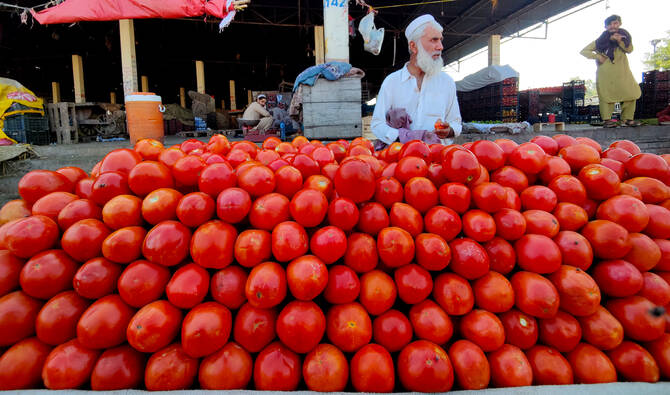
Tomatoes lying on a cart in a market in Islamabad, Pakistan, on October 22, 2025. (AN photo)
Mohammad Imran, a tomato seller in Islamabad’s fruit and vegetable market, explained how the supply crunch unfolded.
“Today’s rate is Rs400 [$1.42]. The supply from Afghanistan has stopped because the border is closed,” he said. “Now it’s coming from Iran, Sindh, and Quetta. Demand hasn’t decreased — people still buy the same amount — but supply is much less.”
Imran added that a week ago, tomatoes were selling for even higher prices, such as Rs560 [$1.99] or Rs600 per kilogram.
Nusrat Jehan, another customer, said she had just bought a kilogram of tomatoes for Rs400, which used to sell for much lower a few days earlier.
“Earlier, you know, the rates were a little low,” she said. “But due to the closure of borders, maybe that’s why [the prices have surged].”

People walk past tomato cart in a market in Islamabad, Pakistan, on October 22, 2025. (AN photo)
Shapur Khan, a vegetable wholesaler, said the difference in the supply volume of tomatoes has been staggering since the border closed.
“In Pakistan there are less tomatoes and even the tomatoes we get from Iran are less,” Khan told Arab News.
He said Pakistan imported around 80 to 120 trucks of tomatoes daily from Afghanistan.
“Now, we are getting 10 to 15 trucks from Iran and the rest from Swat [in Pakistan] but it’s not enough,” he said.
Officials say the government is monitoring the situation and expects prices to stabilize soon.
Sajid Abbasi, Chairman of the Market Committee in Islamabad, said authorities were aware of the sudden spike in tomato prices and were taking measures to increase its supply.
“We are aware of the price fluctuations caused by the border closure,” Abbasi said. “Alternative supply routes are being strengthened, and we expect prices to normalize soon.”


