

Pakistan’s sesame exports to China surge 87% as Beijing’s edible oil demand grows

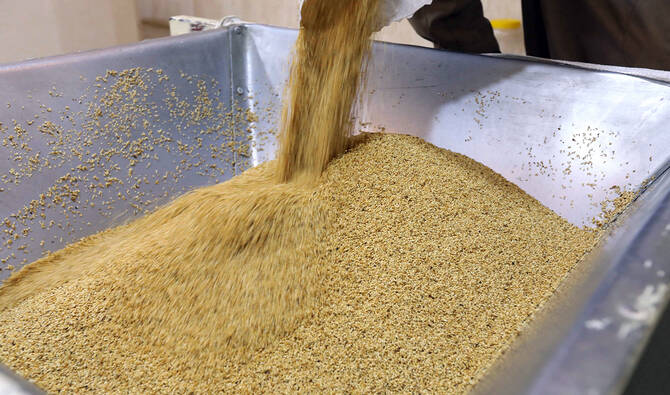
Toasted sesame seeds are fed into a processing machine in Amedi district in the Kurdistan region, Iraq, on November 21, 2020. (AFP/File)
Short Url
Updated 22 October 2025
Follow

Pakistan’s sesame exports to China surge 87% as Beijing’s edible oil demand grows

  • Pakistan exported over 55 million kg of sesame to China in 2025, up from 24 million kg last year
  • China imports about 1.5 million tons of sesame annually, with Pakistan emerging as a new key supplier

ISLAMABAD: Pakistan’s sesame seed exports to China jumped 87% in the first nine months of 2025, reaching $68.56 million, state media reported on Wednesday, as rising Chinese demand for edible oils and traditional food products drives a growing market for the oilseed.

The increase is attributed to the high quality of Pakistan’s sesame crop, favorable climatic conditions, and stronger trade links under the China-Pakistan Economic Corridor (CPEC).

Pakistan exported 55.61 million kilograms of sesame seeds to China from January to September 2025 at an average price of $1.23 per kg, compared with 23.95 million kg during the same period last year.

“In September 2024, we successfully organized the ‘Sesame Trade and Investment Opportunities in China’ event,” Pakistan’s Ambassador to China Khalil Hashmi was quoted as saying by the Associated Press of Pakistan. 

“A 23-member Pakistani delegation secured deals for 15,000 metric tons and signed a $28 million memorandum of understanding with Daming government-backed enterprises.”

China is the world’s largest sesame-importing nation, consuming roughly 1.5 million tons a year while producing only about 320,000 tons domestically. Pakistan’s 55,000-ton exports still represent a small share of China’s total imports but mark a significant breakthrough for Pakistani agribusiness, which has traditionally lagged behind African competitors such as Ethiopia, Tanzania and Nigeria that supply more than half of China’s demand.

Pakistani officials say sesame seeds are now a strategic export item, supporting the government’s push to expand agricultural exports under the CPEC framework. 

According to Hashmi, 177 Pakistani sesame companies are now registered in China, signaling deeper integration into the regional supply chain for edible oils, snacks and health products.

Experts expect Pakistan’s sesame trade to continue growing despite recent floods that damaged cropland, citing improved processing capacity and higher global prices. The Pakistan Bureau of Statistics has also reported an uptick in overall agricultural exports, with seafood shipments to China climbing above $153 million in the same period.

For Beijing, sesame imports have become essential to secure edible-oil supplies as China’s domestic oilseed output remains constrained by land and water limitations. 

For Pakistan, they represent a rare bright spot in export diversification, offering new income for farmers, valuable foreign exchange and a path toward greater agri-industrial cooperation with its largest trading partner. 


Two Pakistani men indicted in $10 million Medicare fraud scheme in Chicago

Updated 12 February 2026
Follow

Two Pakistani men indicted in $10 million Medicare fraud scheme in Chicago

  • Prosecutors say defendants billed Medicare and private insurers for nonexistent services
  • Authorities say millions of dollars in proceeds were laundered and transferred to Pakistan

ISLAMABAD: Two Pakistani nationals have been indicted in Chicago for allegedly participating in a $10 million health care fraud scheme that targeted Medicare and private insurers, the US Justice Department said on Thursday.

A federal grand jury charged Burhan Mirza, 31, who resided in Pakistan, and Kashif Iqbal, 48, who lived in Texas, with submitting fraudulent claims for medical services and equipment that were never provided, according to an indictment filed in the US District Court for the Northern District of Illinois.

Medicare is the US federal health insurance program primarily serving Americans aged 65 and older, as well as certain younger people with disabilities.

“Rooting out fraud is a priority for this Justice Department, and these defendants allegedly billed millions of dollars from Medicare and laundered the proceeds to Pakistan,” Deputy Attorney General Todd Blanche said in a statement.

“These alleged criminals stole from a program designed to provide health care benefits to American seniors and the disabled, not line the pockets of foreign fraudsters,” he added. “We will not tolerate these schemes that divert taxpayer dollars to criminals.”

Prosecutors said that in 2023 and 2024, the defendants and their alleged co-conspirators used nominee-owned laboratories and durable medical equipment providers to bill Medicare and private health benefit programs for nonexistent services.

According to the indictment, Mirza obtained identifying information of individuals, providers and insurers without their knowledge and used it to support fraudulent claims submitted on behalf of shell companies. Iqbal was allegedly linked to several durable medical equipment providers that filed false claims and is accused of laundering proceeds and coordinating transfers of funds to Pakistan.

Mirza faces 12 counts of health care fraud and five counts of money laundering. Iqbal is charged with 12 counts of health care fraud, six counts of money laundering and one count of making a false statement to US law enforcement. Arraignments have not yet been scheduled.

Three additional defendants, including an Indian, previously charged in the investigation, have pleaded guilty to federal health care fraud charges and are awaiting sentencing.

An indictment contains allegations, and the defendants are presumed innocent unless proven guilty in court.