

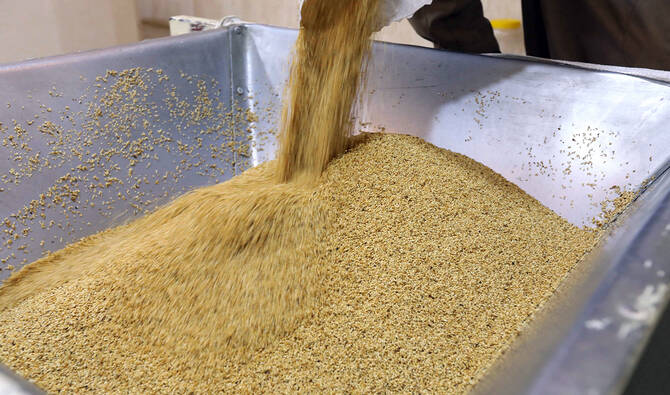

ISLAMABAD: Pakistan’s sesame seed exports to China jumped 87% in the first nine months of 2025, reaching $68.56 million, state media reported on Wednesday, as rising Chinese demand for edible oils and traditional food products drives a growing market for the oilseed.
The increase is attributed to the high quality of Pakistan’s sesame crop, favorable climatic conditions, and stronger trade links under the China-Pakistan Economic Corridor (CPEC).
Pakistan exported 55.61 million kilograms of sesame seeds to China from January to September 2025 at an average price of $1.23 per kg, compared with 23.95 million kg during the same period last year.
“In September 2024, we successfully organized the ‘Sesame Trade and Investment Opportunities in China’ event,” Pakistan’s Ambassador to China Khalil Hashmi was quoted as saying by the Associated Press of Pakistan.
“A 23-member Pakistani delegation secured deals for 15,000 metric tons and signed a $28 million memorandum of understanding with Daming government-backed enterprises.”
China is the world’s largest sesame-importing nation, consuming roughly 1.5 million tons a year while producing only about 320,000 tons domestically. Pakistan’s 55,000-ton exports still represent a small share of China’s total imports but mark a significant breakthrough for Pakistani agribusiness, which has traditionally lagged behind African competitors such as Ethiopia, Tanzania and Nigeria that supply more than half of China’s demand.
Pakistani officials say sesame seeds are now a strategic export item, supporting the government’s push to expand agricultural exports under the CPEC framework.
According to Hashmi, 177 Pakistani sesame companies are now registered in China, signaling deeper integration into the regional supply chain for edible oils, snacks and health products.
Experts expect Pakistan’s sesame trade to continue growing despite recent floods that damaged cropland, citing improved processing capacity and higher global prices. The Pakistan Bureau of Statistics has also reported an uptick in overall agricultural exports, with seafood shipments to China climbing above $153 million in the same period.
For Beijing, sesame imports have become essential to secure edible-oil supplies as China’s domestic oilseed output remains constrained by land and water limitations.
For Pakistan, they represent a rare bright spot in export diversification, offering new income for farmers, valuable foreign exchange and a path toward greater agri-industrial cooperation with its largest trading partner.


