Pakistan, Saudi Arabia discuss Gaza situation amid regional peace efforts

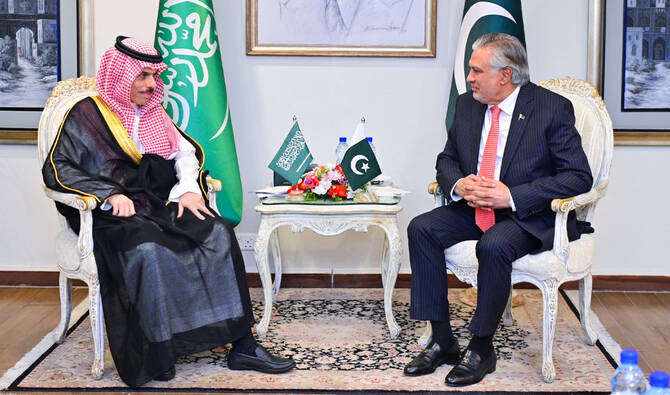
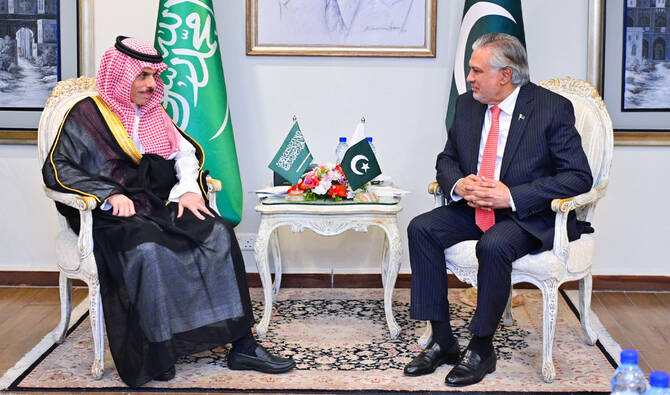
Deputy Prime Minister and Foreign Minister Senator Ishaq Dar meeting with the Foreign Minister of Saudi Arabia, Prince Faisal bin Farhan (left), in Islamabad on April 16, 2025. (PID/File)
Short Url
Updated 22 October 2025
Follow

Pakistan, Saudi Arabia discuss Gaza situation amid regional peace efforts

  • Pakistani and Saudi foreign ministers reaffirm shared commitment to Middle East peace in a phone call
  • Both countries recently signed a landmark defense pact, deepening consultations on key regional issues

KARACHI: Pakistan and Saudi Arabia discussed the situation in Gaza and the broader region, the Pakistani foreign office said on Wednesday, as both allies coordinate their positions on the Middle East.

The two countries have worked closely to help end Israel’s military campaign against Palestinians as eight Muslim-majority nations, including their own top representatives, met United States President Donald Trump in September to discuss the situation in Gaza before a peace plan was formally unveiled.

The plan outlined a phased implementation, beginning with a ceasefire and the release of Israeli hostages held by Hamas. A ceasefire deal was later signed in Sharm el-Sheikh, Egypt, earlier this month, in a ceremony attended by leaders from several nations.

“Deputy Prime Minister and Foreign Minister Senator Ishaq Dar spoke on the phone late last night with the Foreign Minister of Saudi Arabia, Prince Faisal bin Farhan,” the foreign office said in a post on social media platform X. “Building on their previous discussions, the two leaders reviewed recent regional developments, including Gaza and Palestine.”

“Both reaffirmed their shared commitment to peace and stability in the region and agreed to stay closely engaged on matters of mutual interest,” it added.

Saudi Arabia remains a key economic and strategic partner for Pakistan, with ties strengthened by a landmark strategic defense pact signed during Prime Minister Shehbaz Sharif’s last visit to the kingdom.

Under the agreement, any act of aggression against one country will be considered an attack against both, underscoring their deep security partnership.

The deal also provides for expanded defense cooperation, including joint military training, intelligence sharing, collaborative exercises and technology exchange, reflecting the growing trust and alignment between the two nations.

Both countries have also intensified consultations since then, with Saudi authorities maintaining close contact with Islamabad during Pakistan’s recent military standoff with Afghanistan. 


Ex-Pakistan spy chief’s conviction signals tougher days ahead for Imran Khan — analysts

Updated 4 sec ago
Follow

Ex-Pakistan spy chief’s conviction signals tougher days ahead for Imran Khan — analysts

  • Ex-ISI director-general sentenced to 14 years for political interference, misuse of authority
  • Hameed also investigated over his alleged role in May 9, 2023 nationwide unrest

ISLAMABAD: The recent conviction of former Pakistan spy chief Lt. General Faiz Hameed signals tougher days ahead for former Prime Minister Imran Khan and his political party, Pakistan Tehreek-e-Insaf (PTI), political and security analysts said Friday.

A military court on Thursday sentenced Hameed to 14 years of rigorous imprisonment after finding him guilty of engaging in political activities, violating the Official Secrets Act and misusing authority and government resources.

One of the most influential officers of his generation, Hameed served as director-general of Pakistan’s powerful Inter-Services Intelligence agency ISI from 2019 to 2021. He was widely seen as close to former prime minister Khan, who has been jailed since August 2023 on corruption charges that he says are politically motivated.

Dr. Ayesha Siddiqa, a security analyst who has written extensively on military affairs, told Arab News that, “Further punishments could be imposed on Faiz Hameed and Imran Khan.” 

“They may face stricter measures,” she added. 
 
Senator Faisal Vawda, a former federal minister, believes ex-spy chief Hameed would provide evidence against Khan in cases linked to the May 2023 unrest.

“Fourteen years’ imprisonment … this is the beginning … Hamid in his trial is giving evidence and testimony against Khan sahab/jadoogar and others in connection with May 9 events,” Vawda wrote on X on Dec. 11, 2025.

Dr. Siddiqa further adds that a recent press conference by Pakistan’s military spokesperson, in which he lashed out at Khan, suggested that a “further tightening of the PTI” would follow in the days ahead.

On Dec. 5, 2025, Pakistan’s military spokesperson, Lt. Gen. Ahmed Sharif Chaudhry, accused Khan of spreading an “anti-army” narrative, saying his rhetoric had moved beyond normal politics and posed a “national security threat.”

Hammed is accused of instigating attacks on government and military installations during nationwide unrest on May 9, 2023.

Protests erupted across Pakistan on May 9, 2023, following Khan’s arrest, with demonstrators from his party and supporters damaging military and government property. Khan and his political party PTI deny they instructed supporters to resort to violence.

Pakistan’s military said in August 2023 that it was separately examining Hameed’s alleged role in “fomenting vested political agitation and instability in cahoots with political elements.”

Minister for Parliamentary Affairs Tariq Fazal Chaudhry told reporters at a press conference Friday that the conviction would have “far-reaching political consequences” in the days ahead.

“This verdict ensures that no one will dare in future to repeat such political engineering or such unconstitutional abuse of authority,” Chaudhry said.

He added that Hameed’s conviction had reinforced public trust in the military’s accountability process.

PTI’s Secretary Information Sheikh Waqas told Arab News that Hameed’s conviction was “an internal matter of the military institution.”

“If and when the detailed verdict is made public and contains any reference, only then can a comment be considered,” he said. 

Dr. Siddiqa, however, questioned the impartiality of the verdict, saying it did not reflect a “broader pattern” of reform within the military.

“Corruption has occurred before, political involvement has taken place and occasional punishments have been meted out,” she said. “This is not the first punishment, nor does it indicate a pattern.”

She added, “The answer is no — this is selective justice.”

Journalist and political analyst Muneeb Farooq said the verdict was significant and “no joke,” adding that the current military leadership is “inexplicably hard and strict in every way.”

“It’s a move to punish the evil,” he said. “That’s how the current military leadership sees it.”

Lahore-based political analyst Salman Ghani said Hameed’s conviction is alarming for “corrupt elements” and those who once wielded influence in Pakistan.

However, he questioned why accountability had not extended to then-army chief General Qamar Javed Bajwa, who has also been accused by the ruling Pakistan Muslim League-Nawaz party, along with Hameed, of engineering the ouster of former Prime Minister Nawaz Sharif.

“Did he not have the support and approval of the army chief of the time for the actions he carried out?” Ghani asked.