

Unspoilt corner of Portugal fears arrival of high end tourism

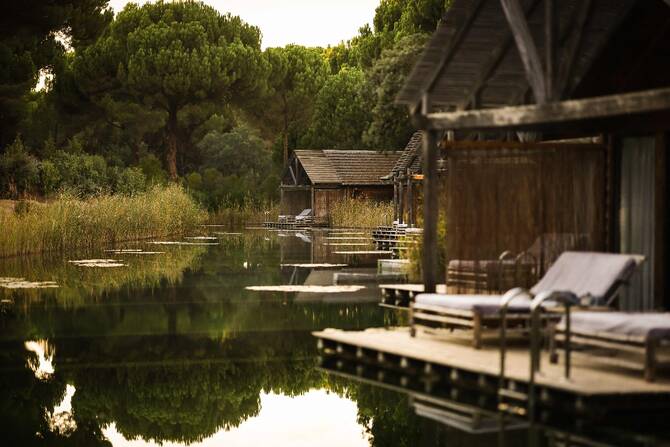
A view of the “Sublime” hotel in Comporta, Portugal. (AFP)
Short Url
Updated 22 October 2025
Follow

Unspoilt corner of Portugal fears arrival of high end tourism

  • Rapid development in the coastal region of Comporta has alarmed locals and environmentalists, who fear a repeat of the unchecked growth seen in Portugal’s southernmost Algarve province, long a package holiday destination

COMPORTA: Above the pine forests and dunes that stretch along the nearly deserted beaches of southwestern Portugal, cranes rise from building sites soon to be luxury hotels — a sign of the region’s contentious transformation into a playground for the wealthy.
Rapid development in the coastal region of Comporta has alarmed locals and environmentalists, who fear a repeat of the unchecked growth seen in Portugal’s southernmost Algarve province, long a package holiday destination.
Dubbed “the new Portuguese Riviera,” Comporta has drawn high-profile visitors including Oscar-winning actor Nicole Kidman and Princess Caroline of Monaco.
Real estate consultancy Knight Frank lists the region, located about an hour’s drive south of Lisbon, among the five most sought-after luxury residential markets worldwide.
“Comporta appeals to a wealthy clientele seeking nature, privacy and wellness,” the company wrote in a recent report.
French designer Christian Louboutin was among the first international figures to discover Comporta’s charm, opening a hotel in Melides, a small village of whitewashed houses with blue doors.
Princess Eugenie, whose uncle is Britain’s head of state King Charles III, splits her time between London and Comporta, drawn by the region’s relaxed lifestyle.
“I can go to the supermarket in sportswear, my hair in disarray, and nobody cares,” she told the podcast Table and Manners in 2023.

- ‘Overrun by tourism’ -

Environmentalists warn that development projects threaten the region’s unique mix of dunes, pine forests, gnarled cork trees and an endless patchwork of rice fields.
Campaign group Dunas Livres (Free Dunes) says eight “mega-projects” are under development, each covering hundreds of hectares, which will increase water consumption in a region already threatened by drought.
“These hotel complexes, with golf courses, swimming pools and a very large number of tourist beds, obviously consume a lot of water,” Catarina Rosa, a biologist with the group, told AFP.
“Comporta, a true natural treasure, is being overrun by tourism,” she added.
The transformation traces back to the collapse of the Espirito Santo bank during the 2011 debt crisis.
The Espirito Santo family were once the sole owners of the 12,000-hectare Herdade da Comporta estate but sold large parcels to developers following the collapse of their banking empire.
Since then, investors including French developer Claude Berda’s Vanguard Properties and US-based Discovery Land Company have launched private residences, hotel complexes and golf courses.
Discovery Land is behind the CostaTerra Golf and Ocean Club, planned to feature nearly 300 luxury villas.

- ‘Frenzy’ -

Local residents have mixed feelings about the changes.
Some have sold small properties for staggering sums, while others worry that skyrocketing real estate prices are disrupting their way of life or forcing them out.
A small house worth 20,000 euros ($23,000) two decades ago is now valued at one million euros, said Jacinto Ventura, a farmer and president of a local association in Melides.
“This real estate bubble, with no clear end in sight, has driven prices into a frenzy. And this frenzy has forced a large portion of the population to move away,” he told AFP.
Residents also complain about restricted access to public beaches and rising costs in local shops since the arrival of wealthy visitors.
While some are leaving the area, others are trying to hold on.
Belinda Sobral, 42, a former engineer who reopened her grandparents’ tavern in the nearby town of Grandola, said the problem is not tourism itself, but the pace of development.
“It has been too fast, without planning or respect for the locals,” the mother of two said.
“I want to preserve the identity of this place. Without memory, Comporta will become another Ibiza — a resort like so many others,” she added.


Epstein files reveal links to cash, women, power in Africa

Updated 6 sec ago
Follow

Epstein files reveal links to cash, women, power in Africa

  • Documents attest to Epstein’sclose ties with Karim Wade, son of former Senegalese president Abdoulaye Wade
  • They also reveal his ties to Nina Keita, niece of Ivorian president Alassane Ouattara

PARIS: Jeffrey Epstein built close ties with powerful figures in Senegal and Ivory Coast, files released by the US government last month show, detailing the late sex offender’s influence network across Africa.
Emails, scheduled meetings, investment projects, and loans reviewed by AFP attest to the disgraced New York financier’s close relationship with Karim Wade, son of former Senegalese president Abdoulaye Wade.
They also reveal his ties to Nina Keita, niece of Ivorian president Alassane Ouattara.
Wade and Epstein met in 2010 through Emirati businessman Sultan Ahmed bin Sulayem, who recently resigned as CEO of port giant DP World after mounting pressure over his close friendship with Epstein.
The pair quickly struck up a rapport.
“Thanks for coming. I think there are many things to consider... I feel confident that we will have fun,” Epstein wrote to Wade on November 15, 2010 after their first meeting in Paris.
“Have a safe trip back to your paradise Island,” Wade replied.
While Wade’s exchanges show no link to Epstein-related sex trafficking crimes, they do reveal conversations on potential business ventures in various sectors, such as finance and energy.
Nicknamed the “Minister of Heaven and Earth” for the multiple portfolios he held including international cooperation, energy, and air transport, Wade was a powerful figure in Senegal until April 2012, when his father’s bid for a third term sparked deadly riots.
Epstein saw him as “one of the most important players in africa” and invited him to meet close contacts such as Ehud Barak, then Israel’s defense minister.
He also put him in touch with Chinese businessman Desmond Shum to discuss “offshore banking.”
The US Department of Justice documents show Shum and Wade met in Beijing on May 9, 2011.
That same month, Wade planned an African tour through Senegal, Mali, and Gabon for Epstein.

‘You will not suffer’ 

Epstein and Wade’s relationship became even more apparent after the latter’s fortunes reversed when his father left office in 2012.
That autumn, Epstein proposed that his “friend” — under the Dakar authorities’ scrutiny over his assets — use his house in Florida.
“You and your family are welcome to use my house in palm beach, staff is there, pool etc. you will not suffer,” Epstein wrote.
“Txs a lot Brother for the advise,” Wade replied a few weeks later to another email, in which Epstein urged him to “stay mentally strong.”
Numerous files suggest Epstein became financially involved on Karim Wade’s behalf after his arrest in 2013 and his 2015 sentencing to six years in prison for corruption.
Karim Wade’s lawyer, Mohamed Seydou Diagne, sent two invoices in May 2014 and July 2015 of $500,000 to one of Epstein’s companies.
Contacted by AFP on Monday, Diagne said he “did not consider it useful to comment.”
Other archives suggest that Epstein covered at least $50,000 in fees for the US lobbying firm Nelson Mullins, hired by Wade’s entourage to secure his release.
Epstein regularly exchanged emails with Robert Crowe, a partner at the firm who kept him informed of their efforts in the US and Senegal.
In a June 16, 2016 email thread where Epstein and Crowe discussed whether then Senegalese president Macky Sall would pardon Wade, Crowe writes: “He has told my friends high up at State that he was going to do it. They have been putting pressure on him!“
Karim Wade was released from prison eight days later, on June 24, and went into exile in Qatar, which he credited for efforts toward his release.
Jeffrey Epstein was told by Sultan Ahmed bin Sulayem and Nina Keita.

‘A very interesting person!’

The DOJ documents show Nina Keita was close to both Epstein and Karim Wade and that she acted as a regular intermediary while Wade was in prison.
Keita also helped put Epstein in contact with her uncle, president of Ivory Coast since May 2011, and his team.
“He thought you were a very interesting person! ... they were all very happy to have you here,” she wrote on January 20, 2012, after the financier’s visit to Abidjan.
She had booked him the “ministerial suite” of the luxury Hotel Ivoire for that trip.
Ahead of the visit, Epstein had said he hoped to see “very pretty girls there, as well as interesting places.”
“You will!” Keita replied.
Emails show Keita, a former model, at least once sent photos and the phone number of a young woman to Epstein.
He then met this woman at the Ritz hotel in Paris on August 31, 2011.
“ask sadia to send pictures of her sister. i prefer under 25,” Epstein wrote to Keita after the meeting.
Now the deputy general director of Ivorian petroleum stocks company GESTOCI, Keita also appears in a February 2019 will in which Epstein requested that debts owed to him by a number of people be canceled upon his death.
AFP received no response to its requests for comment from both Keita and the Ivorian presidency, or from Karim Wade, who was contacted through his entourage.
The mere mention of a person’s name in the Epstein files does not in itself imply wrongdoing.