

‘Authenticity is our biggest advantage,’ says Princess Lamia bint Majed

1 / 3
Princess Lamia bint Majed highlighted the growing influence of Saudi women in media at Athar Festival. (AN Photo/Jafar Al-Saleh)
2 / 3
Princess Lamia bint Majed highlighted the growing influence of Saudi women in media at Athar Festival. (AN Photo/Jafar Al-Saleh)
3 / 3
Princess Lamia bint Majed highlighted the growing influence of Saudi women in media at Athar Festival. (AN Photo/Jafar Al-Saleh)
Short Url
Updated 21 October 2025
Follow

‘Authenticity is our biggest advantage,’ says Princess Lamia bint Majed

  • Princess Lamia bint Majed: ‘I don’t think we need another Hollywood or Bollywood … What we have here is a new story, it’s a new tradition, new values for the world’
  • Princess Lamia: ‘Why is everyone really interested in Saudi Arabia? Because it’s different, even from the perspective of heritage and culture’

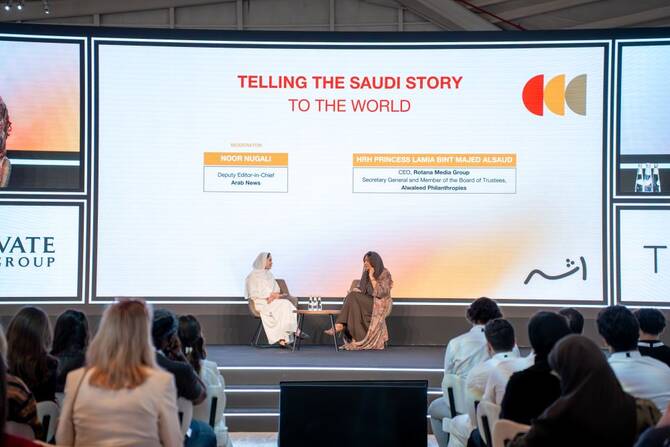
RIYADH: Saudi Arabia’s creative spirit took center stage at the third annual Athar Festival in Riyadh on Tuesday, where Princess Lamia bint Majed, CEO of Rotana Media Group and secretary-general of Alwaleed Philanthropies, spoke about the power of authentic storytelling in shaping Saudi narratives.

In a one-on-one fireside chat with Arab News Deputy Editor-in-Chief Noor Nugali — during a session titled “Telling the Saudi Story to the World” — Princess Lamia reflected on her journey from launching Rotana Magazine to leading one of the region’s most influential media groups. Arab News is a media partner of the festival. 

“I think authenticity is our advantage,” she said. “I don’t think we need another Hollywood or Bollywood … What we have here is a new story, it’s a new tradition, new values for the world.”

She added that the Kingdom’s growing appeal lies in its cultural richness and individuality. “Now, why is everyone really interested in Saudi Arabia? Because it’s different, even from the perspective of heritage and culture, the materials, the places, the beautiful scenery, our natural resources, our tradition.”

Under her leadership, Rotana has preserved and promoted regional culture while embracing digital transformation. 

“At the end of the day, we believed that there is a future for the Saudi media. Rotana is the first private Saudi entity launched as a Saudi private channel — Rotana Khaleejia — which is 100 percent Saudi. We are the first to believe in the Saudi talent and production,” she said, noting the company’s early support for films such as “Wadjda” by Haifaa Al-Mansour.

The group’s effort’s include restoring 2,300 Arabic films and using media as a form of soft power to connect with audiences in five languages.  

Princess Lamia emphasized the role of Saudi youths in shaping the country’s media future: “Seventy-one percent of the population is under 35. They will be the ones to tell the stories and build the future, so those youth and this generation, they are the people that are going to tell the story … They don’t wait for someone to represent them anymore, they’re creating their own platform.”

Looking across the Athar audience, filled with students and emerging creatives, she said: “What we’re seeing here today, this is Saudi.” 

She also highlighted the growing influence of Saudi women in the media, naming figures such as Jomana Al-Rashid, Nugali, Israa Assiri, and Haifaa Al-Mansour. 

“The fact that women holding leadership positions in the Kingdom or doing something groundbreaking is not news anymore, that itself is a message,” Nugali said during the session.

“Now we’re writing the story,” Princess Lamia said. “We have the responsibility to keep the door open for the people (who come after). Every person is a story … You, me, and us — we will create the story of Saudi Arabia 2030.”


14 sculptures go on display at public spaces in Riyadh

Updated 11 December 2025
Follow

14 sculptures go on display at public spaces in Riyadh

  • The works were chosen by Riyadh Art from its international Tuwaiq Sculpture symposium to reflect its ‘vision of weaving beauty and intellect into the city’s fabric’
  • Initiative aligns with efforts to make art a key part of city’s identity that improves quality of life and promotes the cultural economy, says Royal Commission for Riyadh City’s Khalid Al-Hazani

RIYADH: Fourteen sculptures selected from the annual international Tuwaiq Sculpture symposium, a Riyadh Art program, went on display on Wednesday at three prominent public spaces across the Saudi capital: ROSHN Front, the SEDRA residential community, and Sports Boulevard.

The project is part of Riyad Art’s efforts to showcase artworks in public spaces, and the addition of more works in other places is expected later.

Khalid Al-Hazani, the executive vice president of the lifestyle sector at the Royal Commission for Riyadh City, said: “This step reflects (Riyadh Art’s) vision of weaving beauty and intellect into the city’s fabric, and creating vibrant and culturally rich public spaces, allowing art to become an integral part of people’s daily lives.”

It is also in line with Riyadh Art’s broader strategy for transforming the city into an open-air art gallery, he added, thereby “turning art into a central element of the city’s identity and a key contributor to improving quality of life and promoting the cultural economy.” 

The Riyadh Art Program installed on Wednesday 14 sculptures selected from the Tuwaiq International Sculpture Symposium at prominent locations in Riyadh, including the ROSHN Front, SEDRA Residential Community, and Sports Boulevard. (Supplied)

The three chosen locations were considered perfect places to host the artworks because of their vibrancy, strong community connections and accessibility, Al-Hazani noted.

“This provides residents and visitors with the opportunity to engage with the sculptures in their everyday lives,” he said.

Seven of the sculptures have been installed at ROSHN Front, considered a key urban hub. The artworks on display there form a thought-provoking artistic landscape that encourages interaction, organizers said, and explores a number of themes including the values of urban transformation, community spirit, and creative curiosity.

Three sculptures are on display at the SEDRA residential community. Chosen to complement its serene character and nature-integrated urban planning, they blend in with their surroundings to reflect the values of environmental harmony, contemplation and renewal, organizers explained.

The remaining four sculptures are at Sports Boulevard, known for its open, green spaces. These works reflect several concepts, in particular ideas of nature, balance and public health.

All of the sculptures are part of Riyadh Art’s permanent collection, which includes works created by local and international artists during the Tuwaiq Sculpture symposium.