PARIS: Crime gangs around Europe are increasingly robbing valuable jewels and gold from cash-needy museums like the Louvre, but while police often catch the thieves, they struggle to recover the priceless goods, law enforcement and art experts say.
Only a small pool of criminals would be capable of such a job as Sunday’s audacious robbery in Paris and may already be known to police, the specialists say. But the objects themselves could be quickly broken down into component parts and sold on.
“If I steal a Van Gogh, it’s a Van Gogh. I can’t dispose of it through any other channel than an illicit art market,” said Marc Balcells, a Barcelona-based expert in crimes against cultural heritage. “But when I am stealing ... jewelry, I can move it through an illicit market as precious stones.”
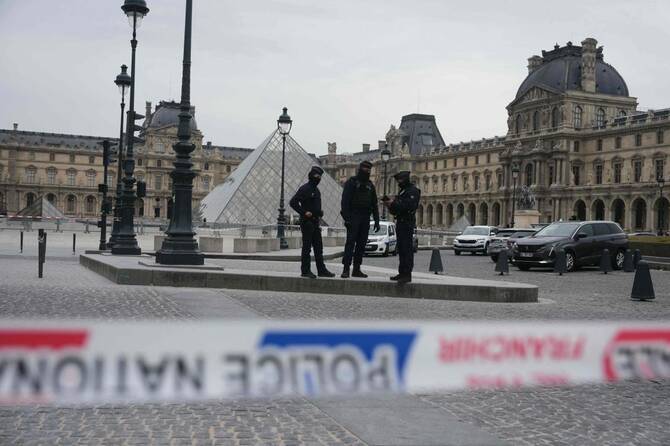
The brazen heist of crown jewels from the Louvre, the world’s most visited museum, has been decried by some as a national humiliation and sparked security checks across France’s multitude of cultural sites.
“If you target the Louvre, the most important museum in the world, and then get away with the French crown jewels, something was wrong with security,” said art investigator Arthur Brand.
Officials at the Louvre, home to artworks such as the Mona Lisa, had in fact already sounded the alarm about lack of investment.
And at least four French museums have been robbed in the last two months, according to media reports.
On Tuesday, prosecutors said they had charged a Chinese-born woman for the theft of six gold nuggets worth about €1.5 million ($1.75 million) from Paris’s Museum of Natural History last month. She was arrested in Barcelona trying to dispose of some melted gold, they said.
Christopher Marinello, founder of Art Recovery International, which tracks stolen art, said museum heists were on the rise across Europe and further afield.
He cited cases in the Netherlands, France, Egypt.
“If you have jewels or gold in your collections, you need to be worried,” Marinello said.
Whodunnit?
Paris prosecutors have entrusted the investigation to a specialized Paris police unit known as the BRB, which is used to dealing with high-profile robberies.
Former police officer Pascal Szkudlara, who served in the unit, said the BRB handled the 2016 Kim Kardashian probe, when Paris thieves stole her $4 million engagement ring, as well as a recent spate of kidnappings of wealthy crypto bosses.
He said the BRB has about 100 agents, with over a dozen specialized in museum thefts. Investigators will look at video footage, telephone records, and forensic evidence, while informants will also be activated.
“They can have teams working on it 24/7 and for a long period,” Szkudlara said, expressing “100 percent” confidence the thieves would be caught.
Police will be poring over security footage going back weeks, looking to identify suspicious people casing out the joint, Brand said.
Corinne Chartrelle, who previously worked at the French Police’s Central Office for the Fight against Trafficking in Cultural Property, said the jewels could feasibly end up in a global diamond center like Antwerp where there “are probably people who aren’t too concerned about the origin of the items.”
The diamonds could also be cut into smaller stones and the gold melted down, leaving buyers unaware of their provenance.
If the thieves feel the net closing, they could chuck or destroy the loot altogether.
Police are clearly in a race against time.
“Once they’ve been cut into smaller jewels, the deed is done. It’s over. We’ll never see these pieces again intact,” said Marinello. “It’s a very small percentage, recovering stolen artworks. When it comes to jewelry, that percentage is even less.”
Any theory about the objects being ordered up by a mysterious buyer was laughable, said Brand. “That’s unheard of,” he said. “You only see it in Hollywood movies.”
Cultural authorities across Europe will be looking at how to better secure museums at a time of tight public finances.
Brand said it was impossible to properly safeguard a museum, so the best thing was to slow down the time it takes to steal objects and escape, giving police longer to respond by making windows or display cases thicker, or adding more doors.
“They know they have only five, six minutes to get away with it because after six minutes, the police show up. So if they go into a museum ... and they find out that it takes more than six, seven, eight minutes, they will not do it,” he said.
Finland’s National Gallery Director General Kimmo Leva said financial realities meant tough decisions.
“A tightening everyday economy is, naturally, not the best basis for making the investments needed to mitigate potential threats,” Leva said.


![]()

French police may nab Louvre thieves but unlikely to recover their loot
Short Url
https://arab.news/vtabs
French police may nab Louvre thieves but unlikely to recover their loot
- Manhunt underway for perpetrators of Louvre heist
- Museum thefts on the rise in France and around Europe


Latest updates


© 2026 SAUDI RESEARCH & PUBLISHING COMPANY, All Rights Reserved And subject to Terms of Use Agreement.