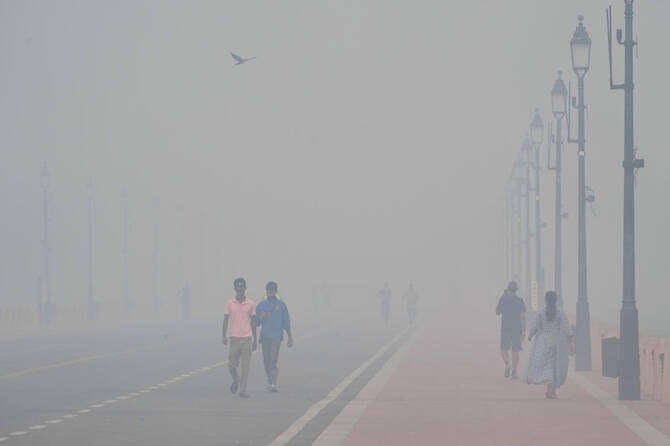
NEW DELHI: Thick smog blanketed India’s capital on Tuesday, a day after millions celebrated the Hindu festival of Diwali with fireworks that sent air pollution levels soaring to hazardous levels across the city.
Revelers in New Delhi burst firecrackers late into Monday night, filling the air with smoke and fine particles that mixed with seasonal pollution and stagnant weather conditions. By Tuesday morning, the city’s Air Quality Index had climbed above 350 in several neighborhoods, a level considered “severe” and dangerous to breathe, according to the World Health Organization’s daily recommended maximum exposure.
Visibility also dropped in some parts of the city as a gray haze enveloped streets, high-rises and historical monuments.
“I have never seen anything like this before. We can’t see anything here because of pollution,” said Vedant Pachkande, a tourist visiting New Delhi.
India’s top court last week eased a blanket ban on firecrackers in New Delhi during Diwali, allowing limited use of “green firecrackers” that emit fewer pollutants. Developed by federal research institutes, they are designed to cut particulate and gas emissions by about 30 percent. The court had said they could be used during specific hours from Saturday to Tuesday, but like past years the rule was mostly flouted.
New Delhi and its metropolitan region – home to more than 30 million people – routinely ranks among the world’s most polluted cities during the winter months when widespread Diwali fireworks coincide with cooler weather and smoke from crop residue fires set by farmers in nearby states.
Authorities in New Delhi have implemented a set of measures to curb pollution levels, which include limits on construction activity and restrictions on diesel generators. But environmentalists say long-term solutions, such as cleaner energy and stricter vehicle-emission controls, are needed to prevent the annual crisis.
Rising pollution also cuts the amount of sunshine India receives, a recent study found.
Indian scientists have found that sunshine hours – the time strong sunlight reaches the Earth – have steadily declined across most of India due to rising air pollution, according to a study published this month in Scientific Reports, a journal by Nature Portfolio. The researchers attributed the drop to increasing aerosols – tiny particles from industrial emissions, biomass burning and vehicle pollution.
“We see a greater impact in more polluted regions such as northern India,” said Manoj K. Srivastava, a scientist at Banaras Hindu University and one of the study’s authors.
Srivastava said the reduction in sunshine can affect the amount of solar power India can generate as well as the country’s agricultural productivity apart from impacting local environment and people’s health.


![]()


Thick smog blankets New Delhi after Diwali fireworks, pushing air quality to hazardous levels
Short Url
https://arab.news/c7a5e
Thick smog blankets New Delhi after Diwali fireworks, pushing air quality to hazardous levels
- Revelers in New Delhi burst firecrackers late into Monday night, filling the air with smoke and fine particles that mixed with seasonal pollution and stagnant weather conditions


Washington state faces historic floods that have washed away homes and stranded families
MOUNT VERNON: Days of torrential rain in Washington state has caused historic floods that have stranded families on rooftops, washed over bridges and ripped at least two homes from their foundations, and experts warned that even more flooding expected Friday could be catastrophic.
Washington is under a state of emergency and evacuation orders are in place for tens of thousands of residents. Gov. Bob Ferguson on Thursday urged everyone to follow evacuation instructions as yet another river neared record levels.
“I understand that many in our state have experienced significant floods in the past,” he said on the social platform X. “However, we’re looking at a historic situation.”
About 78,000 residents of a major agricultural region north of Seattle were ordered to evacuate the floodplain of the Skagit River, which was expected to crest Friday morning.
The floods were impacting large parts of the state, with several bridges flooded and some major roads inundated or washed out. Some roads had no alternate routes and no estimated reopening time, including a large part of state Route 410.
A landslide blocked part of Interstate 90 east of Seattle, with photos showing vehicles trapped by tree trunks, branches, mud and standing water.
In the north near the US-Canada border, the cities of Sumas, Nooksack and Everson were evacuated after being inundated. The border crossing at Sumas was closed and Amtrak suspended trains between Seattle and Vancouver, B.C.
Sumas Mayor Bruce Bosch said much of the city has been “devastated” by the high waters just four years after a similar flood.
Flooding rivers break records
The Snohomish River surged nearly a foot (30 centimeters) higher than its record Thursday in the picturesque city that shares its name, while the Skagit River rose just above its record Thursday night in Mount Vernon, according to the National Water Prediction Service.
Earlier Thursday, the Skagit just missed its previous record as flooding surged through the mountain town of Concrete.
The waters stopped just short of getting inside Mariah Brosa’s raised riverfront home in Concrete, but the raging river still slapped debris against her home and totaled her fiancé’s work car, she said.
“I didn’t think it would come this high,” she said.
Flooding from the Skagit has long plagued Mount Vernon, the largest city in Skagit County with some 35,000 residents. Flooding in 2003 displaced hundreds of people.
A floodwall that protects downtown passed a major test in 2021, when the river crested near record levels. Water was at the foot of the floodwall as of late Thursday morning, Mayor Peter Donovan said.
In nearby Burlington, officials hoped dikes and other systems would protect their community from catastrophe, said Michael Lumpkin, with the police department.
Officials respond to flooding
Authorities across Washington state in recent days have rescued people from cars and homes after an atmospheric river soaked the region.
Helicopters rescued two families on Thursday from the roofs of homes in Sumas that had been flooded by about 15 feet (4.6 meters) of water, while the city’s fire station had 3 feet (91 centimeters) of water, according Frank Cain JR., battalion chief for Whatcom County Fire District 14.
In nearby Welcome, erosion from the floodwaters caused at least two houses to collapse into the Nooksack River, he said. No one was inside at the time.
In a football field in Snoqualmie, a herd of elk swam and waded through neck-high water.
East of Seattle, residents along Issaquah Creek used water pumps as rushing floodwaters filled yards Thursday morning. Yellow tape blocked off a hazardous area along the creek.
Climate change has been linked to some intense rainfall. Scientists say that without specific study they cannot directly link a single weather event to climate change, but in general it’s responsible for more intense and more frequent extreme storms, droughts, floods and wildfires.
Another storm system is expected to bring more rain starting Sunday.
Washington is under a state of emergency and evacuation orders are in place for tens of thousands of residents. Gov. Bob Ferguson on Thursday urged everyone to follow evacuation instructions as yet another river neared record levels.
“I understand that many in our state have experienced significant floods in the past,” he said on the social platform X. “However, we’re looking at a historic situation.”
About 78,000 residents of a major agricultural region north of Seattle were ordered to evacuate the floodplain of the Skagit River, which was expected to crest Friday morning.
The floods were impacting large parts of the state, with several bridges flooded and some major roads inundated or washed out. Some roads had no alternate routes and no estimated reopening time, including a large part of state Route 410.
A landslide blocked part of Interstate 90 east of Seattle, with photos showing vehicles trapped by tree trunks, branches, mud and standing water.
In the north near the US-Canada border, the cities of Sumas, Nooksack and Everson were evacuated after being inundated. The border crossing at Sumas was closed and Amtrak suspended trains between Seattle and Vancouver, B.C.
Sumas Mayor Bruce Bosch said much of the city has been “devastated” by the high waters just four years after a similar flood.
Flooding rivers break records
The Snohomish River surged nearly a foot (30 centimeters) higher than its record Thursday in the picturesque city that shares its name, while the Skagit River rose just above its record Thursday night in Mount Vernon, according to the National Water Prediction Service.
Earlier Thursday, the Skagit just missed its previous record as flooding surged through the mountain town of Concrete.
The waters stopped just short of getting inside Mariah Brosa’s raised riverfront home in Concrete, but the raging river still slapped debris against her home and totaled her fiancé’s work car, she said.
“I didn’t think it would come this high,” she said.
Flooding from the Skagit has long plagued Mount Vernon, the largest city in Skagit County with some 35,000 residents. Flooding in 2003 displaced hundreds of people.
A floodwall that protects downtown passed a major test in 2021, when the river crested near record levels. Water was at the foot of the floodwall as of late Thursday morning, Mayor Peter Donovan said.
In nearby Burlington, officials hoped dikes and other systems would protect their community from catastrophe, said Michael Lumpkin, with the police department.
Officials respond to flooding
Authorities across Washington state in recent days have rescued people from cars and homes after an atmospheric river soaked the region.
Helicopters rescued two families on Thursday from the roofs of homes in Sumas that had been flooded by about 15 feet (4.6 meters) of water, while the city’s fire station had 3 feet (91 centimeters) of water, according Frank Cain JR., battalion chief for Whatcom County Fire District 14.
In nearby Welcome, erosion from the floodwaters caused at least two houses to collapse into the Nooksack River, he said. No one was inside at the time.
In a football field in Snoqualmie, a herd of elk swam and waded through neck-high water.
East of Seattle, residents along Issaquah Creek used water pumps as rushing floodwaters filled yards Thursday morning. Yellow tape blocked off a hazardous area along the creek.
Climate change has been linked to some intense rainfall. Scientists say that without specific study they cannot directly link a single weather event to climate change, but in general it’s responsible for more intense and more frequent extreme storms, droughts, floods and wildfires.
Another storm system is expected to bring more rain starting Sunday.
Latest updates






© 2025 SAUDI RESEARCH & PUBLISHING COMPANY, All Rights Reserved And subject to Terms of Use Agreement.