

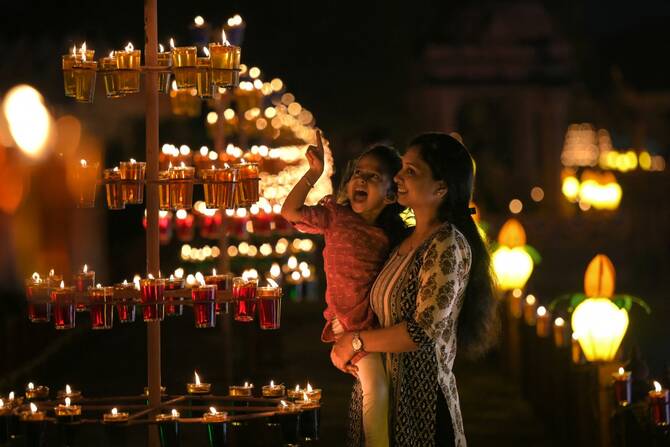
India lights up as millions celebrate Diwali festival

People gather around oil lamps outside Akshardham Temple on the outskirts of Ahmedabad on Oct. 19, 2025, on the eve of Diwali, the Hindu festival of lights. (AFP)
Short Url
Updated 20 October 2025
Follow

India lights up as millions celebrate Diwali festival

  • As Indians travel to observe Diwali with families, it is also known as festival of homecoming
  • It symbolizes victory of light over darkness and is celebrated with candles, diyas, firecrackers

NEW DELHI: Millions of Indians celebrated on Monday the festival of lights, Diwali, one of Hinduism’s most significant and widely observed holidays.

Diwali symbolizes the victory of light over darkness, good over evil, and knowledge over ignorance.

In the northern parts of India, it marks Rama’s return to Ayodhya after defeating the demon king Ravana, while in other parts of the country it is associated with Lakshmi, the deity of fortune.

It is celebrated with bright lights, prayers for wealth, health, and prosperity, and exchanging gifts and sweets. Homes and temples are cleaned and decorated with diyas — oil lamps — candles, paper lamps and traditional colorful designs known as rangoli to invite good luck.

Across the country, markets in cities and towns bustle with shoppers buying sweets, gifts, decorations, and firecrackers.

“Kids are mostly excited about bursting crackers. Diwali night looks beautiful with all houses lit up and different types of colorful crackers brightening the sky too,” said Kanchan Mala, a homemaker in Mokama, in the eastern Indian state of Bihar.

“Special dishes are prepared and at night we light earthen lamps. These oil lamps are filled with mustard oil and a cotton wick is dipped into it and lit, and we put them in front of our houses or on the terrace. I put hundreds of diyas on the parapets of the terrace.”

As millions of Indians travel to observe Diwali with their families, it is also known as a festival of homecoming.

“It’s a festival celebrated best with family members. For me Diwali also means a time to get together with my sons and daughters who live in cities,” Mala told Arab News.

“Diwali makes me feel young.”

Despite many people leaving major cities for the countryside, metropolises like New Delhi see no relief from toxic air pollution which — unlike during other national festivals — gets worse throughout Diwali.

On Monday morning, the Indian capital was shrouded in a thick haze, with the Air Quality Index at 339, or “very poor,” according to the Central Pollution Control Board in Delhi.

The main contributing factor was the use of firecrackers, which produce large amounts of ultrafine toxic particles.

Simran Sodhi, a resident of New Delhi, was one of many troubled by the pollution.

“The smog in the air gets terrible and I wish people would stop bursting firecrackers. Celebrations don’t have to be a loud noise and smog,” she said.

“Diwali means time to cherish with family and loved ones. A time to introspect on the year gone by and plan for the future.”


Nowhere to pray as logs choke flood-hit Indonesian mosque

Updated 57 min 12 sec ago
Follow

Nowhere to pray as logs choke flood-hit Indonesian mosque

  • Before the disaster, the mosque bustled with worshippers — locals and students alike — attending daily and Friday prayers
  • Indonesia consistently ranks among the countries with the highest annual deforestation rates

ACEH TAMIANG, Indonesia: Almost two weeks on from devastating floods, Muslim worshippers in Indonesia’s Sumatra who gathered at their local mosque on Friday for prayers were blocked from entering by a huge pile of thousands of uprooted trees.
The deadly torrential rains had inundated vast tracts of rainforest nearby, leaving residents of the Darul Mukhlisin mosque and Islamic boarding school to search elsewhere for places of worship that had been less damaged.
“We have no idea where all this wood came from,” said Angga, 37, from the nearby village of Tanjung Karang.
Before the disaster, the mosque bustled with worshippers — locals and students alike — attending daily and Friday prayers.
“Now it’s impossible to use. The mosque used to stand near a river,” said Angga. “But the river is gone — it’s turned into dead land.”
Village residents told AFP the structure likely absorbed much of the impact of trees and logs carried by the torrents, preventing even greater destruction downstream.
When AFP visited the site, the mosque was still encircled by a massive heap of timber — a mix of uprooted trees and felled logs, likely from nearby forests.
By Friday, the death toll from one of northern Sumatra’s worst recent disasters — including in Aceh, where a tsunami wreaked havoc in 2004 — had reached 995 people, with 226 still missing and almost 890,000 displaced, according to the National Disaster Mitigation Agency.

- Uncontrolled logging -

Authorities have blamed the scale of devastation partly on uncontrolled logging.
Environmentalists say widespread forest loss has worsened floods and landslides, stripping the land of tree cover that normally stabilizes soil and absorbs rainfall.
Indonesia consistently ranks among the countries with the highest annual deforestation rates.
President Prabowo Subianto, visiting Aceh Tamiang district on Friday, assured victims the government was working to restore normalcy.
“We know conditions are difficult, but we will overcome them together,” he said, urging residents to “stay alert and be careful.”
“I apologize for any shortcomings (but) we are working hard,” he said.
Addressing environmental concerns, Prabowo called for better forest protection.
“Trees must not be cut down indiscriminately,” he said.
“I ask local governments to stay vigilant, to monitor and safeguard our nature as best as possible.”
But frustrations were growing, with flood victims complaining about the pace of relief efforts.
Costs to rebuild after the disaster could run up to 51.82 trillion rupiah ($3.1 billion) and the Indonesian government has so far shrugged off suggestions that it call for international assistance.
Back in nearby Babo Village, Khairi Ramadhan, 37, said he planned to seek out another mosque for prayers.
“I’ll find one that wasn’t hit by the flood,” he said. “Maybe some have already been cleaned. I don’t want to dwell on sorrow anymore.”