

US joined by Mexico, Costa Rica and Jamaica in plan to host 2031 Women’s World Cup, the only bid

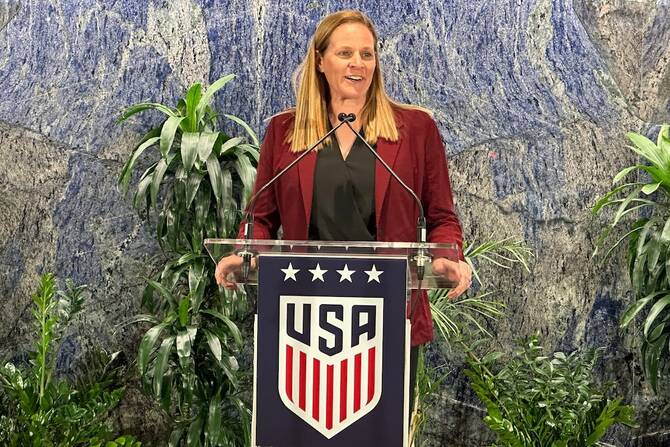
United States Soccer President Cindy Parlow Cone speaks at a news conference in New York Monday, to announce the US, Mexico, Jamaica, and Costa Rica have joined a proposal to co-host the 2031 Women’s World Cup, the only bid being considered by FIFA. (AP)
Short Url
Updated 21 October 2025
Follow

US joined by Mexico, Costa Rica and Jamaica in plan to host 2031 Women’s World Cup, the only bid

  • Cindy Parlow Cone: This Women’s World Cup will be equal in every sense of the word to a men’s World Cup
  • She said more than 30 US cities have expressed interest in hosting in 2031, when 104 games will be played

NEW YORK: The US plans to co-host the 2031 World Cup with regional neighbors, the same structure being used for the men’s championship next year.

Mexico, Costa Rica and Jamaica were added Monday to the US Soccer Federation proposal as co-hosts, the only bid to be considered when FIFA members meet April 30 to formally decide where the expanded 48-nation tournament will be played.

“This Women’s World Cup will be equal in every sense of the word to a men’s World Cup,” US Soccer Federation president Cindy Parlow Cone said during a news conference, “not just in the number of teams and matches, but equal in the quality of the facilities, with the same type of travel, accommodations and support.”

She said more than 30 US cities have expressed interest in hosting in 2031, when 104 games will be played. Decisions on stadiums likely won’t be made until 2027 at the earliest.

Next year’s men’s tournament will be played at 11 NFL stadiums, three in Mexico and two in Canada, with all games in the US from the quarterfinals on.

FIFA, running the World Cup rather than a local organizing committee, is asking up to $6,730 list price for regular tickets and as much as $73,200 for an eight-game hospitality plan at MetLife Stadium in East Rutherford, New Jersey, site of the 2026 men’s final on July 19.

“The demand for the Women’s World Cup here is going to be incredible,” USSF CEO JT Batson said. “We see from our own pricing data of selling tickets for our men’s and women’s national team games that ticket prices are very similar.”

Batson said the USSF, FIFA, host federations and host cities will reflect on next summer’s tournament as part of planning for 2031.

The US hosted the 1999 Women’s World Cup, which was expanded from 12 teams to 16, and 1.2 million fans attended the 32 matches.

“Women in general as they walk through the world is a political act. Women on a soccer field is more of a political act, saying to the world: I deserve to be here,” said Abby Wambach, the 2012 world player of the year. “In 1999, FIFA didn’t believe that the team could play in big football stadiums. And the organizing committee and the players said: No, we can do this. We will figure out how to sell this thing out.”

The US is a four-time women’s champion. Canada was not included in the bid because it hosted the 2015 tournament.

The USSF and the Mexican Football Federation withdrew their joint bid to host the 2027 tournament in April 2024 and said they intended to focus on staging the 2031 event. Two weeks later, FIFA selected Brazil for 2027.

FIFA said this past April the USSF was the only bidder for the 2031 tournament. A United Kingdom plan by England, Scotland, Wales and Northern Ireland was the sole submission for 2035.

The US also staged the 2003 tournament on four months’ notice after FIFA decided not to stick with the original host, China, where there was an outbreak of the SARS virus. Six venues were used for a schedule that included 15 doubleheaders, and the tournament drew about 680,000.

Wambach isn’t concerned the 2027 and 2031 tournaments will be streamed by Netflix in the US rather than televised on a broadcast or cable network.

“Netflix is in a position to try fun, unique, different things that legacy media might not,” Wambach said. “Our women’s national team, we win World Cups, right? And so if we win World Cups, I don’t care who you are, you’re getting Netflix for that month.”


Australia depth shows up England’s Ashes ‘failures’

Updated 12 December 2025
Follow

Australia depth shows up England’s Ashes ‘failures’

SYDNEY: A well-drilled Australia are on the cusp of retaining the Ashes after just six days of cricket — not bad for a team lambasted by England great Stuart Broad before the series began as its weakest since 2010.
The hosts take a 2-0 lead into the third Test at Adelaide on December 17 needing only a draw to keep the famous urn and pile more humiliation on Ben Stokes’s tourists.
Australia have put themselves on the brink despite missing injured pace spearheads Pat Cummins and Josh Hazlewood, with the performances of stand-ins Michael Neser and Brendan Doggett a reflection of their depth.
“The great and the healthiest thing for Australian cricket right now is that they’ve got almost a second XI or an Australia ‘A’ side that could come in and play some outstanding cricket too,” said former Australia Test quick Brett Lee.
“The guys who have had their opportunity, the Doggetts and the Nesers, have stood up. They’ve taken their opportunity and taken it with both hands, which is brilliant.”
The strength of the country’s talent pool was driven home by Australia ‘A’ crushing England’s second-tier side by an innings and 127 runs at Allan Border Field while Stokes’s men were being thrashed down the road in the second Test at the Gabba.
Young prospects Fergus O’Neill, Cooper Connolly and Campbell Kellaway stood out, while discarded Test batsman Nathan McSweeney fired a double-century reminder to selectors.
It is a far cry from the pre-Ashes war-of-words where England were hyped as having their best chance in a generation to win a series in Australia, with seamer Broad’s comments coming back to haunt him.
“It’s probably the worst Australian team since 2010 when England last won and it’s the best English team since 2010,” said Broad, who retired in 2023 and is now working as a pundit.
“It’s actually not an opinion, it’s fact.”
At the time, he pointed to questions over the make-up of Australia’s batting line-up and a perceived lack of bowling depth.
Both have been blown out of the water.

On the go

Australia went into the first Test in Perth dogged by uncertainty, with the uncapped Jake Weatherald as Usman Khawaja’s sixth opening partner since David Warner retired nearly two years ago.
In a quirk of fate, Khawaja was unable to bat in the first innings because of back spasms with Marnus Labuschagne replacing him.
But it was when he pulled out again in the second innings and Travis Head stepped up that the tide turned on England with his stunning 69-ball match-winning century.
“Ever since Travis Head stuck his hand up to open when Khawaja got hurt in Perth, Australia have looked like a different team,” said Australian legend Glenn McGrath.
Labuschagne said Head and Weatherald’s confidence trickled down to the lower order in Brisbane, where himself, Steve Smith and Alex Carey all blasted quick-fire half centuries.
It leaves selectors with a dilemma for the third Test: recall now-fit 85-Test veteran Khawaja or persist with Weatherald and Head, whose home ground is Adelaide.
Smith, who stood in for Cummins as skipper in the first two Tests, attributed Australia’s success so far to being able to adapt “in real time.”
“We play ‘live’. We adapt on the go, instead of getting back in the sheds and going, ‘We should have done this’,” he said.
“Sometimes it’s just playing the long game. I think we’ve just adapted so well the last couple of years, and played in real time, I suppose.”
For former Australia captain Greg Chappell, Australia’s success has been as much about England’s failures.
While their aggressive “Bazball” approach might be suited to flat English pitches and small grounds, it has been brutally exposed by the bigger boundaries and demanding conditions in Australia.
“The failure that has ensued across the first two Tests is a whole-of-system one, a catastrophic breakdown of both the game plan and its execution,” he wrote in a column.
“While the players have been the immediate culprits, the off-field leaders —  Brendon McCullum and Ben Stokes — are equally responsible for not recognizing the different challenges presented by Test cricket in Australia.”