
Pakistani, Afghan negotiators hold talks in Doha after fierce clashes, airstrikes

1 / 2
City skyline view, ahead of the emergency Arab-Islamic summit, to discuss the Israeli attack on Hamas on the Gulf country's soil, in Doha, Qatar, on September 15, 2025. (REUTERS/File)
2 / 2
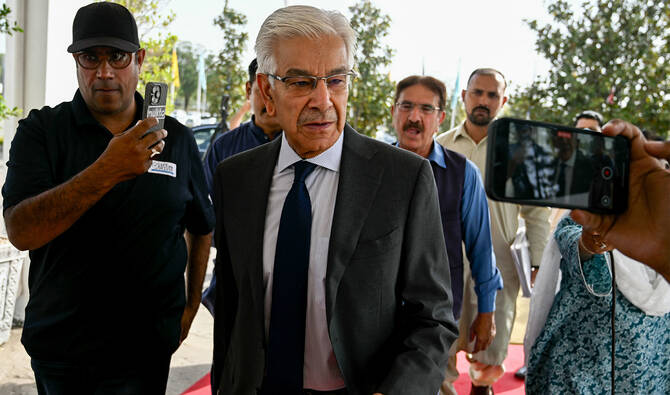
Pakistan's Defence Minister Khawaja Muhammad Asif (C) arrives at the Parliament House in Islamabad on June 10, 2025. (AFP/File)
Short Url
Updated 18 October 2025
Follow

Pakistani, Afghan negotiators hold talks in Doha after fierce clashes, airstrikes

  • The development comes hours after another Pakistani strike killed at least 10 people, including three Afghan cricketers
  • The fierce battles broke out last Saturday amid Islamabad’s claims of Kabul sheltering militant groups attacking Pakistan

KARACHI: Pakistan’s Defense Minister Khawaja Asif and intelligence chief are in Doha to hold talks with their Afghan counterparts, Pakistani state media reported on Saturday, after days of deadly clashes between the neighbors.

The fierce battles between the two neighbors along their long, porous border broke out last Saturday and have led to the deaths of dozens of people on both sides, with Pakistan carrying out airstrikes in Kandahar and Kabul before a two-day truce that expired Friday evening.

Pakistan “conducted precision aerial strikes” in Afghan border areas on Friday, a security official said, adding that they targeted the Hafiz Gul Bahadur group of the Tehreek-e-Taliban Pakistan (TTP). Friday’s strikes killed three Afghan cricketers among at least 10 people, Afghan authorities said.

The aerial strikes ended 48 hours of calm between the two countries, with defense ministers and intelligence chiefs from the two countries arriving in the Qatari capital of Doha on Saturday.

“The talks began at 2pm Pakistan Standard Time,” the state-run Pakistan TV reported.

Pakistan’s foreign office said the talks will focus on immediate measures to end “cross-border terrorism against Pakistan, emanating from Afghanistan and restore peace and stability along the Pak-Afghan border.”

“Pakistan does not seek escalation but urges the Afghan Taliban authorities to honor their commitments to the international community and address Pakistan’s legitimate security concerns by taking verifiable action against terrorist entities,” it added.

Islamabad said the Hafiz Gul Bahadur group had been involved in a suicide bombing and gun attack at a military camp in the North Waziristan district that borders Afghanistan, which left seven Pakistani paramilitary troops dead on Friday.

The Afghanistan Cricket Board told AFP that three players who were in the region for a tournament were killed by Friday’s airstrikes, revising down an earlier toll of eight.

Meanwhile, United States (US) President Donald Trump offered to help end hostilities between Pakistan and Afghanistan.

“I do understand that Pakistan attacked or there is an attack going on with Afghanistan,” he said in a meeting with the Ukrainian president Volodymyr Zelensky at the White House.

“That’s an easy one for me to solve if I have to solve it. In the meantime, I have to run the USA. But I love solving wars.”

The clashes between Pakistan and Afghanistan broke out amid Islamabad’s claims that the Afghan Taliban had been sheltering banned militant groups like the TTP and the Baloch Liberation Army (BLA), which carry out cross-border attacks against Pakistan. Kabul denies the allegations.


Pakistan remittances seen surpassing $40 billion in FY26 as Saudi Arabia leads November inflows

Updated 47 min 3 sec ago
Follow

Pakistan remittances seen surpassing $40 billion in FY26 as Saudi Arabia leads November inflows

  • The country’s November remittances rose 9.4 percent year-on-year to $3.2 billion, official data show
  • Economic experts say rupee stability and higher use of formal channels are driving the upward trend

ISLAMABAD: Pakistan’s workers’ remittances are expected to exceed the $40 billion mark in the current fiscal year, economic experts said Tuesday, after the country recorded an inflow of $3.2 billion in November, with Saudi Arabia once again emerging as the biggest contributor.

Remittances are a key pillar of Pakistan’s external finances, providing hard currency that supports household consumption, helps narrow the current-account gap and bolsters foreign-exchange reserves. The steady pipeline from Gulf economies, led by Saudi Arabia and the United Arab Emirates, has remained crucial for Pakistan’s balance of payments.

A government statement said monthly remittances in November stood at $3.2 billion, reflecting a 9.4 percent year-on-year increase.

“The growth in remittances means the full-year figure is expected to cross the $40 billion target in fiscal year 2026,” Sana Tawfik, head of research at Arif Habib Limited, told Arab News over the phone.

“There are a couple of factors behind the rise in remittances,” she said. “One of them is the stability of the rupee. In addition, the country is receiving more inflows through formal channels.”

Tawfik said the trend was positive for the current account and expected inflows to remain strong in the second half of the fiscal year, noting that both Muslim festivals of Eid fall in that period, when overseas Pakistanis traditionally send additional money home for family expenses and celebrations.

The official statement said cumulative remittances reached $16.1 billion during July–November, up 9.3 percent from $14.8 billion in the same period last year.

It added that November inflows were mainly sourced from Saudi Arabia ($753 million), the United Arab Emirates ($675 million), the United Kingdom ($481.1 million) and the United States ($277.1 million).

“UAE remittances have regained momentum in recent months, with their share at 21 percent in November 2025 from a low of 18 percent in FY24,” said Muhammad Waqas Ghani, head of research at JS Global Capital Limited. “Dubai in particular has seen a steady pick-up, reflecting improved inflows from Pakistani expatriates owing to some relaxation in emigration policies.”