Pakistan central bank says stronger forex buffers enabled $20 billion interbank purchases in three years

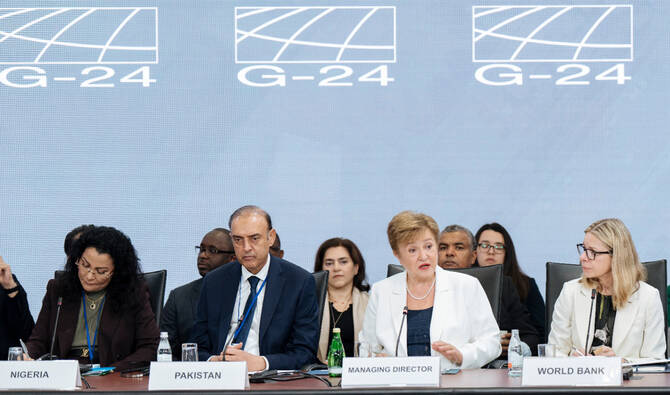
State Bank of Pakistan Governor, Jameel Ahmad (second from left) is attending a meetin on foreign investors on the sideline of IMF-World Bank annual meeting in Washington DC on October 17, 2025. (Finance Ministry)
Short Url
Updated 18 October 2025
Follow

Pakistan central bank says stronger forex buffers enabled $20 billion interbank purchases in three years

  • Governor Jameel Ahmad says SBP reforms and remittance inflows helped rebuild reserves five-fold since early 2023
  • Central bank targets $17.5 billion in foreign exchange reserves by June 2026 amid improving macroeconomic stability

KARACHI: Pakistan’s central bank governor said on Friday improved foreign exchange buffers and a more stable market environment had enabled the State Bank of Pakistan (SBP) to purchase $20 billion from the interbank market over the past three years to rebuild reserves and strengthen its capacity to absorb external shocks.

Governor Jameel Ahmad told senior executives from global financial and investment institutions on the sidelines of the IMF-World Bank Annual Meetings in Washington the SBP’s strategy to reform exchange companies and promote remittances through formal channels had stabilized the market, allowing Pakistan to increase its foreign reserves nearly five-fold since February 2023.

“SBP has improved the stability and transparency of the FX market through structural reforms in exchange companies and the promotion of remittances through formal channels,” Ahmad said, according to an official statement. “These efforts have brought stability in the FX market, allowing SBP to strategically purchase $20 billion during the last three years from the interbank market to build its FX reserves.”

He added that the central bank now aims to raise foreign exchange reserves to $17.5 billion by June 2026, emphasizing that the stronger position reflects SBP’s focus on building buffers “to withstand external shocks.”

Ahmad said headline inflation had declined sharply to 5.6 percent in September 2025, down from over 25 percent two years earlier, while core inflation had fallen below 8 percent. Despite flood-related disruptions, he projected inflation would stabilize within the 5-7 percent range in the medium term.

Pakistan’s economy grew by 3 percent in FY25, the SBP governor said, and growth in FY26 was expected to remain between 3.25 and 4.25 percent.

He added that policy consistency and fiscal discipline had created space for structural reforms, enabling Pakistan to pursue “sustainable growth and socioeconomic uplift” with support from multilateral partners such as the IMF and World Bank.


Pakistan says $50 million meat export deal with Tajikistan nearing finalization

Updated 09 December 2025
Follow

Pakistan says $50 million meat export deal with Tajikistan nearing finalization

  • Islamabad expects to finalize agreement soon after Dushanbe signals demand for 100,000 tons
  • Pakistan is seeking to expand agricultural trade beyond rice, citrus and mango exports

ISLAMABAD: Tajikistan has expressed interest in importing 100,000 tons of Pakistani meat worth more than $50 million, with both governments expected to finalize a supply agreement soon, Pakistan’s food security ministry said on Tuesday.

Pakistan is trying to grow agriculture-based exports as it seeks regional markets for livestock and food commodities, while Tajikistan, a landlocked Central Asian state, has been expanding food imports to support domestic demand. Pakistan currently exports rice, citrus and mangoes to Dushanbe, though volumes remain small compared to national production, according to official figures.

The development came during a meeting in Islamabad between Pakistan’s Federal Minister for National Food Security and Research Rana Tanveer Hussain and Ambassador of Tajikistan Yusuf Sharifzoda, where agricultural trade, livestock supply and food-security cooperation were discussed.

“Tajikistan intends to purchase 100,000 tons of meat from Pakistan, an import valued at over USD 50 million,” the ambassador said, according to the ministry’s statement, assuring full facilitation and that Islamabad was prepared to meet the demand.

The statement said the two sides agreed to expand cooperation in meat and livestock, fresh fruit, vegetables, staple crops, agricultural research, pest management and standards compliance. Pakistan also proposed strengthening coordination on phytosanitary rules and establishing pest-free production zones to support long-term exports.

Pakistan and Tajikistan have long maintained political ties but bilateral food trade remains below potential: Pakistan produces 1.8 million tons of mangoes annually but exported just 0.7 metric tons to Tajikistan in 2024, while rice exports amounted to only 240 metric tons in 2022 out of national output of 9.3 million tons. Pakistan imports mainly ginned cotton from Tajikistan.