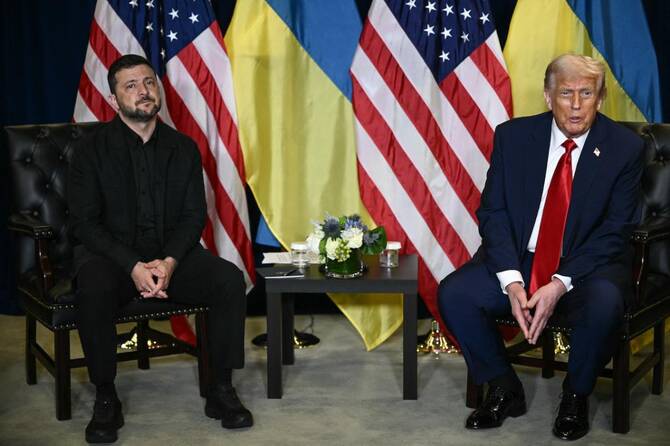
WASHINGTON: Ukrainian President Volodymyr Zelensky meets Donald Trump at the White House Friday, seeking US-made Tomahawk missiles even as the US president reaches out to Russia’s Vladimir Putin for a fresh summit.
Zelensky will be making his third trip to Washington since Trump returned to office, following a disastrous televised shouting match in February and a make-up meeting in August, as the US leader’s stance on the war blows hot and cold.
Trump’s latest pivot came on the eve of Zelensky’s visit. He announced that he would be meeting Putin in Budapest, in a fresh bid to reach a peace deal and end Moscow’s invasion launched in 2022.
Ukraine had hoped Zelensky’s trip would be more about adding to the pressure on Putin, especially by getting American-made long-range Tomahawk cruise missiles that can strike deep into Russia.
But Trump, who once said he could end the war in Ukraine within 24 hours, appears set on pursuing a new diplomatic breakthrough to follow the Gaza ceasefire deal that he brokered last week.
Trump said Thursday he had a “very productive” call with Putin and that they would meet in the Hungarian capital within the next two weeks. He added that he hoped to have “separate but equal” meetings with both Putin and Zelensky but did not elaborate.
Zelensky said as he arrived Thursday in Washington that he hoped Trump’s success with the Gaza deal would bring results to end the war that has left swathes of his own country in ruins.
“We expect that the momentum of curbing terror and war that succeeded in the Middle East will help to end Russia’s war against Ukraine,” Zelensky said on X.
Zelensky insisted that the threat of Tomahawks had forced Moscow to negotiate.
“We can already see that Moscow is rushing to resume dialogue as soon as it hears about Tomahawks,” Zelensky said, adding that he’ll also be meeting US defense companies to discuss additional supplies of air defense systems.
’Didn’t like it’
Trump however cast doubt on whether Ukraine would ever get the coveted weapons, which have a 1,000-mile (1,600-kilometer) range.
Trump told reporters on Thursday that the United States could not “deplete” its own supply. “We need them too, so I don’t know what we can do about that,” he said.
The US president said the Russian leader “didn’t like it” when he raised the possibility during their call of giving Tomahawks to Ukraine.
The Kremlin said on Thursday it was making immediate preparations for a Budapest summit after what it called the “extremely frank and trustful” Putin-Trump call.
But Putin told Trump that giving Ukraine Tomahawks would “not change the situation on the battlefield” and would harm “prospects for peaceful resolution,” the Russian president’s top aide Yuri Ushakov told journalists.
Trump’s relations with Putin — a leader for whom he has repeatedly expressed admiration over the years — and Zelensky have swung wildly since he returned to the White House in January.
After an initial rapprochement, Trump has shown increasing frustration with Putin, particularly since he came away from meeting the Russian president in Alaska with no end to the war in sight.
Zelensky meanwhile has gone the opposite way, winning back Trump’s support after the disastrous Oval Office encounter when the US president and Vice President JD Vance berated him in front of the cameras.
The Ukrainian returned in August — wearing a suit after he was mocked for not wearing one in the first meeting — and accompanied by a host of Western leaders in solidarity.


![]()

Trump to meet Zelensky after announcing Putin summit
Short Url
https://arab.news/wd7jv
Trump to meet Zelensky after announcing Putin summit
- Zelensky will meet Donald Trump at the White House Friday, seeking US-made Tomahawk missiles even as the US president reaches out to Russia’s Vladimir Putin


Latest updates


© 2026 SAUDI RESEARCH & PUBLISHING COMPANY, All Rights Reserved And subject to Terms of Use Agreement.