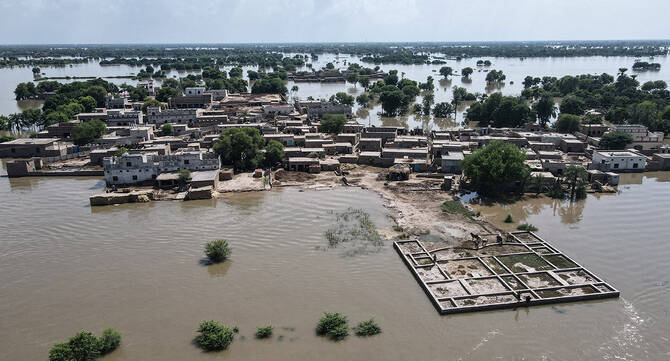

KARACHI: Pakistani economists warned this week that recent floods could weigh down the national economy, even as the International Monetary Fund (IMF) approved Islamabad’s economic performance in its latest reviews under two lending programs this week, paving the way for the release of $1.2 billion.
The IMF announced on Tuesday that it had reached a staff-level agreement with Pakistan on the second review of its $7 billion Extended Fund Facility (EFF) and the first review of the $1.4 billion Resilience and Sustainability Facility (RSF).
The agreement, pending approval by the Fund’s executive board, will provide balance-of-payments support and strengthen the country’s capacity to respond to climate shocks.
“This time, the government has this fiscal pressure, and this is a key risk,” said Muhammad Waqas Ghani, head of research at JS Global Capital Ltd., referring to flood losses estimated at around $3.5 billion.
“The government will have to really cope up with the challenge,” he added.
Finance Minister Muhammad Aurangzeb, who met IMF Managing Director Kristalina Georgieva in Washington this week, expressed satisfaction with the staff-level agreement, saying Pakistan had achieved macroeconomic stabilization.
He said the government was “committed to staying the course on reforms in taxation, energy, state-owned enterprises and privatization,” while seeking investments in mining, digital infrastructure, agriculture, oil and gas, and pharmaceuticals.
Economist Ahsen Mehanti, chief executive officer of Arif Habib Commodities Ltd., described the IMF agreement as a “significant development,” noting that earlier uncertainty had weighed on Pakistan’s markets amid reports that the Fund had identified a “mismatch” in Pakistan’s trade data and wanted adjustments.
“There was quite a bit of uncertainty, which was causing the markets, especially the stock markets, to fall in Pakistan, because the IMF tranche of around $1.2 billion was in question,” he said.
Pakistan’s benchmark KSE-100 Index rebounded sharply after the announcement, recovering more than 7,000 points in a single session on Oct. 14 and gaining about 5 percent over the next two days.
Mehanti said his estimates suggested that the floods had caused about $5 billion in losses that would impact the exchequer through higher import costs, particularly for cotton.
“Cotton will be important in the coming period,” he said.
All Pakistan Textile Mills Association Chairman Kamran Arshad has echoed the same opinion, saying millers were likely to double cotton imports to about $3 billion this year as floods destroyed thousands of acres of crops in the eastern Punjab province.
“In the upcoming period, the impact of flood losses in terms of increased poverty and unemployment levels will be seen,” Mehanti said.
However, economists said the staff-level agreement would largely help Pakistan maintain macroeconomic stability and encourage foreign investment from partners such as China and Saudi Arabia.
“We are expecting this development [signing of the agreement] to maintain economic stability, which is [expected to bring] in Chinese investment,” said Mehanti, adding that he also expected to see positive movement in the mining and agricultural sectors alongside a potential $10 billion refinery investment from Saudi Arabia after its defense pact with Pakistan.
While the IMF deal has eased short-term concerns, analysts said Pakistan would continue to face the perpetual threat of political unrest, as demonstrated by the recent protests by a religio-political party that led to serious clashes with the police.
“This is one of the major problems the country faces,” Ghani said, referring to sporadic political demonstrations.
“If we remember 2017, the economy basically got derailed because of political instability,” he added. “So, obviously, it’s serious.”