

Opposition demands Imran Khan hospital transfer as government assures specialized examination

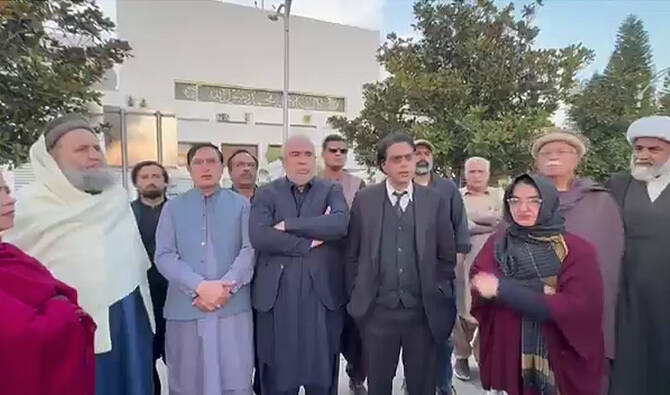
Screengrab showing members belonging to Pakistan Tehreek-e-Insaf protesting outside National Assembly of Pakistan on February 14, 2026, demanding that jailed former PM Imran Khan be shifted to hospital. (PTI Official)
Short Url
Updated 14 February 2026
Follow

Opposition demands Imran Khan hospital transfer as government assures specialized examination

  • Khan’s family says he spoke to his sons for 20 minutes, calls for urgent treatment under personal doctors
  • Former health minister warns ex-PM’s vision loss could be ‘irreversible’ without immediate intervention

ISLAMABAD: Pakistan’s opposition protest entered its second day on Saturday as its leaders demanded that jailed former prime minister Imran Khan be shifted to a private hospital for urgent eye treatment, amid the government’s assurance that his examination would be conducted at a specialized medical institution.

A group of leaders belonging to Tehreek-e-Tahafuz-e-Ayeen-e-Pakistan — or the Movement to Protect the Constitution of Pakistan — gathered outside Parliament House a day after its members started a sit-in, as police maintained a heavy security presence around the building and nearby roads.

Salman Akram Raja, the secretary general of Khan’s Pakistan Tehreek-e-Insaf (PTI) party, called for the former premier’s early transfer for treatment at Islamabad’s Shifa International Hospital.

“We have been told that there is consent to take him to Shifa International,” he said in a video message. “If that is the case, there should be no delay. We are also being told that one member of Khan’s family will be allowed to accompany him.”

Raja said Khan’s treatment should come first, followed by his release.

“Restoration of the Constitution and rule of law in this country has now become inevitable,” he added.

Separately, Mustafa Nawaz Khokhar, another politician, told a news conference at the National Press Club that the opposition’s only demand was that Khan be granted full access to the required medical facilities.

“He has already lost vision in one eye,” he told the media.

“His treatment should take place in the presence of his family,” he continued. “Until this demand is met, we will not step back.”

Dr. Zafar Mirza, a former health minister under Khan’s administration who accompanied Khokhar, said Khan was suffering from central retinal vein occlusion, a serious eye condition that can lead to permanent vision loss if not treated promptly.

“If intervention is not carried out even now, it is possible that he may never be able to see from one eye again,” he said, warning that the extent of the damage remained unclear and could be irreversible.

Earlier in the day, Khan’s legal team filed a petition in the Islamabad High Court seeking suspension of his 17-year prison term in a graft case and his release on medical grounds, citing what they described as his deteriorating health.

Khan’s sister, Aleema Khan, said in a post on X that the former premier had spoken to his sons for about 20 minutes following a direction from the chief justice of Pakistan and that the family was now awaiting urgent treatment at Shifa International Hospital under the supervision of his personal doctors.

“We cannot and will not tolerate any further delay,” she said.

Information Minister Attaullah Tarar said in a social media post that Khan’s further examination and treatment would be conducted at a “specialized medical institution” and that a detailed report would be submitted to the Supreme Court.

“Conjecture, speculation and efforts to turn this into political rhetoric and mileage for vested interests may please be avoided,” he added.

The opposition protest followed a report submitted to the Supreme Court this month by amicus curiae Barrister Salman Safdar, who visited Khan at Rawalpindi’s Adiala jail and recommended that the seriousness of his ocular condition be independently assessed without delay.

Medical documents cited in the filing mentioned drastically reduced vision in Khan’s right eye, which led prison authorities to take him to a government hospital where he underwent an intravitreal injection.

Khan’s party said his family and legal team were not informed about the development, which was first mentioned in a local media report.

The PTI has blamed the government for negligence leading to damage to Khan’s vision, though the allegation has been denied by federal ministers who say that the case is being monitored by the country’s top court while promising “best possible treatment.”

Support for Khan also came from former Pakistani cricketers who played under his captaincy during Pakistan’s 1992 World Cup victory.

Ramiz Raja said on X that seeing Khan “suffer and lose sight in one eye is an emotional meltdown,” while Wasim Akram wished him “strength, a speedy recovery, and a full return to good health.”

Waqar Younis urged that politics be put aside and called for Khan’s timely treatment.

Khan, 73, has been in custody since August 2023 in connection with multiple cases that he and his party say are politically motivated, an allegation the government denies.


Qatar, Pakistan resolve to boost strategic, economic cooperation at Doha talks

Updated 24 February 2026
Follow

Qatar, Pakistan resolve to boost strategic, economic cooperation at Doha talks

  • Both countries urge dialogue on Afghanistan amid renewed border tensions between Islamabad and Kabul
  • Discussions focus on bilateral trade and investment, energy, defense, manpower and labor and culture

ISLAMABAD: Pakistan and Qatar on Tuesday agreed to deepen their strategic and economic cooperation during high-level talks between Prime Minister Shehbaz Sharif and his Qatari counterpart Sheikh Mohammed bin Abdulrahman bin Jassim Al Thani, Sharif’s office said.

Sharif visited Qatar along with a high-level delegation on the invitation of Qatari emir Sheikh Tamim bin Hamad Al Thani. The Pakistani premier also held meetings with Qatar’s trade and defense ministers to discuss cooperation in various domains.

The visit came at a time when Pakistan is seeking closer economic engagement with Gulf partners amid its broader push to stabilize the economy and attract investment, while maintaining security and defense cooperation with key regional states.

During their meeting in Doha, PM Sharif and Qatar’s Sheikh Mohammed discussed bilateral relations and exchanged views on regional and international developments, according to the Pakistan prime minister’s office.

“They reaffirmed the strong brotherly relations between Pakistan and Qatar and expressed satisfaction at the growing momentum in political, economic and institutional ties,” Sharif’s office said.

“Discussions focused on enhancing cooperation in the fields of trade and investment, energy, defense, manpower and labor and culture, with both sides stressing the importance of their task force to accelerate cooperation in all these areas.”

Pakistan and Qatar maintain strong trade and investment ties. In 2022, the office of Qatar’s emir said the Qatar Investment Authority planned to invest $3 billion in Pakistan, targeting sectors including transport, aviation, education, health, media, technology and labor.

Nearly 300,000 Pakistanis live and work in Qatar, according to Pakistan’s foreign office, with many employed in health, education, engineering and public services, as well as construction and transport. The two countries engage through forums such as the Bilateral Political Consultations and the Joint Ministerial Commission.

Sharif said he had productive discussions with Qatar’s emir, Sheikh Tamim bin Hamad Al Thani, on how the two sides could transform their brotherly ties into mutually beneficial economic relationships. 

“We also took stock of the regional situation,” he said on X. “Pakistan and Qatar will continue to work together for peace and stability in the region and beyond.”

Prime Minister Shehbaz Sharif (second right) meets the Qatari Emir Qatar’s emir Sheikh Tamim bin Hamad Al Thani (left) in Doha, Qatar, on February 24, 2026. (PID)

DIALOGUE WITH AFGHANISTAN

Earlier, Sharif and Qatar’s Deputy PM Sheikh Saoud Al-Thani discussed the situation in Afghanistan and called for dialogue to support regional stability.

The meeting took place amid renewed tensions after Islamabad carried out airstrikes last week on what it described as Tehreek-e-Taliban Pakistan (TTP) targets inside Afghanistan. Kabul said the strikes killed civilians and vowed to respond to what it called a violation of its sovereignty.

“Regional developments were also discussed, in particular the situation in Iran and Afghanistan,” Sharif’s office said in a statement. “Both sides emphasized the importance of dialogue, de-escalation and collective efforts to promote peace and stability in the region.”

This was the second time in less than six months that Pakistan conducted airstrikes in Afghanistan. The last strikes triggered heavy, weeklong clashes between the neighbors along their border before Qatar and Turkiye mediated a ceasefire between them in Oct. last year.

Separately, Sharif held meetings with Qatar’s State Minister for Trade Dr. Ahmed bin Mohammed Al-Sayed and a delegation of the Qatar Businessmen Association (QBA), highlighting Pakistan’s investment-friendly reforms.

He invited QBA members to explore opportunities in infrastructure, logistics, energy, agriculture, technology and export-oriented manufacturing, his office said.