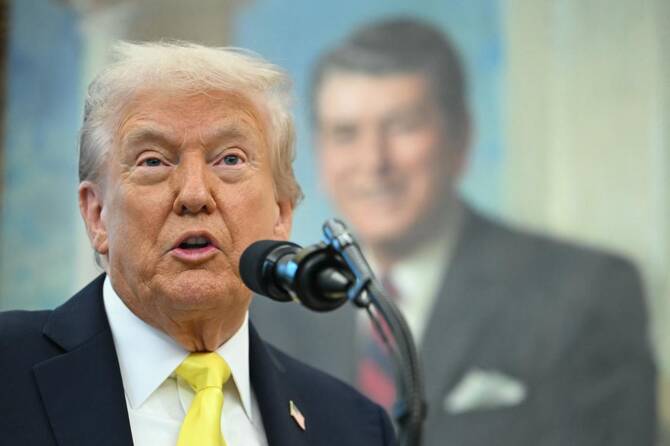
WASHINGTON: US President Donald Trump said Wednesday he was considering strikes targeting Venezuelan cartels on land, after a series of deadly strikes at sea against alleged drug-carrying boats.
“We are certainly looking at land now, because we’ve got the sea very well under control,” Trump told reporters in the Oval Office, when asked if he was weighing strikes on land.
But Trump declined to confirm a New York Times report that he had secretly authorized the CIA to conduct covert action in Venezuela against the administration of President Nicolas Maduro.
Asked if he had given the CIA authority to “take out” Maduro, Trump replied: “That’s a ridiculous question for me to be given. Not really a ridiculous question, but wouldn’t it be a ridiculous question for me to answer?”
Trump said on Tuesday that another strike on boats allegedly transporting drugs from Venezuela had killed six “narcoterrorists.”
At least 27 people have been killed so far in such attacks. Experts question the legality of using lethal force in foreign or international waters against suspects who have not been intercepted or questioned.
Colombia’s President Gustavo Petro has said he believes some of those killed were Colombian.

Trump considering strikes on land against Venezuela cartels
Short Url
https://arab.news/p5vhm
Trump considering strikes on land against Venezuela cartels
- US has recently laucnhed strikes at sea against alleged drug-carrying boats
Families set off on migration journeys and find themselves torn apart
MIAMI: During the first Trump administration, families were forcibly separated at the border.
Now parents inside the United States are being arrested by immigration authorities and separated from their families during prolonged detention inside the country.
Three recent migrants told The Associated Press that their journeys were sources of deep pain and uncertainty because they marked the possible start of permanent separation between loved ones. Associated Press photographers documented the human toll.
___
Jakelin Pasedo
Jakelin Pasedo and her two young sons arrived in Miami in December 2024 and received refugee status while Pasedo cares for the boy and works cleaning offices. Their husband and father, Antonio Laverde, who left Venezuela in 2022, was arrested in June at his shared housing and detained for three months before asking to return to Venezuela. Fearing persecution if she goes back, Pasedo hopes to reunite with her husband in the US
Amavilia
Amavilia crossed from Guatemala in September 2023 and cares for two young children — breastfeeding and waking at 3 a.m. to cook lunches she sells for $10 while also selling homemade ice cream and chocolate‑covered bananas door to door. Her husband Edgar, who had lived and worked in South Florida for over 20 years, was detained on a 2016 warrant and deported to Guatemala on June 8, leaving the family unable to pay rent and reliant on donations at first.
She and her husband declined to provide their last names because they are worried about repercussion from US immigration officials.
Amavilia fears police, urges her daughter to stay calm, and keeps going “entrusting myself to God,” hoping to provide stability despite the uncertainty.
“I fell into despair. I didn’t know what to do,” said Amavilia, 31.
Yaoska
Yaoska, five months pregnant, lives in Miami with her two young sons, one a US citizen, with a 24‑hour GPS supervision bracelet. She fled Nicaragua in 2022. Her husband, a political activist who faced threats and beatings at home, was detained at an appointment with Immigration and Customs Enforcement and failed his credible fear interview.
Yaoska spoke on condition of anonymity and requested the same for her husband to protect him from the Nicaraguan government.
He was deported after three months of detention. Yaoska’s work authorization runs until 2028, but she fears for her family’s future and struggles to find stable work.
“It’s so hard to see my children like this. They arrested him right in front of them,” Yaoska said, her voice trembling.
Now parents inside the United States are being arrested by immigration authorities and separated from their families during prolonged detention inside the country.
Three recent migrants told The Associated Press that their journeys were sources of deep pain and uncertainty because they marked the possible start of permanent separation between loved ones. Associated Press photographers documented the human toll.
___
Jakelin Pasedo
Jakelin Pasedo and her two young sons arrived in Miami in December 2024 and received refugee status while Pasedo cares for the boy and works cleaning offices. Their husband and father, Antonio Laverde, who left Venezuela in 2022, was arrested in June at his shared housing and detained for three months before asking to return to Venezuela. Fearing persecution if she goes back, Pasedo hopes to reunite with her husband in the US
Amavilia
Amavilia crossed from Guatemala in September 2023 and cares for two young children — breastfeeding and waking at 3 a.m. to cook lunches she sells for $10 while also selling homemade ice cream and chocolate‑covered bananas door to door. Her husband Edgar, who had lived and worked in South Florida for over 20 years, was detained on a 2016 warrant and deported to Guatemala on June 8, leaving the family unable to pay rent and reliant on donations at first.
She and her husband declined to provide their last names because they are worried about repercussion from US immigration officials.
Amavilia fears police, urges her daughter to stay calm, and keeps going “entrusting myself to God,” hoping to provide stability despite the uncertainty.
“I fell into despair. I didn’t know what to do,” said Amavilia, 31.
Yaoska
Yaoska, five months pregnant, lives in Miami with her two young sons, one a US citizen, with a 24‑hour GPS supervision bracelet. She fled Nicaragua in 2022. Her husband, a political activist who faced threats and beatings at home, was detained at an appointment with Immigration and Customs Enforcement and failed his credible fear interview.
Yaoska spoke on condition of anonymity and requested the same for her husband to protect him from the Nicaraguan government.
He was deported after three months of detention. Yaoska’s work authorization runs until 2028, but she fears for her family’s future and struggles to find stable work.
“It’s so hard to see my children like this. They arrested him right in front of them,” Yaoska said, her voice trembling.
© 2025 SAUDI RESEARCH & PUBLISHING COMPANY, All Rights Reserved And subject to Terms of Use Agreement.