

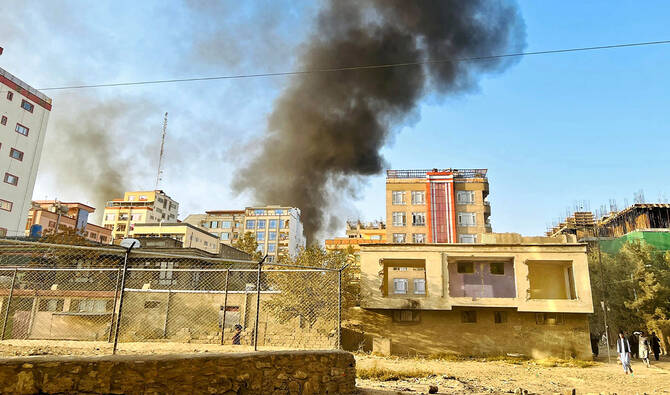

ISLAMABAD: The deadly clashes between Pakistan and Afghanistan, which have killed dozens on both sides, could place the Taliban administration in Kabul under growing internal pressure if cross-border hostilities with Pakistan continue, analysts said on Wednesday.
Pakistan and Afghanistan announced a temporary ceasefire earlier in the day after some of the heaviest fighting along their frontier in recent years. Prior to that, Pakistan’s military said it had repelled coordinated attacks by Afghan Taliban fighters at multiple points along the border in Balochistan and Khyber Pakhtunkhwa provinces, accusing Kabul’s forces of destroying a key trade gate and endangering civilians.
Speaking to Arab News, Maj. Gen. (r) Inam-ul-Haq said the Taliban regime was divided between two dominant factions — the Kandaharis, who control the movement’s leadership and religious base, and the Haqqanis, who wield influence in Kabul and parts of eastern Afghanistan.
“There are already fissures between the Kandahar and Haqqani factions, and those will widen if such clashes continue,” he said. “They [the Taliban] understand this, which is why they will want to wrap it up quickly.”
Pakistan’s state media said on Wednesday that the military had launched “precision strikes” on Kandahar, the birthplace of the Taliban movement and home to its influential supreme leader, Mullah Haibatullah Akhundzada.
The Haqqani Network, led by Sirajuddin Haqqani, is another powerful faction within the Taliban and is seen as more open to negotiation due to its long-standing ties with Pakistan.
Haq said the Haqqanis appeared less involved in the current conflict.
“The decision-making is being led by the puritanical Kandahar faction rather than the pragmatic Kabul-based leadership,” he said.
The analyst noted that previous skirmishes between the two sides had remained “localized,” but this latest flare-up was “more spread out,” though he dismissed the possibility of a full-scale war.
“Pakistani forces dominate the heights along the international border, a decisive advantage in mountain warfare,” he said. “The Taliban don’t have the logistics or capability to sustain prolonged conflict.”
However, he expressed concern about the Taliban’s antagonism toward Pakistan, saying it was partly rooted in the narrative developed over two decades of war.
“Over the past 20 years, Pakistan was portrayed as the source of Afghanistan’s ills, past, present, and future,” he said. “That narrative has seeped deep into Afghan society, including the Taliban. Managing that resentment will be a long-term challenge.”
Asked if there was any opening for cooperation, Haq said there was a sliver of hope.
“Pakistan’s objective is simple: rein in the Tehreek-e-Taliban Pakistan [TTP],” he said. “The key is whether the Taliban are willing to cooperate.”
Pakistan has experienced a surge in militant attacks in its western provinces of Khyber Pakhtunkhwa and Balochistan that border Afghanistan, attributing the spike in violence to cross-border attacks on its civilians and security forces.
Officials in Islamabad have long accused Kabul of allowing militants affiliated with the TTP and the separatist Baloch Liberation Army (BLA) to use its soil to launch attacks against Pakistani civilians and security forces.
Afghanistan denies the allegations, blaming Islamabad for failing to manage its internal security.
Sami Yousafzai, who has written extensively about militancy in Pakistan and Afghanistan, said the clashes were as much about political legitimacy for the Kabul administration as they were about border management.
“This is a serious issue between two countries,” he said. “Hatred is spreading, and this time the clashes are getting serious.”
Yousafzai noted that the Taliban, who were widely viewed as close to Islamabad in the past, wanted “to get rid of the perception that they are Pakistan’s puppets.”
He added that while militarily weaker, the Taliban had gained politically at home by projecting defiance.
“They’ve strengthened their domestic standing by showing they can resist Pakistan,” he noted. “Pakistan, being a more stable state, cannot afford constant border skirmishes when it’s already facing challenges on its eastern front [with India].”
Yousafzai suggested diplomacy, not military escalation, offered the only sustainable path forward.
“If Pakistan wants to eliminate the TTP threat, it will have to engage the Taliban in talks,” he added.
Other analysts said the confrontation had been building for months amid militant activity and the breakdown of quiet diplomatic engagement.
“For months, Pakistan has accused the Afghan Taliban of sheltering TTP and Baloch militants,” said Ihsan Tipu Mehsud, co-founder of The Khorasan Diary, a conflict monitoring platform. “Those covering the border regions could sense that things were heading toward an open conflict.”
Abdullah Khan, managing director of the Pakistan Institute for Conflict and Security Studies, called the confrontation “the deadliest we have ever seen along the frontier.”
“The clashes have taken place from Chitral to Balochistan,” he said. “They erupted after alleged Pakistani strikes on TTP targets inside Afghanistan last week, but the Taliban’s direct attacks on Pakistani positions mark a new phase.”
Khan concurred with Haq that fighting could backfire on the Taliban leadership.
“Continued fighting could embolden opposition groups like the National Resistance Front, while external powers such as China or Middle Eastern states might step in to defuse tensions,” he said.
Asked about how Pakistan would proceed after the ceasefire, he said Islamabad’s “patience has run out.”
“Pakistan now expects Kabul to address its security concerns just as it has done for China, the US, and other countries.”


