Nestlé, KAUST partner to advance research and innovation in food and agriculture

Short Url
Updated 15 October 2025
Follow

Nestlé, KAUST partner to advance research and innovation in food and agriculture

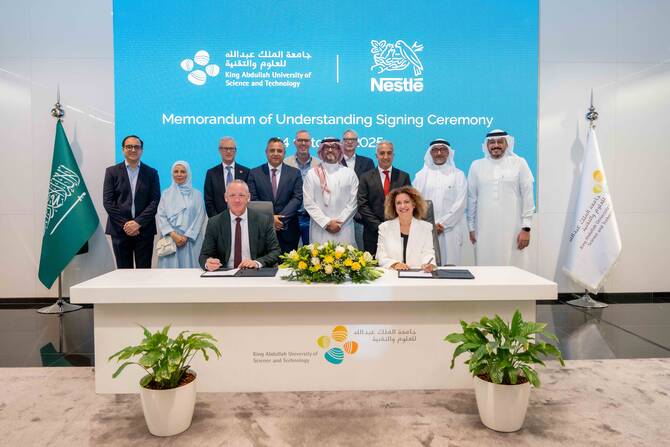
Nestlé Saudi Arabia has announced the signing of a strategic MoU with King Abdullah University of Science and Technology, in the presence of high-level officials from the Ministry of Investment, Nestlé and KAUST. The agreement marks a significant step toward establishing a joint framework for collaboration in the fields of packaging, agriculture, and food technology. 

The signing ceremony was attended by Yasser Abdul Malak, chairman and chief executive of Nestlé Middle East and North Africa; Robert Helou, chief executive of Nestlé Saudi Arabia; and Dr. Ian Campbell, senior vice president of the National Transformation Institute at KAUST. The partnership seeks to develop innovative and sustainable solutions that enhance public health, strengthen food safety standards, and support national efforts to localize knowledge and foster innovation within the food ecosystem. 

The collaboration focuses on advanced research in food and nutrition sciences, aiming to develop solutions that promote healthy lifestyles and environmental sustainability, leveraging KAUST’s world-class research ecosystem — which includes scientists from more than 120 nationalities — and Nestlé’s global expertise in food technology. 

The agreement reflects Nestlé’s long-term commitment to investment in the Kingdom. In November 2022, the company signed an agreement with the Ministry of Investment to invest SR7 billion ($1.86 billion) over 10 years, covering the establishment of an advanced manufacturing facility and the launch of various research and development projects. 

Commenting on the importance of the agreement, Helou said: “This partnership builds on Nestlé’s long-standing investment in Saudi Arabia and contributes to improving quality of life and public health through research and solutions that support sustainable food supply chains and meet the evolving aspirations of the Saudi market, in alignment with the goals of Saudi Vision 2030.” 

Campbell added: “This agreement with Nestlé Saudi Arabia marks an important step in advancing national priorities through science and innovation. By combining King Abdullah University of Science and Technology’s research expertise with Nestlé’s industrial leadership, we aim to deliver solutions in food, health, and agriculture that improve quality of life and promote sustainable development. This partnership also reflects our shared commitment to supporting Saudi Vision 2030 through empowering national talent, enhancing food security, and driving long-term economic value.” 

Dr. Rania Abou Samra, head of research and development and innovation at Nestlé Middle East and North Africa, said: “At Nestlé, we believe that innovation in food technology is the key to achieving a healthier and more sustainable food future. Our collaboration with King Abdullah University of Science and Technology opens new horizons for developing modern technologies that meet consumer needs and contribute to the well-being of society.” 

The MoU aligns with the objectives of Saudi Vision 2030, addressing scientific challenges in food and health, supporting local agricultural production, improving crop efficiency, and contributing to the development of a knowledge-based economy that enhances quality of life.

Both parties affirmed that this partnership reflects a shared understanding of the importance of combining investment, scientific research, and innovation — translating into tangible projects that support sustainable development and place human health at the core of their priorities. 


Preventive care: rethinking everyday health in Saudi Arabia

Updated 10 December 2025
Follow

Preventive care: rethinking everyday health in Saudi Arabia

In Saudi Arabia, a quiet revolution is reshaping the way people think about health. It is not happening in operating rooms or emergency wards — it is unfolding in homes, schools, and communities. It is imperative we ask ourselves: what if health began long before the doctor’s visit? What if the most powerful interventions were the ones we made every day — at home, at school and in our communities?

This philosophy is at the heart of Haleon’s work in Saudi Arabia, where the consumer healthcare company is helping redefine what it means to be healthy. It is not just about curing illness; it is about preventing it. It is not just about access; it is about empowerment. And it is not just about innovation; it is about inclusion.

Prevention as a national imperative

Saudi Arabia’s Vision 2030 and its Health Sector Transformation Program have placed preventive care at the center of the national strategy. This is not just policy — it is a paradigm shift. From chronic disease management to oral hygiene education, the Kingdom is investing in initiatives that help people stay healthy, not just get treated.

This shift is especially critical in a region where lifestyle-related conditions like diabetes, heart disease, and obesity are on the rise. By promoting healthier habits and early intervention, Saudi Arabia is not only improving individual outcomes, it is reducing long-term strain on hospitals and clinics.

From awareness to action

Health literacy remains one of the most overlooked barriers to better outcomes in the pursuit toward preventive health, with low health literacy associated with 2.8 times higher health costs per person. By focusing on everyday habits, Haleon is shifting the narrative from reactive care to proactive wellness.

Darśana Nair, general manager of Haleon Saudi Arabia, said: “When people understand their health, they’re empowered to protect it.”

This belief drives Haleon’s broader investment in wellness, including its Pain Management Institute, a resource hub for both professionals and patients navigating chronic pain. With 70 percent of its Saudi business dedicated to over-the-counter products, Haleon is championing accessible, preventive care that meets people where they are.

Inclusivity as a strategy

Haleon’s commitment to health equity is evident in its outreach; the company ensures that no community is left behind. Arabic-language materials and culturally tailored programs make health information more relevant and actionable, breaking down barriers and building trust.

Global roots, local impact

Headquartered in Jeddah, Haleon has built a workforce that is nearly 50 percent Saudi nationals and invested in local manufacturing, including the production of Panadol in the Kingdom. This localization strategy strengthens supply chains, supports job creation, and aligns with Saudi Arabia’s broader goals for industrial growth and economic resilience.

“Our collaboration with the Ministry of Investment to localize Panadol manufacturing is just one example of how we support job creation, industrial growth, and supply chain resilience,” said Nair. “By promoting prevention and self-care, we also help reduce the long-term burden on hospitals and make the healthcare system more sustainable for everyone.”

A new era of everyday health

Haleon’s work in Saudi Arabia is more than corporate strategy — it is a vision for the future. “We believe that better everyday health is possible for everyone,” Nair said. “Working alongside our partners and communities, we are proud to support Saudi Arabia’s vision for the future.”

  • The writer, Darsana Nair, is general manager at Haleon.