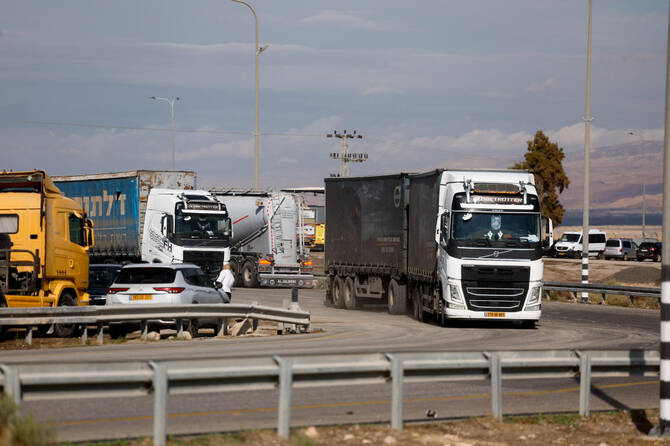
JERUSALEM: Israel reopened the only crossing on the border it controls between Jordan and the occupied West Bank on Wednesday to aid trucks for Gaza after nearly three months of closure, Israeli and Palestinian officials told AFP.
Israel closed the crossing after a Jordanian truck driver shot dead an Israeli soldier and a reserve officer at the border in September.
The crossing in the Jordan Valley reopened to travelers a few days later, but not to humanitarian aid destined for the Gaza Strip, which has been devastated by more than two years of war.
“The Allenby crossing was open today and trucks are going from the Allenby crossing to Gaza,” said a spokesperson for COGAT, the Israeli defense ministry body that oversees civilian affairs in the Palestinian Territories.
A Palestinian official speaking on condition of anonymity confirmed that the crossing had been opened.
On Tuesday 96 trucks carrying materials for the production of cement were allowed to pass through the crossing, the official said.
On Wednesday a further 20 trucks of humanitarian aid entered, and on Thursday sand was expected to be allowed in for the construction sector, the official added.
Since the crossing’s closure, Jordan said it had been able to send some aid to Gaza via the Sheikh Hussein crossing, located north of the occupied West Bank.
On Tuesday, an Israeli official said the transfer of goods and aid from Jordan through Allenby was about to resume after a government directive.
“All aid trucks destined for the Gaza Strip will proceed under escort and security, following a thorough security inspection,” the official said.
The Allenby crossing is the only international gateway for Palestinians from the West Bank that does not require entering Israel, which has occupied the territory since 1967.


![]()

Israel reopens West Bank-Jordan crossing for Gaza aid
Short Url
https://arab.news/nc4t4
Israel reopens West Bank-Jordan crossing for Gaza aid
- Israel closed the Allenby crossing to aid destined for the Gaza strip in September
- Palestinian official says 96 trucks carrying cement meterials were allowed to pass through on Tuesday


Latest updates




Recommended


© 2026 SAUDI RESEARCH & PUBLISHING COMPANY, All Rights Reserved And subject to Terms of Use Agreement.