

Palestinian Authority condemns Hamas for ‘heinous’ executions in Gaza

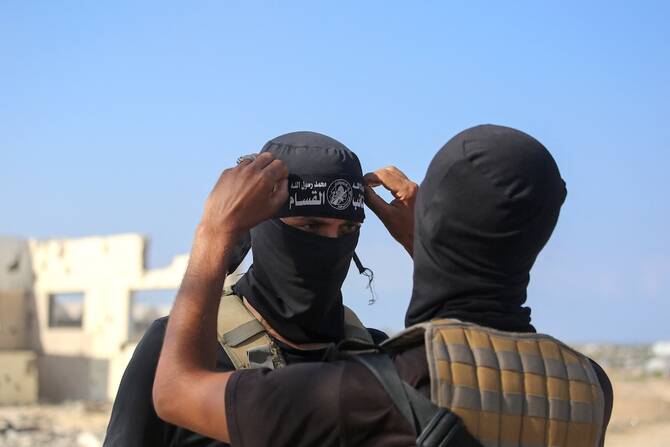
Fighters of the Ezzedine Al-Qassam Brigades, the armed wing of Hamas movement, at Deir El-Balah in the central Gaza Strip on Oct. 13, 2025. (AFP)
Short Url
Updated 15 October 2025
Follow

Palestinian Authority condemns Hamas for ‘heinous’ executions in Gaza

  • Says the actions of the group undermine efforts to unify Palestinian institutions under one legitimate authority
  • Authority calls for an end to such violations, for the protection of unarmed citizens, and for those involved in killings to be held accountable

LONDON: The Palestinian Authority has condemned extrajudicial killings and field executions of Palestinians carried out by Hamas gunmen in Gaza, which have claimed the lives of at least 32 people since Friday.

The Palestinian presidency said the killings, carried out by Hamas without fair trials, were “heinous crimes that are utterly rejected under any pretext.”

It continued: “These acts constitute a crime and a blatant violation of human rights, representing a grave breach of the rule of law and reflecting the movement’s determination to impose its authority through force and terror, at a time when the people in Gaza are enduring the hardships of war, destruction and siege.”

The Palestinian Authority said that such actions undermine efforts to unify Palestinian institutions under one legitimate authority and rule of law. It called for an end to the violations, for protection of unarmed citizens, and for those involved in the killings to be held accountable.

The presidency said it holds Hamas fully responsible for “these crimes that harm the supreme interests of the Palestinian people,” the Palestinian Wafa news agency reported.

The attempt by Hamas to reassert its control over Gaza, as Palestinians begin to return to their homes following the ceasefire agreement between Hamas and Israel, provides “pretexts to the (Israeli) occupation, obstructs reconstruction, deepens division, and hinders the establishment of a free and independent State of Palestine,” the authority added.

Hamas has been weakened by two years of war in Gaza, the assassinations of top officials by Israel, Israeli military operations against the group’s allies in Lebanon and Iran, and the fall of the Assad regime in Syria.

Facing increasing opposition and internal challenges from other Palestinian groups in Gaza, Hamas has attempted to reassert its authority since the US-brokered ceasefire came into effect last week by cracking down on dissent, resulting in the deaths of dozens of its opponents.

US President Donald Trump seemed to imply in comments to the press on Monday that the US had approved a “limited role” for Hamas in policing Gaza during the initial stages of the ceasefire.

However, the 20-point US peace plan that led to the truce states that Hamas must disarm and will play no future role in governing Gaza. And on Tuesday, Trump said that the group would be forced to disarm in a “reasonable period of time,” and if it did not, “we will disarm them and it will happen quickly and perhaps violently.”


Israel police to deploy around Al-Aqsa for Ramadan, Palestinians report curbs

Updated 17 February 2026
Follow

Israel police to deploy around Al-Aqsa for Ramadan, Palestinians report curbs

  • The Al-Aqsa compound is a central symbol of Palestinian identity and also a frequent flashpoint

JERUSALEM: Israeli police said Monday that they would deploy in force around the Al-Aqsa Mosque during the Muslim holy month of Ramadan, which begins this week, as Palestinian officials accused Israel of imposing restrictions at the compound.
Over the course of the month of fasting and prayer, hundreds of thousands of Palestinians traditionally attend prayers at Al-Aqsa — Islam’s third-holiest site, located in east Jerusalem, which Israel captured in 1967 and later annexed.
Arad Braverman, a senior Jerusalem police officer, said forces would be deployed “day and night” across the compound, known to Jews as the Temple Mount, and in the surrounding area.
He said thousands of police would also be on duty for Friday prayers, which draw the largest crowds of Muslim worshippers.
Braverman said police had recommended issuing 10,000 permits for Palestinians from the occupied West Bank, who require special permission to enter Jerusalem.
He did not say whether age limits would apply, adding that the final number of people would be decided by the government.
The Palestinian Jerusalem Governorate said in a separate statement it had been informed that permits would again be restricted to men over 55 and women over 50, mirroring last year’s criteria.
It said Israeli authorities had blocked the Islamic Waqf — the Jordanian?run body administering the site — from carrying out routine preparations, including installing shade structures and setting up temporary medical clinics.
A Waqf source confirmed the restrictions and said 33 of its employees had been barred from entering the compound in the week before Ramadan.
The Al-Aqsa compound is a central symbol of Palestinian identity and also a frequent flashpoint.
Under long?standing arrangements, Jews may visit the compound — which they revere as the site of their second temple, destroyed by the Romans in 70 AD — but they are not permitted to pray there.
Israel says it is committed to maintaining this status quo, though Palestinians fear it is being eroded.
Braverman reiterated Monday that no changes were planned.
In recent years, a growing number of Jewish ultranationalists have challenged the prayer ban, including far?right politician Itamar Ben-Gvir, who prayed at the site while serving as national security minister in 2024 and 2025.