

Pakistan briefs envoys on Afghan border clashes, vows to defend sovereignty

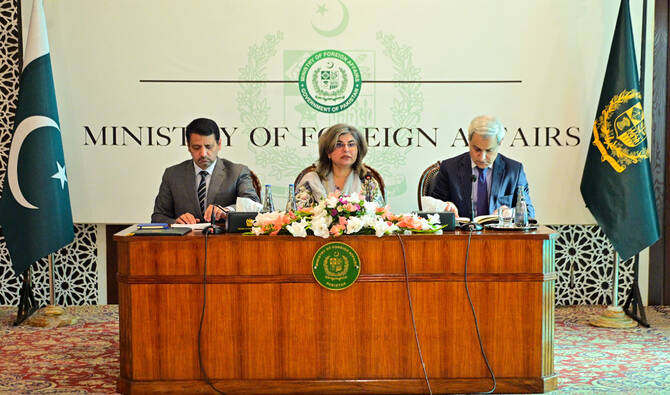
Pakistan’s Foreign Secretary, Ambassador Amna Baloch (center), speaks during a briefing on the recent developments along the Pak-Afghan border to resident ambassadors in Islamabad on October 13, 2025. (MOFA)
Short Url
Updated 14 October 2025
Follow

Pakistan briefs envoys on Afghan border clashes, vows to defend sovereignty

  • Islamabad has long accused Afghanistan of allowing cross-border militants attacks
  • Last week, Pakistan military vowed to do ‘whatever is necessary’ to defend its borders

ISLAMABAD: A leading Pakistani diplomat briefed foreign envoys in Islamabad on the recent escalation of hostilities along the Pakistan-Afghanistan border, highlighting the country’s “legitimate security concerns” and its resolve to protect its territorial integrity, the foreign office said in a statement on Tuesday.

The fighting began late Saturday when Afghan forces struck multiple Pakistani military posts. Kabul claimed to have killed 58 Pakistani soldiers in response to what it described as repeated violations of Afghan territory and airspace. Pakistan’s military gave different figures, saying it lost 23 soldiers and killed more than 200 “Taliban and affiliated terrorists” during retaliatory fire along the frontier.

Foreign Secretary Ambassador Amna Baloch gave a comprehensive briefing to resident ambassadors in Islamabad on the recent developments along the Pak-Afghan border, according to an official statement.

“She underscored Pakistan’s legitimate security concerns and its unwavering resolve to protect its territorial integrity and national security,” the Foreign Office said.

Pakistan has long accused Afghanistan of allowing militants affiliated with the Tehreek-e-Taliban Pakistan (TTP) and theBaloch Liberation Army (BLA) to use its soil to launch attacks against Pakistani civilians and security forces.

Kabul denies the allegations, blaming Islamabad for failing to manage its internal security.

Last week, Pakistan’s military vowed to do “whatever is necessary” to defend its borders after Kabul accused Islamabad of violating Afghan airspace and bombing a border town.

The recent border clashes have also disrupted bilateral trade between the two countries, leaving thousands of traders stranded and goods worth millions of dollars stuck at key crossings.

Foreign governments, including Saudi Arabia, China and Russia, have expressed concern over the fighting and urged both sides to exercise restraint as an informal ceasefire appeared to be holding.


ADB approves $381 million for climate-resilient agriculture, social services in Punjab

Updated 8 sec ago
Follow

ADB approves $381 million for climate-resilient agriculture, social services in Punjab

  • Support will upgrade Punjab’s education and nursing systems, improving learning outcomes and health care capacity
  • Package includes $124 million for agriculture, $107 million for STEM schooling and $150 million for nursing reforms

KARACHI: The Asian Development Bank (ADB) said on Saturday it approved $381 million in financing for Pakistan’s Punjab province to modernize agriculture and strengthen education and health services, with a major focus on building climate resilience after monsoon floods this year caused widespread destruction across the country’s most populous province.

The package includes concessional loans and grants for farm mechanization, STEM education, and nursing sector reforms.

ADB said the investments are intended to help Punjab, home to more than half of Pakistan’s population and a key contributor to its economy, recover from climate shocks and transition toward more sustainable and resilient development.

“Investing in education, health, and agricultural mechanization will play a transformative role in driving the growth of Punjab, a vital pillar of Pakistan’s economy,” said ADB Country Director for Pakistan Emma Fan. “These strategic investments will modernize agriculture, enhance human capital, and significantly improve livelihoods for millions of people across Punjab.”

The bank approved $120 million in concessional loans and a $4 million grant for the Punjab Climate-Resilient and Low-Carbon Agriculture Mechanization Project, which will support 220,000 rural farm households.

The program aims to reduce climate vulnerability by shifting farmers toward modern, low-emission machinery, provide alternative livelihoods for agricultural workers and train 15,000 women in new skills. It will also introduce a financing model to help small farmers access advanced equipment.

Punjab produces most of Pakistan’s wheat, rice, and maize but still relies on outdated machinery, contributing to grain losses and routine burning of crop residues, a major source of air pollution, said ADB.

It noted the new project will promote modern mechanization, including rice harvesters, to address these issues.

ADB also approved $107 million for the Responsive, Ready, and Resilient STEM Secondary Education in Punjab Program, including a $7 million grant from the Asian Development Fund.

The results-based program aims to modernize secondary schooling by expanding inclusive STEM education, improving access and quality across the province.

A further $150 million concessional loan was approved for the Punjab Nursing and Health Workforce Reform Program, which will upgrade nursing curricula, develop disaster-resilient training facilities, strengthen workforce governance, and introduce digital human-resource systems.

The program seeks to expand the pool of qualified nurses to strengthen health service delivery and meet rising national and global demand.

Key components include the establishment of three centers of excellence in Lahore, Multan and Rawalpindi, equipped with simulation labs, digital learning platforms, and gender-responsive hostels.

ADB said it remains committed to supporting climate-resilient and inclusive development across Asia and the Pacific through innovative financing tools and partnerships.