

Israel army says four returned hostage bodies identified

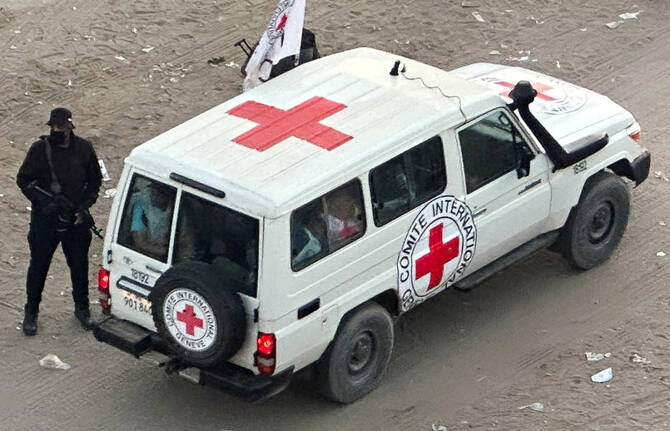
A Red Cross vehicle moves along a road before the expected release of hostages held in Gaza, Oct. 13, 2025. (REUTERS/Ramadan Abed)
Short Url
Updated 14 October 2025
Follow

Israel army says four returned hostage bodies identified

  • Hamas still holds the remains of 24 deceased hostages, which it has agreed to return to Israel

JERUSALEM: The Israeli military said Tuesday that the bodies of four hostages returned by Hamas have been identified, including that of a Nepalese student.

In a statement, the military named two of the victims as Guy Iluz, an Israeli national, and Bipin Joshi, an agriculture student from Nepal.

The names of the other two hostages have not yet been released at the request of their families, the statement added.

Iluz, who was 26 at the time of the attack, had been attending the Nova music festival when Hamas-led militants launched their assault on October 7, 2023.

He reportedly tried to flee the site in a jeep and later hid in a tree, from where he made his last contact with his parents before being captured and taken to the Gaza Strip.

The military said Iluz was injured and abducted alive by militants but later died of his injuries due to lack of medical treatment while in captivity.

It did not specify when he actually died, though his death was announced in December 2023.

Iluz had worked as a sound technician for famous Israeli musicians.

Joshi, who was 22 at the time of the attack, was part of a Nepalese agricultural training group that had arrived in Israel three weeks before the Hamas assault.

He was abducted from Kibbutz Alumim and was photographed sheltering with Thai workers shortly before militants reached the area.

“It is assessed that he was murdered in captivity during the first months of the war,” the military said.

‘We will not rest’

Joshi’s Nepalese friend Himanchal Kattel, the group’s only survivor, said that the attackers had thrown a grenade into the shelter, which Joshi caught and threw away before it exploded, saving Kattel’s life.

“The return of Guy and Bipin … brings some measure of comfort to families who have lived with agonizing uncertainty and doubt for over two years,” said the Hostages and Missing Families Forum, the main Israeli group campaigning for the release of all hostages.

“We will not rest until all 24 hostages are brought home,” it said in a statement.

The four bodies were returned by Hamas on Monday, following the release of all 20 surviving captives as part of a ceasefire deal brokered by US President Donald Trump.

Palestinian militants are still holding the bodies of 24 hostages, which are expected to be returned under the terms of the ceasefire agreement.


UN-sanctioned migrant smuggler killed in western Libya

A boat used by migrants is seen near the western town of Sabratha, Libya March 19, 2019. (REUTERS)
Updated 13 December 2025
Follow

UN-sanctioned migrant smuggler killed in western Libya

  • In June 2018, the UN Security Council imposed sanctions on Al-Dabbashi, along with another five Libyan traffickers

CAIRO: A notorious militia leader in Libya, sanctioned by the UN for migrant trafficking across the Mediterranean Sea, was killed on Friday in a raid by security forces in the west of the country, according to Libyan authorities.
Ahmed Oumar Al-Fitouri Al-Dabbashi, nicknamed Ammu, was killed in the western city of Sabratha when security forces raided his hideout. The raid came in response to an attack on a security outpost by Al-Dabbashi’s militia, which left six members of the security forces severely wounded, according to a statement issued by the Security Threat Enforcement Agency, a security entity affiliated with Libya’s western government.
Al-Dabbashi, who was also sanctioned by the US Treasury for trafficking, was the leader of a powerful militia, the “Brigade of the Martyr Anas Al-Dabbashi,” in Sabratha, the biggest launching point in Libya for Europe-bound African migrants.
Al-Dabbashi’s brother Saleh Al-Dabbashi, another alleged trafficker, was arrested in the same raid, added the statement.
In June 2018, the UN Security Council imposed sanctions on Al-Dabbashi, along with another five Libyan traffickers. At the time, the UN report said that there was enough evidence that Al-Dabbashi’s militia controlled departure areas for migrants, camps, safe houses and boats.
Al-Dabbashi himself exposed migrants, including children, to “fatal circumstances” on land and at sea, and of threatening peace and stability in Libya and neighboring countries, according to the same report.
Al-Dabbashi was also sanctioned by the US Treasury for the same reason.
Libya has been a main transit point for migrants fleeing war and poverty in Africa and the Middle East. The country was plunged into chaos following a NATO-backed uprising that toppled and killed longtime autocrat Muammar Qaddafi in 2011.
The country has been fragmented for years between rival administrations based in the east and the west of Libya, each backed by various armed militias and foreign governments.