


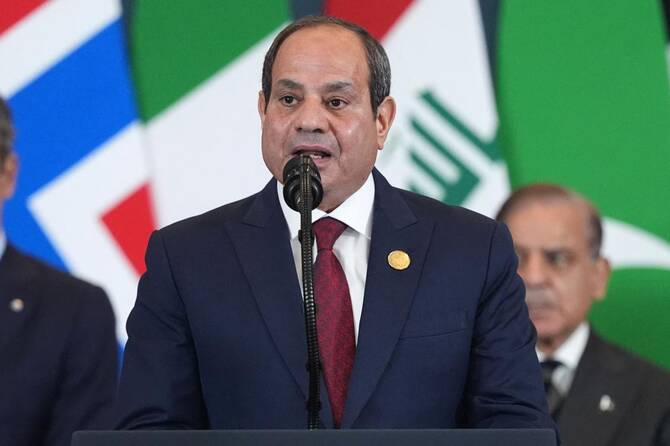

SHARM EL-SHEIKH: Egyptian President Abdel Fattah El-Sisi told a summit of world leaders Monday that US President Donald Trump’s Mideast proposal represents the “last chance” for peace in the region and reiterated his call for a two-state solution, saying Palestinians have the right to an independent state.
The summit in Egypt was aimed at supporting the ceasefire reached in Gaza, ending the Israel-Hamas war and developing a long-term vision to rebuild the devastated Palestinian territory.
Trump’s plan holds out the possibility of a Palestinian state, but only after a lengthy transition period in Gaza and a reform process by the internationally recognized Palestinian Authority. Israeli Prime Minister Benjamin Netanyahu opposes Palestinian independence.
In his speech, El-Sisi also also awarded Trump the Order of the Nile, the country’s highest civilian honor.
Israel and Hamas came under pressure from the United States, Arab countries and Turkiye to agree on the ceasefire’s first phase negotiated in Qatar through mediators. The truce began Friday.
But major questions remain over what happens next, raising the risk of a slide back into war. The gathering reflects the international will to follow through on the deal.
More than 20 world leaders attended the summit, including King Abdullah of Jordan, Turkish President Recep Tayyip Erdogan, Qatar’s Emir Sheikh Tamim bin Hamad Al Thani, the French president and the British prime minister.
Opinion
This section contains relevant reference points, placed in (Opinion field)
Israel and Hamas have no direct contacts and were not expected to attend. Israeli Prime Minister Benjamin Netanyahu will not travel to the meeting because of a Jewish holiday, his office said. Trump headed to Egypt after a stop in Israel.
World leaders lined up to have their photos taken with Trump ahead of the meeting. Trump smiled and gave a thumbs-up to photographers.
Israel has rejected any role in Gaza for the internationally backed Palestinian Authority, whose leader, Mahmoud Abbas, arrived in the Egyptian Red Sea resort town of Sharm El-Sheikh on Monday before the gathering.
The summit unfolded soon after Hamas released 20 remaining living Israeli hostages and Israel started to free hundreds of Palestinians from its prisons, crucial steps under the ceasefire.
A new page
El-Sisi’s office said the summit aimed to “end the war” in Gaza and “usher in a new page of peace and regional stability” in line with Trump’s vision.
Egyptian Air Force jets escorted Trump’s Air Force One for a spin above the resort before he landed and was received by El-Sisi at the airport.
Ahead of the meeting, Egyptian Foreign Minister Badr Abdelatty said it was critical that Israel and Hamas fully implement the first phase of the ceasefire deal so that the parties, with international backing, can begin negotiations on the second phase.
Abdelatty said the success of Trump’s vision for Mideast peace will depend on his continued commitment to the process, including applying pressure on the parties and deploying military forces as part of an international contingent expected to carry out peacekeeping duties in the next phase.
“We need American engagement, even deployment on the ground, to identify the mission, task and mandate of this force,” Abdelatty told The Associated Press.
Directly tackling the remaining issues in depth is unlikely at the gathering, which is supposed to last about two hours. El-Sisi and Trump are expected to issue a joint statement after it ends.
Under the first phase, Israeli troops pulled back from some parts of Gaza, allowing hundreds of thousands of Palestinians in Gaza to return home from areas they were forced to evacuate. Aid groups are preparing to bring in large quantities of aid kept out of the territory for months.
Critical challenges ahead
The next phase of the deal will have to tackle disarming Hamas, creating a post-war government for Gaza and handling the extent of Israel’s withdrawal from the territory. Trump’s plan also stipulates that regional and international partners will work to develop the core of a new Palestinian security force.
Abdelatty said the international force needs a UN Security Council resolution to endorse its deployment.
He said Hamas will have no role in the transitional period in Gaza. A 15-member committee of Palestinian technocrats, with no affiliation to any Palestinian factions and vetted by Israel, will govern day to day affairs in Gaza. The committee would receive support and supervision from a “Board of Peace” proposed by Trump to oversee the implementation of the phases of his plan, Abdelatty said.
“We are counting on Trump to keep the implementation of this plan for all its phases,” he told AP.
Another major issue is raising funds for rebuilding Gaza. The World Bank, and Egypt’s postwar plan, estimate reconstruction and recovery needs in Gaza at $53 billion. Egypt plans to host an early recovery and reconstruction conference for Gaza in November.
Roles for other countries
Turkiye, which hosted Hamas political leaders for years, played a key role in bringing about the ceasefire agreement.
Jordan, alongside Egypt, will train the new Palestinian security force.
Germany, one of Israel’s strongest international backers and top suppliers of military equipment, plans to be represented by Chancellor Friedrich Merz. He has expressed concern over Israel’s conduct of the war and its plan for a military takeover of Gaza.
British Prime Minister Keir Starmer, who also is attending, has he said will pledge 20 million British pounds ($27 million) to help provide water and sanitation for Gaza and that Britain will host a three-day conference on Gaza’s reconstruction and recovery.
Speaking in Egypt, Starmer said Britain was ready to “play its full part” in ensuring that the current ceasefire results in a lasting peace.
UN Secretary-General António Guterres, European Union President António Costa and Italian Prime Minister Giorgia Meloni also are attending.


