Pakistan PM invites UAE investment across tech and resource sectors at National Day event

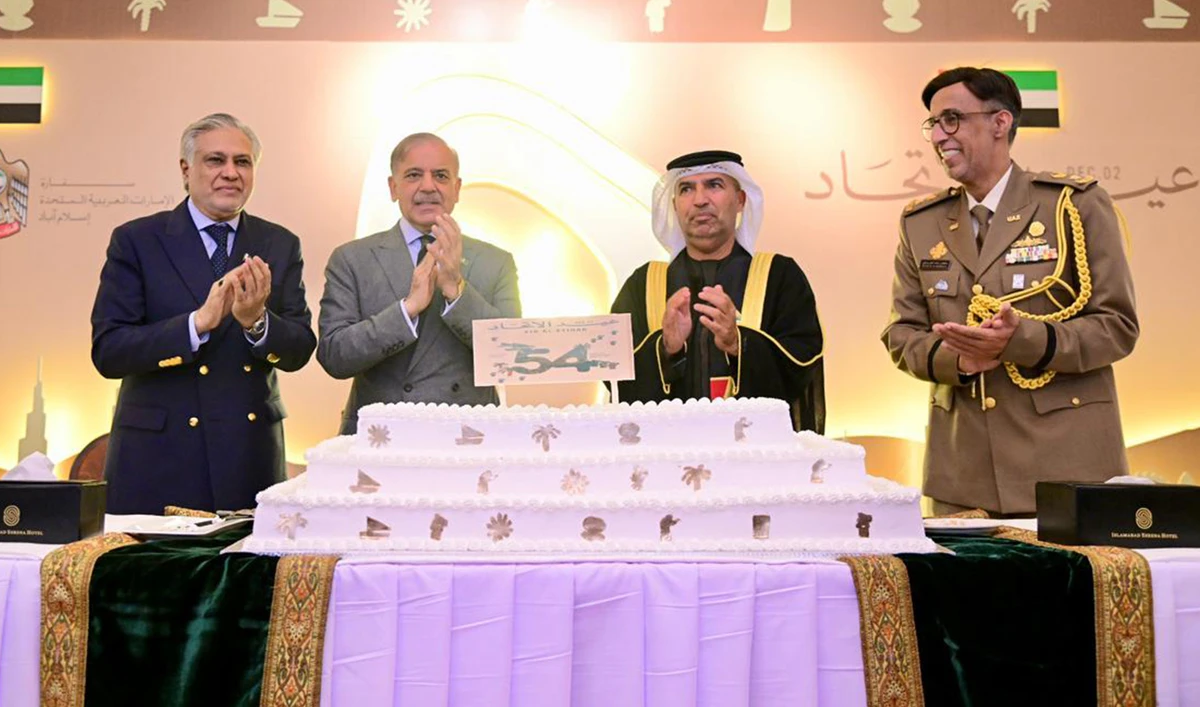
rime Minister Shehbaz Sharif cuts cake at a ceremony of the national day of the United Arab Emirates at the UAE embassy in Islamabad on December 8, 2025. (PMO)
Short Url
Updated 08 December 2025
Follow

Pakistan PM invites UAE investment across tech and resource sectors at National Day event

  • Shehbaz Sharif says the UAE remains a key economic partner and continues to lend ‘critical support’ to Pakistan
  • UAE envoy says both nations have potential for cooperation in renewable energy, AI and economic diversification

ISLAMABAD: Pakistan is ready to welcome investment from the United Arab Emirates across emerging technologies and resource sectors, Prime Minister Shehbaz Sharif said on Monday, as both countries marked the 54th National Day of the Gulf country in Islamabad.

Speaking at the ceremony attended by senior ministers, diplomats and business leaders, Sharif said the UAE remained a key economic partner for Pakistan and continued to lend “critical support” to the country’s stabilizing economy.

“Pakistan takes great pride in its strategic partnership with the UAE, which continues to deepen across every domain of life,” he said. “With Pakistan’s economy stabilizing, we stand ready to welcome Emirati investment in renewable energy, AI, fintech, agriculture and minerals.”

Sharif praised the UAE’s leadership and recalled his earliest memories of the Gulf nation as “a land that believed in possibilities long before they became realities,” saying the country’s progress under President Sheikh Mohamed bin Zayed Al Nahyan commanded “profound admiration.”

UAE Ambassador Salem Al Bawab Al Zaabi said the Emirates was committed to strengthening ties with Pakistan in areas including the economy, energy and artificial intelligence.

He said the two countries shared a “deep-rooted friendship built on mutual respect, shared values and a common vision for regional peace and development.”

“We see tremendous potential for collaboration in renewable energy, artificial intelligence, sustainability and economic diversification,” the ambassador said, adding that the UAE aimed to broaden the scope of its economic relations with Pakistan.

The UAE hosts around 1.8 million Pakistani expatriates, one of the country’s largest overseas communities, who Sharif said contributed “tirelessly” to the Gulf state’s development.

Sharif and Deputy Prime Minister Ishaq Dar also joined the UAE ambassador in a cake-cutting ceremony to mark the occasion.
Sindh assembly passes resolution rejecting move to separate Karachi

Updated 21 February 2026
Follow

Sindh assembly passes resolution rejecting move to separate Karachi

  • Chief Minister Shah cites constitutional safeguards against altering provincial boundaries
  • Calls to separate Karachi intensified amid governance concerns after a mall fire last month

ISLAMABAD: The provincial assembly of Pakistan’s southern Sindh province on Saturday passed a resolution rejecting any move to separate Karachi, declaring its territorial integrity “non-negotiable” amid political calls to carve the city out as a separate administrative unit.

The resolution comes after fresh demands by the Muttahida Qaumi Movement (MQM) and other voices to grant Karachi provincial or federal status following governance challenges highlighted by the deadly Gul Plaza fire earlier this year that killed 80 people.

Karachi, Pakistan’s largest and most densely populated city, is the country’s main commercial hub and contributes a significant share to the national economy.

Chief Minister Syed Murad Ali Shah tabled the resolution in the assembly, condemning what he described as “divisive statements” about breaking up Sindh or detaching Karachi.

“The province that played a foundational role in the creation of Pakistan cannot allow the fragmentation of its own historic homeland,” Shah told lawmakers, adding that any attempt to divide Sindh or separate Karachi was contrary to the constitution and democratic norms.

Citing Article 239 of Pakistan’s 1973 Constitution, which requires the consent of not less than two-thirds of a provincial assembly to alter provincial boundaries, Shah said any such move could not proceed without the assembly’s approval.

“If any such move is attempted, it is this Assembly — by a two-thirds majority — that will decide,” he said.

The resolution reaffirmed that Karachi would “forever remain” an integral part of Sindh and directed the provincial government to forward the motion to the president, prime minister and parliamentary leadership for record.

Shah said the resolution was not aimed at anyone but referred to the shifting stance of MQM in the debate while warning that opposing the resolution would amount to supporting the division of Sindh.

The party has been a major political force in Karachi with a significant vote bank in the city and has frequently criticized Shah’s provincial administration over its governance of Pakistan’s largest metropolis.

Taha Ahmed Khan, a senior MQM leader, acknowledged that his party had “presented its demand openly on television channels with clear and logical arguments” to separate Karachi from Sindh.

“It is a purely constitutional debate,” he told Arab News by phone. “We are aware that the Pakistan Peoples Party, which rules the province, holds a two-thirds majority and that a new province cannot be created at this stage. But that does not mean new provinces can never be formed.”

Calls to alter Karachi’s status have periodically surfaced amid longstanding complaints over governance, infrastructure and administrative control in the megacity, though no formal proposal to redraw provincial boundaries has been introduced at the federal level.