ANKARA: Top diplomats from Turkiye and Iraq reached a tentative agreement Friday on sharing water and managing dwindling flows through the Tigris and Euphrates rivers as the region faces worsening drought conditions.
Iraqi Foreign Minister Fuad Hussein told a joint news conference that the draft “framework” agreement on water management between the two neighbors would soon be signed in Iraq.
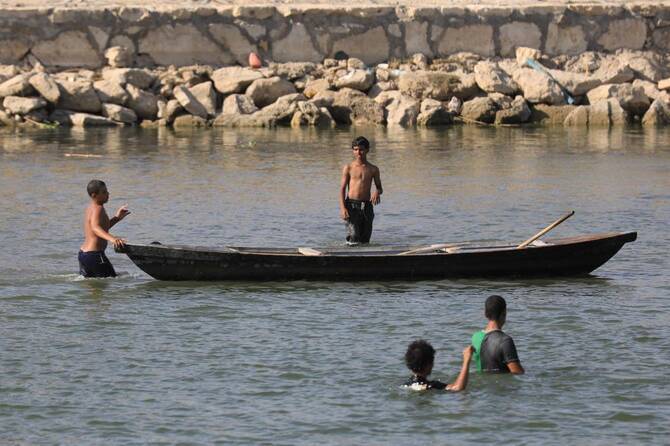
Iraqi officials have long complained that dams built by Turkiye are reducing Iraq’s water supply. The Tigris and Euphrates Rivers, which provide most of Iraq’s fresh water, originate in Turkiye. Experts fear that climate change could exacerbate water shortages in Iraq.
“We know and understand the difficulties you are experiencing. We are brothers and sisters in this region,” Turkish Foreign Minister Hakan Fidan said, insisting that Turkiye was actively engaged in helping Iraq address the water situation. “The waters of the Euphrates and Tigris (rivers) belong to all of us.”
Fidan said he hoped water rehabilitation projects would be swiftly implemented. “This water shortage will continue to be a problem not only today but also for years to come,” he said.
The two countries recently have improved relations that were often strained over Turkish military incursions into northern Iraq for operations against the Kurdistan Workers’ Party, or PKK, which Turkiye considers a terrorist group. Baghdad frequently condemned the incursions as a violation of its sovereignty, while Ankara accused Iraq of not doing enough to fight the PKK.
On Thursday, Turkiye lifted its flight ban on an airport in Iraq’s semiautonomous Kurdish region, a restriction originally imposed in 2023 due to concerns over alleged PKK activity in the area.
Last month, Iraq resumed exporting oil from the semiautonomous Kurdish region through Turkiye’s Ceyhan port after exports had been halted for more than two years.
The decision to resume flights to Sulaymaniyah International Airport was announced by the office of Nechirvan Barzani, president of the Kurdish Region, late Thursday following a meeting in Ankara with Turkish President Recep Tayyip Erdogan.
Erdogan and Barzani discussed Turkiye’s relations with Iraq and the Kurdish region, as well as opportunities for cooperation and regional developments, according to a statement from Erdogan’s office.
The PKK, designated a terrorist organization by Turkiye, the United States, and the European Union, has led a decades-long insurgency in Turkiye that has extended into Iraq and Syria, resulting in tens of thousands of deaths.
Earlier this year, the PKK agreed to disband and renounce armed conflict as part of a new peace initiative with Turkiye. A symbolic disarmament ceremony was held near Sulaymaniyah in July.
In a statement, the Kurdistan Region Presidency welcomed Turkiye’s decision to resume flights, calling it a reflection of the strong ties between the two sides and a move that would deepen mutual cooperation.
Turkish Airlines also confirmed the resumption of flights.
“As the flag carrier, we continue to proudly represent Turkiye in the skies across the globe. In line with this vision, we are delighted to soon reconnect our Sulaymaniyah route with the skies once again,” the company’s spokesperson, Yahya Ustun, said on social media.

Turkiye and Iraq reach draft agreement on sharing water as drought worsens
https://arab.news/pr5fx
Turkiye and Iraq reach draft agreement on sharing water as drought worsens
- Iraqi officials have long complained that dams built by Turkiye are reducing Iraq’s water supply
- The Tigris and Euphrates Rivers, which provide most of Iraq’s fresh water, originate in Turkiye
Israeli strikes kill 3 people in Gaza, hospital says
- Shifa Hospital reported the deaths amid the months-old ceasefire that has seen continued fighting
DEIR AL-BALAH: Israeli military strikes on Monday killed three people west of Gaza City, according to the hospital where the casualties arrived.
Shifa Hospital reported the deaths amid the months-old ceasefire that has seen continued fighting. The Israeli army said Monday it is striking targets in response to Israeli troops coming under fire in the southern city of Rafah, which it says was a violation of the ceasefire. The army said it is striking targets “in a precise manner.”
The four-month-old U.S-backed ceasefire followed stalled negotiations and included Israel and Hamas accepting a 20-point plan proposed by US President Donald Trump aimed at ending the war unleashed by Hamas’ Oct. 7, 2023, attack into Israel. At the time, Trump said it would lead to a “Strong, Durable, and Everlasting Peace.”
Hamas freed all the living hostages it still held at the outset of the deal in exchange for thousands of Palestinian prisoners held by Israel and the remains of others.
But the larger issues the agreement sought to address, including the future governance of the strip, were met with reservations, and the US offered no firm timeline.
Top UN official concerned over Israel’s West Bank decision
The United Nations top official on Monday expressed concern about the Israeli security cabinet’s decision to deepen the country’s control over the occupied West Bank.
Secretary-General Antonio Guterres is “gravely concerned” and warned that the Israeli decision could erode the prospect of a two-state solution, spokesperson Stéphane Dujarric said in a statement.
“Such actions, including Israel’s continued presence in the Occupied Palestinian Territory are not only destabilizing but – as recalled by the International Court of Justice – unlawful,” he said.
Israel ‘s security cabinet on Sunday approved measures that aim to deepen Israeli control over the occupied West Bank and weaken the already limited powers of the Palestinian Authority.
Israel’s far-right Finance Minister Bezalel Smotrich said the measures would make it easier for Jewish settlers to force Palestinians to give up land, adding that “we will continue to bury the idea of a Palestinian state.”
Israel captured the West Bank, as well as Gaza and east Jerusalem, in the 1967 Mideast war. The Palestinians want all three territories for a future state.
Rafah crossing improving, official says
The Palestinian official set to oversee day-to-day affairs in Gaza said on Monday that passage through the Rafah crossing with Egypt is starting to improve after a chaotic first week of reopening marked by confusion, delays and a limited number of crossings.
Ali Shaath, head of the National Committee for the Administration of Gaza, told Egypt’s Al-Qahera News that operations at the crossing were improving on Sunday. He said 88 Palestinians were scheduled to travel through Rafah on Monday, more than have crossed in the initial days since reopening. Israel did not immediately confirm the figures.
The European Union border mission at the crossing said in a statement Sunday that 284 Palestinians had crossed since reopening. Travelers included people returning after having fled the war and medical evacuees and their escorts. In total, 53 medical evacuees departed during the first five days of operations.
That remains well below the agreed target of 50 medical evacuees exiting and 50 returnees entering daily, negotiated by Israeli, Egyptian, Palestinian and international officials.
Shaath and other members of the committee remain in Egypt, without Israeli authorization to enter the war-battered enclave.
The Rafah crossing opened last week for the first time since mid-2024, one of the main requirements for the ceasefire between Israel and Hamas. It was closed Friday and Saturday because of confusion around operations.
Palestinian officials say nearly 20,000 people are seeking to leave Gaza for medical care unavailable in its largely destroyed health system.
Palestinians who returned to Gaza in the first days after the crossing reopened described hourslong delays and invasive searches by Israeli authorities and an Israeli-backed Palestinian armed group, Abu Shabab. Israel denied mistreatment.
Gaza’s Health Ministry said on Monday that five people were killed over the previous 24 hours, bringing the death toll to 581 since the October ceasefire. The truce led to the return of the remaining hostages — both living captives and bodies — from the 251 abducted during the Oct. 7, 2023, attack that triggered the war.
Hamas-led militants killed around 1,200 people, mostly civilians, in the attack. Israel’s military offensive has since killed over 72,000 Palestinians, according to the ministry, which operates under the Hamas-run government and is staffed by medical professionals. The UN and independent experts consider it the most reliable source on war casualties.