DEIR AL-BALAH: Israeli military strikes on Monday killed three people west of Gaza City, according to the hospital where the casualties arrived.
Shifa Hospital reported the deaths amid the months-old ceasefire that has seen continued fighting. The Israeli army said Monday it is striking targets in response to Israeli troops coming under fire in the southern city of Rafah, which it says was a violation of the ceasefire. The army said it is striking targets “in a precise manner.”
The four-month-old U.S-backed ceasefire followed stalled negotiations and included Israel and Hamas accepting a 20-point plan proposed by US President Donald Trump aimed at ending the war unleashed by Hamas’ Oct. 7, 2023, attack into Israel. At the time, Trump said it would lead to a “Strong, Durable, and Everlasting Peace.”
Hamas freed all the living hostages it still held at the outset of the deal in exchange for thousands of Palestinian prisoners held by Israel and the remains of others.
But the larger issues the agreement sought to address, including the future governance of the strip, were met with reservations, and the US offered no firm timeline.
Top UN official concerned over Israel’s West Bank decision
The United Nations top official on Monday expressed concern about the Israeli security cabinet’s decision to deepen the country’s control over the occupied West Bank.
Secretary-General Antonio Guterres is “gravely concerned” and warned that the Israeli decision could erode the prospect of a two-state solution, spokesperson Stéphane Dujarric said in a statement.
“Such actions, including Israel’s continued presence in the Occupied Palestinian Territory are not only destabilizing but – as recalled by the International Court of Justice – unlawful,” he said.
Israel ‘s security cabinet on Sunday approved measures that aim to deepen Israeli control over the occupied West Bank and weaken the already limited powers of the Palestinian Authority.
Israel’s far-right Finance Minister Bezalel Smotrich said the measures would make it easier for Jewish settlers to force Palestinians to give up land, adding that “we will continue to bury the idea of a Palestinian state.”
Israel captured the West Bank, as well as Gaza and east Jerusalem, in the 1967 Mideast war. The Palestinians want all three territories for a future state.
Rafah crossing improving, official says
The Palestinian official set to oversee day-to-day affairs in Gaza said on Monday that passage through the Rafah crossing with Egypt is starting to improve after a chaotic first week of reopening marked by confusion, delays and a limited number of crossings.
Ali Shaath, head of the National Committee for the Administration of Gaza, told Egypt’s Al-Qahera News that operations at the crossing were improving on Sunday. He said 88 Palestinians were scheduled to travel through Rafah on Monday, more than have crossed in the initial days since reopening. Israel did not immediately confirm the figures.
The European Union border mission at the crossing said in a statement Sunday that 284 Palestinians had crossed since reopening. Travelers included people returning after having fled the war and medical evacuees and their escorts. In total, 53 medical evacuees departed during the first five days of operations.
That remains well below the agreed target of 50 medical evacuees exiting and 50 returnees entering daily, negotiated by Israeli, Egyptian, Palestinian and international officials.
Shaath and other members of the committee remain in Egypt, without Israeli authorization to enter the war-battered enclave.
The Rafah crossing opened last week for the first time since mid-2024, one of the main requirements for the ceasefire between Israel and Hamas. It was closed Friday and Saturday because of confusion around operations.
Palestinian officials say nearly 20,000 people are seeking to leave Gaza for medical care unavailable in its largely destroyed health system.
Palestinians who returned to Gaza in the first days after the crossing reopened described hourslong delays and invasive searches by Israeli authorities and an Israeli-backed Palestinian armed group, Abu Shabab. Israel denied mistreatment.
Gaza’s Health Ministry said on Monday that five people were killed over the previous 24 hours, bringing the death toll to 581 since the October ceasefire. The truce led to the return of the remaining hostages — both living captives and bodies — from the 251 abducted during the Oct. 7, 2023, attack that triggered the war.
Hamas-led militants killed around 1,200 people, mostly civilians, in the attack. Israel’s military offensive has since killed over 72,000 Palestinians, according to the ministry, which operates under the Hamas-run government and is staffed by medical professionals. The UN and independent experts consider it the most reliable source on war casualties.

Israeli strikes kill 3 people in Gaza, hospital says
Short Url
https://arab.news/npxj2
Israeli strikes kill 3 people in Gaza, hospital says
- Shifa Hospital reported the deaths amid the months-old ceasefire that has seen continued fighting
Israeli settlers kill 19-year-old Palestinian-American, officials and witnesses say
MUKHMAS, WEST BANK: Israeli settlers in the occupied West Bank shot and killed a Palestinian-American during an attack on a village, the Palestinian Health Ministry and a witness said Thursday.
Raed Abu Ali, a resident of Mukhmas, said a group of settlers came to the village Wednesday afternoon where they attacked a farmer, prompting clashes after residents intervened. Israeli forces later arrived, and during the violence armed settlers killed 19-year-old Nasrallah Abu Siyam and injured several others.
Abu Ali said that the army shot tear gas, sound grenades and live ammunition. Israel’s military acknowledged using what it called “riot dispersal methods” after receiving reports of Palestinians throwing rocks but denied that its forces fired during the clashes.
“When the settlers saw the army, they were encouraged and started shooting live bullets,” Abu Ali said. He added that they clubbed those injured with sticks after they had fallen to the ground.
The Palestinian Ministry of Health confirmed Abu Siyam’s death from critical wounds sustained Wednesday afternoon near the village east of Ramallah.
Abu Siyam’s killing is the latest in a surge in violence in the occupied West Bank. Israeli forces and settlers killed 240 Palestinians last year, according to the United Nations Office for the Coordination of Humanitarian Affairs. Palestinians killed 17 Israelis over the same period, six of whom were soldiers. The Palestinian Authority’s Wall and Settlement Resistance Commission said Abu Siyam was the first Palestinian killed by settlers in 2026.
Mukhmas and its surrounding area — most of which lies under Israeli civil and military administration — have become a hot spot for settler attacks, including arson and assaults, as well as the construction of outposts that Israeli law considers illegal.
The Israeli military said late Wednesday that unnamed suspects shot at Palestinians, who were later evacuated for medical treatment. It did not say whether any were arrested.
Abu Siyam’s mother told The Associated Press that he was an American citizen, making him the second Palestinian-American to be killed by Israeli settlers in less than a year.
A US embassy spokesperson said they “condemn this violence.”
Palestinians and rights groups say authorities routinely fail to prosecute settlers or hold them accountable for violence.
UN says Israel’s acts in West Bank may be ethnic cleansing
The UN human rights office on Thursday accused Israel of war crimes and said practices that displace Palestinians and alter the demographic composition of the occupied West Bank “raise concerns over ethnic cleansing.”
The Office of the High Commissioner for Human Rights, citing findings collected November 2024 to October 2025, said Israel was engaged in “concerted and accelerating effort to consolidate annexation” while maintaining a system “to maintain oppression and domination of Palestinians.”
Residents of Palestinian villages and herding communities have been increasingly displaced as Israeli settlements and outposts expand. Since the start of the Israel–Hamas war, the Israeli rights group B’Tselem says about 45 Palestinian communities have been emptied out completely amid Israeli demolition orders and settler attacks.
Additionally, the office said Israeli military operations in the northern West Bank “employed means and methods designed for warfare” including lethal airstrikes and forcibly transferring civilians from their homes. It also said Israel “forbade” residents from returning to their homes in northern West Bank refugee camps. The operation, which Israel said was aimed against militants, displaced tens of thousands of Palestinians.
The report also accused Palestinian security forces of using unnecessary lethal force in the same areas, killing at least eight people, and noted that the Palestinian Authority had engaged in “intimidation, detention and ill-treatment of journalists, human rights defenders and other individuals deemed critical of its rule.”
Neither Israel’s Foreign Ministry nor the Palestinian Authority responded to requests for comment. Israel has repeatedly accused the UN rights office of anti-Israel bias.
Last year, the UN human rights monitor warned of what it called “an unfolding genocide in Gaza” with “conditions of life increasingly incompatible with (Palestinians’) continued existence.” Their report on Thursday also warned of demographic shifts in Gaza raising concerns of ethnic cleansing.
Report finds imprisoned Palestinian journalists were tortured
The Committee to Protect Journalists said that dozens of Palestinian journalists who were detained in Israel during the war in Gaza experienced conditions including physical assaults, forced stress positions, sensory deprivation, sexual violence and medical neglect.
CPJ documented the detention of at least 94 Palestinian journalists and one media worker during the war, from the West Bank, Gaza and Israel Thirty are still in custody, CPJ said.
Half of the journalists, the report found, were never charged with a crime and were held under Israel’s administrative detention system, which allows for suspects deemed security risks to be held for six months and can be renewed indefinitely.
Israel’s prison services did not immediately respond to a request for comment about the report, but rejected a similar report in January about conditions for Palestinian prisoners as “false allegations,” contending it operates lawfully, is subject to oversight and reviews complaints.
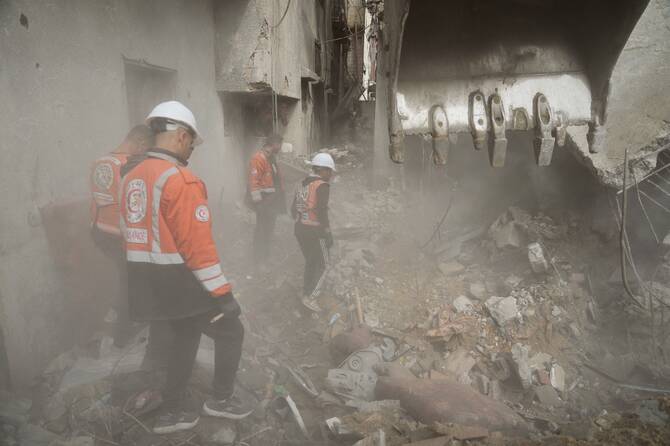
UN development chief says removing Gaza rubble will take 7 years
The vast destruction across Gaza will take at least seven years just to remove the rubble, according to the United Nations Development Program.
Alexander De Croo, the former Belgian prime minister who just returned from Gaza, said that the UNDP had removed just 0.5 percent of the rubble and people in Gaza are experiencing “the worst living conditions that I have ever seen.”
De Croo said 90 percent of Gaza’s 2.2 million people live in “very, very rudimentary tents” in the middle of the rubble, which poses health dangers and a danger from exploding weapons.
He said UNDP has been able to build 500 improved housing units, and has 4,000 more that are ready, but estimates the true need is 200,000 to 300,000 units. The units are meant to be used temporarily while reconstruction takes place. He called on Israel to expand access for goods and items needed for reconstruction and the private sector to begin development.
Raed Abu Ali, a resident of Mukhmas, said a group of settlers came to the village Wednesday afternoon where they attacked a farmer, prompting clashes after residents intervened. Israeli forces later arrived, and during the violence armed settlers killed 19-year-old Nasrallah Abu Siyam and injured several others.
Abu Ali said that the army shot tear gas, sound grenades and live ammunition. Israel’s military acknowledged using what it called “riot dispersal methods” after receiving reports of Palestinians throwing rocks but denied that its forces fired during the clashes.
“When the settlers saw the army, they were encouraged and started shooting live bullets,” Abu Ali said. He added that they clubbed those injured with sticks after they had fallen to the ground.
The Palestinian Ministry of Health confirmed Abu Siyam’s death from critical wounds sustained Wednesday afternoon near the village east of Ramallah.
Abu Siyam’s killing is the latest in a surge in violence in the occupied West Bank. Israeli forces and settlers killed 240 Palestinians last year, according to the United Nations Office for the Coordination of Humanitarian Affairs. Palestinians killed 17 Israelis over the same period, six of whom were soldiers. The Palestinian Authority’s Wall and Settlement Resistance Commission said Abu Siyam was the first Palestinian killed by settlers in 2026.
Mukhmas and its surrounding area — most of which lies under Israeli civil and military administration — have become a hot spot for settler attacks, including arson and assaults, as well as the construction of outposts that Israeli law considers illegal.
The Israeli military said late Wednesday that unnamed suspects shot at Palestinians, who were later evacuated for medical treatment. It did not say whether any were arrested.
Abu Siyam’s mother told The Associated Press that he was an American citizen, making him the second Palestinian-American to be killed by Israeli settlers in less than a year.
A US embassy spokesperson said they “condemn this violence.”
Palestinians and rights groups say authorities routinely fail to prosecute settlers or hold them accountable for violence.
UN says Israel’s acts in West Bank may be ethnic cleansing
The UN human rights office on Thursday accused Israel of war crimes and said practices that displace Palestinians and alter the demographic composition of the occupied West Bank “raise concerns over ethnic cleansing.”
The Office of the High Commissioner for Human Rights, citing findings collected November 2024 to October 2025, said Israel was engaged in “concerted and accelerating effort to consolidate annexation” while maintaining a system “to maintain oppression and domination of Palestinians.”
Residents of Palestinian villages and herding communities have been increasingly displaced as Israeli settlements and outposts expand. Since the start of the Israel–Hamas war, the Israeli rights group B’Tselem says about 45 Palestinian communities have been emptied out completely amid Israeli demolition orders and settler attacks.
Additionally, the office said Israeli military operations in the northern West Bank “employed means and methods designed for warfare” including lethal airstrikes and forcibly transferring civilians from their homes. It also said Israel “forbade” residents from returning to their homes in northern West Bank refugee camps. The operation, which Israel said was aimed against militants, displaced tens of thousands of Palestinians.
The report also accused Palestinian security forces of using unnecessary lethal force in the same areas, killing at least eight people, and noted that the Palestinian Authority had engaged in “intimidation, detention and ill-treatment of journalists, human rights defenders and other individuals deemed critical of its rule.”
Neither Israel’s Foreign Ministry nor the Palestinian Authority responded to requests for comment. Israel has repeatedly accused the UN rights office of anti-Israel bias.
Last year, the UN human rights monitor warned of what it called “an unfolding genocide in Gaza” with “conditions of life increasingly incompatible with (Palestinians’) continued existence.” Their report on Thursday also warned of demographic shifts in Gaza raising concerns of ethnic cleansing.
Report finds imprisoned Palestinian journalists were tortured
The Committee to Protect Journalists said that dozens of Palestinian journalists who were detained in Israel during the war in Gaza experienced conditions including physical assaults, forced stress positions, sensory deprivation, sexual violence and medical neglect.
CPJ documented the detention of at least 94 Palestinian journalists and one media worker during the war, from the West Bank, Gaza and Israel Thirty are still in custody, CPJ said.
Half of the journalists, the report found, were never charged with a crime and were held under Israel’s administrative detention system, which allows for suspects deemed security risks to be held for six months and can be renewed indefinitely.
Israel’s prison services did not immediately respond to a request for comment about the report, but rejected a similar report in January about conditions for Palestinian prisoners as “false allegations,” contending it operates lawfully, is subject to oversight and reviews complaints.
UN development chief says removing Gaza rubble will take 7 years
The vast destruction across Gaza will take at least seven years just to remove the rubble, according to the United Nations Development Program.
Alexander De Croo, the former Belgian prime minister who just returned from Gaza, said that the UNDP had removed just 0.5 percent of the rubble and people in Gaza are experiencing “the worst living conditions that I have ever seen.”
De Croo said 90 percent of Gaza’s 2.2 million people live in “very, very rudimentary tents” in the middle of the rubble, which poses health dangers and a danger from exploding weapons.
He said UNDP has been able to build 500 improved housing units, and has 4,000 more that are ready, but estimates the true need is 200,000 to 300,000 units. The units are meant to be used temporarily while reconstruction takes place. He called on Israel to expand access for goods and items needed for reconstruction and the private sector to begin development.
© 2026 SAUDI RESEARCH & PUBLISHING COMPANY, All Rights Reserved And subject to Terms of Use Agreement.