Israel says killed four militants exiting tunnel in Gaza’s Rafah

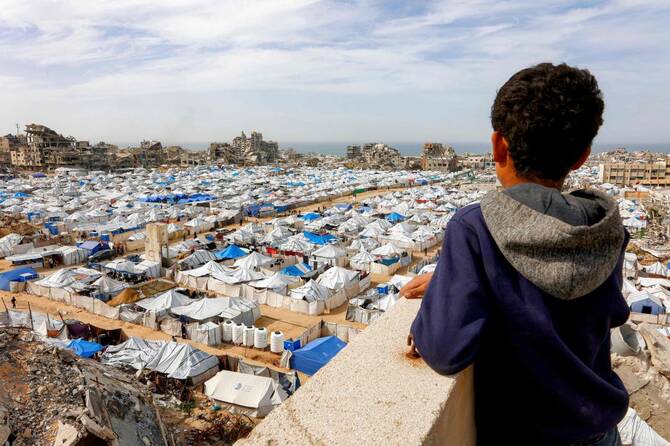
A boy looks at tents sheltering Palestinians displaced by conflict pitched by destroyed and heavily-damaged buildings in the Muqusi area of Gaza City on February 7, 2026. (AFP)
Short Url
Updated 09 February 2026
Follow

Israel says killed four militants exiting tunnel in Gaza’s Rafah

  • It said the attack on its troops was a violation of the ceasefire in Gaza between Israel and Hamas

JERUSALEM: Israel’s military said it killed four suspected militants who attacked its troops as the armed men emerged from a tunnel in southern Gaza on Monday, calling the group’s actions a “blatant violation” of the ceasefire.
Despite a US-brokered truce entering its second phase last month, violence has continued in the Gaza Strip, with Israel and Hamas accusing each other of breaching the agreement.
“A short while ago, four armed terrorists exited an underground tunnel shaft and fired toward soldiers in the Rafah area in the southern Gaza Strip.... Following identification, the troops eliminated the terrorists,” the military said in a statement.
It said none of its troops had been injured in the attack, which it called a “blatant violation of the ceasefire agreement” between Israel and Hamas.
Israeli troops “are continuing to operate in the area to locate and eliminate all the terrorists within the underground tunnel route,” the military added.
Gaza health officials have said Israeli air strikes last Wednesday killed 24 people, with Israel’s military saying the attacks were in response to one of its officers being wounded by enemy gunfire.
That wave of strikes came after Israel partly reopened the Rafah border crossing between Gaza and Egypt on February 2, the only gateway to the Palestinian territory that does not pass through Israel.
Israeli forces seized control of the crossing in May 2024 during the war with Hamas, and it had remained largely closed since.
Around 180 Palestinians have left the Gaza Strip since Rafah’s limited reopening, according to officials in the territory.
Israel has so far restricted passage to patients and their accompanying relatives.
The second phase of the Gaza ceasefire foresees a demilitarization of the territory — including the disarmament of Hamas — along with a gradual withdrawal of Israeli forces.
Hamas has repeatedly said that disarmament is a red line, although it has indicated it could consider handing over its weapons to a future Palestinian governing authority.
Israeli officials say Hamas still has around 20,000 fighters and about 60,000 Kalashnikovs in Gaza.
A Palestinian technocratic committee has been set up with a goal of taking over day-to-day governance in the strip, but it remains unclear whether, or how, it will address the issue of demilitarization.


Egypt condemns Iran’s attacks, stands with GCC, Jordan, Iraq

Updated 9 sec ago
Follow

Egypt condemns Iran’s attacks, stands with GCC, Jordan, Iraq

  • Cairo slams Israel for Lebanon attacks, illegal Gaza actions
  • Diplomacy remains the only solution, experts tell Arab News

CAIRO: Egypt is holding intensive communications with regional and international players to emphasize the need for de-escalation as the US-Israel war on Iran shows no sign of abating.

The Egyptian Foreign Ministry is pushing for calm in the region and has condemned Iran’s attacks on the GCC nations, Jordan and Iraq.

Since the first day of the war, Egypt has prioritized diplomacy as the only way to prevent the region from sliding into chaos.

Foreign Minister Badr Abdelatty, during a recent call with his Iranian counterpart Abbas Araghchi, stressed the seriousness of the situation and condemned Tehran’s behavior.

Egypt condemned Iran’s attack on a residential complex in the Saudi city of Al-Kharj that killed two people, reiterating its full solidarity with the Kingdom.

Cairo also slammed Israel’s attacks in Lebanon, which have resulted in the displacement of nearly 700,000 Lebanese citizens.

The ministry reaffirmed Egypt’s support for Lebanon and its rejection of Israeli violations of Lebanese sovereignty.

It also lambasted Israeli practices in the West Bank, including land confiscation and settlement expansion, in flagrant violation of international law.

Abdel Raouf El-Reedy, Egypt’s former ambassador to the US, told Arab News that Cairo’s position “is characterized by wisdom,” as the country rejects the “attack on the sovereignty of the brotherly Arab countries.”

He added: “The continuation of the war will have negative consequences for the Middle East region.”

El-Reedy said there was no alternative to political and diplomatic solutions, “because the continuation of military escalation will have negative repercussions on the Middle East region.”

President Abdel Fattah El-Sisi said at an iftar function recently that the region was going through difficult circumstances, and expressed hope that the war would end soon.

Speaking to Arab News, Ezzat Saad, executive director of the Egyptian Council for Foreign Affairs, said the attack on Arab countries was unacceptable, and that military escalation would lead to negative consequences for the Middle East.

Many Egyptian citizens told Arab News they support fellow Arab nations.

Ahmed Negm, a dentist, said he stood with Egypt’s neighbors and called for the attacks to end.

Mona Ahmed, a Cairo University graduate, said Egypt has strong and longstanding ties with the GCC states, noting that millions of Egyptians have been working in these countries for many decades.

Mahmoud Ahmed, a graphic designer, voiced concern over the attacks and expressed support for Egypt’s position of solidarity with Arab countries. He also called for peace.

Ahmed Younes, a journalist and researcher, highlighted the strong economic ties between Egypt and the Gulf states, and said the continuation of the war would affect the stability of the Middle East.