

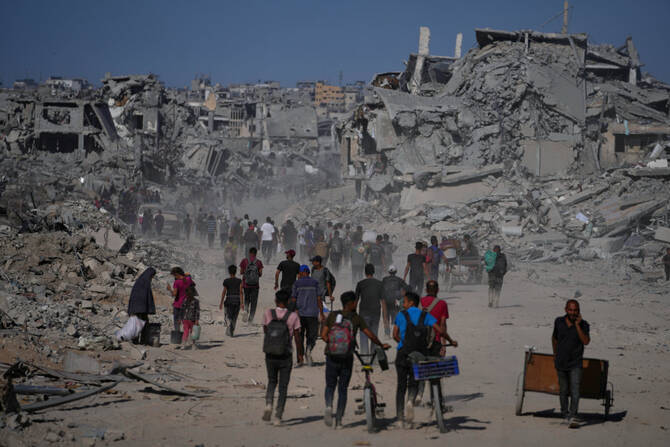

WASHINGTON: US President Donald Trump has undeniably scored a diplomatic victory by helping to broker a truce for Gaza, but the path to the lasting peace he says he wants for the Middle East is littered with obstacles.
And it remains to be seen whether the 79-year-old Trump — who is not exactly known for his attention to the fine print — will devote the same level of energy to the conflict over the long term, once his victory lap in the region is over next week.
“Any agreement between Israelis and Palestinians, but especially one indirectly brokered between Israel and Hamas is an extraordinary achievement,” Aaron David Miller, who worked for multiple US administrations of both parties, told AFP.
“Trump decided to do something that no American president... of either party has ever done, which is to pressure and squeeze an Israeli prime minister on an issue that that prime minister considered vital to his politics,” said Miller, a senior fellow at the Carnegie Endowment for International Peace.
But Miller, who has participated in Middle East peace talks over the years, warned of the “universe of complexity and detail” that remains to be hashed out with respect to the implementation of phase two of the deal.
The Israeli army said its troops had ceased fire at 0900 GMT Friday in the Gaza Strip, in anticipation of the release of all Israeli hostages, dead and alive, in the subsequent 72 hours, in compliance with the deal it reached with Palestinian armed group Hamas.
Trump has said he expects to head to the Middle East on Sunday, with stops in Egypt, where the talks took place, and Israel.
Art of the deal?
Given that every US president over the past 20 years has been unsuccessful in resolving crises between Israel and the Palestinians, Trump’s accomplishment is already remarkable.
But the Republican billionaire president has broader aspirations — to revive the Abraham Accords reached during his first White House term, under which the United Arab Emirates, Bahrain and Morocco offered Israel diplomatic recognition.
Trump has brought his son-in-law Jared Kushner, one of the architects of those accords, back into the administration to work with special envoy Steve Witkoff on the Gaza negotiations.
Officials and foreign policy observers agree that Trump deftly used a mix of carrot and stick — publicly and privately, and especially with Israeli Prime Minister Benjamin Netanyahu — to get the deal done.
He also leveraged his strong ties with Arab and Muslim leaders including Turkiye’s Recep Tayyip Erdogan.
For Miller, Trump clearly played a “decisive” role.
But while the agreement’s first phase appears to be on track, much remains undefined, including how — and if — Hamas will agree to disarm after two years of devastating conflict in the Palestinian territory, following its October 7, 2023 attack on Israel.
“A ceasefire is not yet a lasting peace,” French Foreign Minister Jean-Noel Barrot said Thursday, after meeting with European and Arab ministers on how to help the Palestinians in the post-conflict period.
Steven Cook, a senior fellow at the Council on Foreign Relations, wrote: “Whether this leads to an end to the war remains an open question.”
Huge challenges
Cook says the challenge now is to fully implement Trump’s 20-point plan, which calls for Hamas to surrender its weapons, the creation of an international stabilization force and new governing structures for Gaza that will not include the Palestinian militant group.
Trump insisted Thursday that “there will be disarming” by Hamas and “pullbacks” by Israeli forces.
Then on Friday, he added: “I think there is consensus on most of it, and some of the details, like anything else, will be worked out.”
But his administration will need to work hard to finalize the deal, and ensure that Arab countries in the region are invested in helping rebuild a devastated Gaza.
A team of 200 US military personnel will “oversee” the Gaza truce, senior US officials said Thursday.
Miller said there are “operational” holes in the plan as it stands, including “no detailed planning for either how to decommission and/or demilitarize Gaza, even if you had Hamas’s assent, which you don’t.”
The plan also calls for the creation of a so-called “Board of Peace,” a transitional body to be chaired by Trump himself — a proposal Hamas rejected on Thursday.
“Despite coming to office eager to shed America’s Middle East commitments, Trump just took on a huge one: responsibility for a peace plan that will forever bear his name,” wrote Robert Satloff, executive director of the Washington Institute for Near East Policy.


