Macron warns Israeli settlements threaten Palestinian state

France’s President Emmanuel Macron, next to Saudi Foreign Minister Prince Faisal bin Farhan, speaks during a ministerial meeting on the implementation of the Middle East peace plan. (REUTERS)
Short Url
Updated 09 October 2025
Follow

Macron warns Israeli settlements threaten Palestinian state

  • Macron hailed ceasefire deal in Gaza as “great hope” for the region
  • He said Israeli settlement “fuels tensions, violence, and instability”

PARIS: French President Emmanuel Macron warned Thursday that expanding Israeli settlements threatened a Palestinian state and US-led peace efforts, as France hosted Arab and European ministers to find ways to boost the Palestinians after a Gaza ceasefire deal was announced.

Macron hailed the ceasefire deal as a “great hope” for the region, but said the “acceleration” of settlement construction in the occupied West Bank was an “existential threat” to a Palestinian state.

It was “not only unacceptable and contrary to international law” but “fuels tensions, violence, and instability,” he said in opening remarks to the meeting in Paris.

“It fundamentally contradicts the American plan and our collective ambition for a peaceful region.”

Israel and Hamas earlier agreed a Gaza ceasefire deal to free the remaining living Israeli hostages held by the Palestinian militant group.

It is being seen as a major step toward ending a war that has killed tens of thousands of people and unleashed a humanitarian catastrophe.

The deal brokered through indirect talks in the Egyptian resort of Sharm el-Sheikh came two years after the October 7, 2023 attack by Hamas on Israel, which triggered a relentless retaliatory assault on Hamas-ruled Gaza.

While Europe has strongly supported the ceasefire efforts led by US President Donald Trump, Washington and several European countries are at odds over whether it is the right moment to recognize a Palestinian state.

Macron, in a September 22 speech at the United Nations, recognized a Palestinian state on the heels of similar announcements by Canada, Portugal and the United Kingdom.

The Paris meeting brought together the top diplomats of five key Arab states — Egypt, Jordan, Saudi Arabia, Qatar and the United Arab Emirates — with European counterparts from France, Italy, Germany, Spain and the United Kingdom.

Turkiye and the European Union were also represented.

‘Unnecessary and harmful’

“A ceasefire is not yet a lasting peace,” said French Foreign Minister, Jean-Noel Barrot. “It is the first step on a long road to a political solution that will guarantee Israel’s security while recognizing the legitimate rights of the Palestinians to a state.”

France is hoping that backing up its recognition of a Palestinian state by discussing what happens the “day after” the war ends can boost the prospects of a two-state solution, which Paris still regards as the sole chance for long-term regional peace.

The ministers discussed participating in the International Stabilization Force evoked by Trump as part of his peace plan and support for the Palestinian Authority which runs the occupied West Bank.

Before the ceasefire deal was announced, the Paris meeting had angered Israel, further straining French-Israeli relations in the wake of Macron’s recognition of a Palestinian state.

Israeli Foreign Minister Gideon Saar had in a message on X denounced the “unnecessary and harmful” meeting “concocted behind Israel’s back” at the sensitive moment of the negotiations in Sharm el-Sheikh.


Volcanic eruptions may have brought Black Death to Europe, say new study

Updated 6 sec ago
Follow

Volcanic eruptions may have brought Black Death to Europe, say new study

  • Study says volcanic eruptions in 1345 caused temperatures to drop, leading to crop failure and causing famine
  • This led Italy to have ships bring grain from central Asia, where the bubonic plague is thought to have first emerged
  • The plague killed tens of millions of people and wiped out up to 60 percent of the population in parts of Europe 

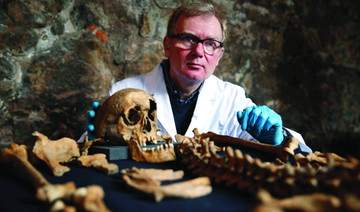
PARIS: Previously unknown volcanic eruptions may have kicked off an unlikely series of events that brought the Black Death — the most devastating pandemic in human history — to the shores of medieval Europe, new research has revealed.
The outbreak of bubonic plague known as the Black Death killed tens of millions and wiped out up to 60 percent of the population in parts of Europe during the mid-14th century.
How it came to Europe — and why it spread so quickly on such a massive scale — have long been debated by historians and scientists.
Now two researchers studying tree rings have suggested that a volcanic eruption may have been the first domino to fall.
By analizing the tree rings from the Pyrenees mountain range in Spain, the pair established that southern Europe had unusually cold and wet summers from 1345 to 1347.
Comparing climate data with written accounts from the time, the researchers demonstrated that temperatures likely dropped because there was less sunlight following one or more volcanic eruptions in 1345.
The change in climate ruined harvests, leading to failed crops and the beginnings of famine.
Fortunately — or so it seemed — “powerful Italian city states had established long-distance trade routes across the Mediterranean and the Black Sea, allowing them to activate a highly efficient system to prevent starvation,” said Martin Bauch, a historian at Germany’s Leibniz Institute for the History and Culture of Eastern Europe.
“But ultimately, these would inadvertently lead to a far bigger catastrophe,” he said in a statement.
Deadly stowaways

The city states of Venice, Genoa and Pisa had ships bring grain from the Mongols of the Golden Horde in central Asia, which is where the plague is thought to have first emerged.
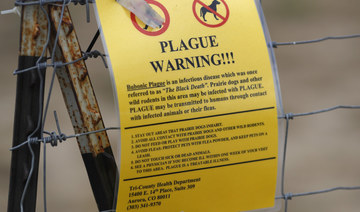
Previous research has suggested that these grain ships brought along unwelcome passengers: rats carrying fleas infected with Yersinia pestis, the bacterium that causes plague.
Between 25 and 50 million people are estimated to have died over the next six years.
While the story encompasses natural, demographic, economic and political events in the area, it was ultimately the previously unidentified volcanic eruption that paved the way for one of history’s greatest disasters, the researchers argued.
“Although the coincidence of factors that contributed to the Black Death seems rare, the probability of zoonotic diseases emerging under climate change and translating into pandemics is likely to increase in a globalized world,” study co-author Ulf Buentgen of Cambridge University in the UK said in a statement.
“This is especially relevant given our recent experiences with Covid-19.”
The study was published in the journal Communications Earth & Environment on Thursday.