

How a young Saudi inventor is looking to advance political science

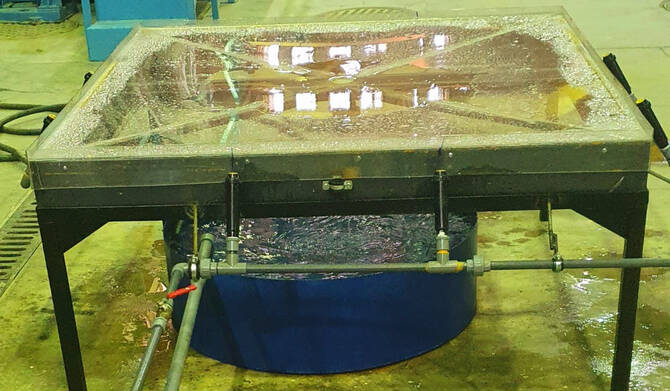
An image showing Al-Shalahi's self-cleaning tile invention being tested. (Supplied)
Short Url
Updated 06 December 2025
Follow

How a young Saudi inventor is looking to advance political science

  • Under Vision 2030, the Kingdom is seeking to establish itself as a global hub in AI, data sovereignty, and digital policy, with a strong emphasis on ethics and governance

RIYADH: Samar Al-Shalahi, 22, is one of Saudi Arabia’s young innovators, having created a patented technology and now researching ways to advance political science through AI.

In 2023, Al-Shalahi was granted a Saudi patent (SAIP Patent No. SA13753) for developing self-cleaning floor tiles, a system designed to reduce manual cleaning and water waste through internal self-washing channels.

The patent was officially registered with the Saudi Authority for Intellectual Property on Sept. 26, 2023, and was showcased at the Geneva International Exhibition of Inventions under the Saudi Arabia pavilion.


Samar Al-Shalahi, Student and innovator

Her experimental work was supervised by Dr. Faisal bin Mohammed Al-Faisal, whose guidance helped her transform a theoretical idea into a practical prototype; a project that later evolved into her patented technology.

“It was my first tangible step toward connecting creativity with practical problem-solving,” she said.

“I learned that innovation doesn’t always mean creating something entirely new; it can be seeing the familiar through a different lens.

I aspire to contribute to developing national policies that strengthen the integration between political science and AI in support of Saudi Arabia’s digital transformation under Vision 2030.

Samar Al-Shalahi, Student and innovator

“That experience fueled my passion to continue exploring new paths in research and innovation.”

This became the foundation for a broader understanding of innovation and its connection to national strength.

She is now a political science student at King Saud University, focusing on how AI shapes national sovereignty, governance and international security, viewing technology as a new determinant of power in the modern international system.

“Governance and technology are increasingly intertwined. It is important for nations to ensure that artificial intelligence serves the public good and supports responsible policymaking,” Al-Shalahi said.

“I aspire to contribute to developing national policies that strengthen the integration between political science and AI in support of Saudi Arabia’s digital transformation under Vision 2030,” she added.

“I seek to be part of the generation that harnesses technology to serve informed political decision-making and to safeguard digital sovereignty.”

Her transition from invention to the intersection of politics and technology reflects the transformation taking place across Saudi Arabia’s research landscape. 

Under Vision 2030, the Kingdom is seeking to establish itself as a global hub in AI, data sovereignty, and digital policy, with a strong emphasis on ethics and governance.

Al-Shalahi has represented Saudi Arabia on international platforms. She was a speaker at the World Association for Sustainable Development’s International Youth Day Global Conference 2025, where she discussed the contributions of Saudi youth in innovation and sustainable development.


Red Sea Global unveils scientific model for regenerative tourism worldwide

Updated 26 February 2026
Follow

Red Sea Global unveils scientific model for regenerative tourism worldwide

  • The report details the model’s rollout at “The Red Sea” and “AMAALA” destinations, backed by studies covering 8 marine habitats

TABUK: Red Sea Global (RSG) has unveiled a science-based model aimed at achieving a 30% net positive conservation benefit across its tourism destinations by 2040. 

The framework is now available for global adoption, according to a statement released by RSG.

Owned by Saudi Arabia’s Public Investment Fund (PIF), Red Sea Global is the multi-project developer behind ambitious regenerative tourism destinations like “The Red Sea” and “AMAALA.” 

As a cornerstone of the Kingdom’s Vision 2030, the company aims to diversify the national economy while setting new global benchmarks for sustainable, nature-positive development.

CEO John Pagano stated that openly sharing this detailed approach will help elevate the global tourism sector and secure a healthier environment for future generations.
 

Map showing the boundaries of the Red Sea Zone. (Graphic from the RSG report)

The cornerstone of this initiative is the proprietary SIIG Model, a four-step framework:
• Survey: Establish biodiversity baselines and monitor long-term changes.
• Identify: Assess risks to priority habitats and species.
• Intervene: Execute evidence-based actions, such as regulating fishing and enhancing natural habitats.
• Gain: Measure and verify biodiversity improvements.

The report details the model’s rollout at “The Red Sea” and “AMAALA” destinations, backed by extensive 2022–2023 environmental baseline studies covering eight marine habitats and priority species groups during 2022 and 2023. 

A major intervention is the 5,015-square-kilometer Fishery Management Area in Al-Wajh Lagoon. The plan reserves 38% of the area for priority conservation—protecting 62% of local coral reefs—while allocating 61% for sustainable fishing.

According to scientific modeling, eliminating fishing in high-protection zones could increase reef fish populations by 113%, sharks and rays by 72%, and marine mammals by 24%. These measures are expected to boost coral resilience, support ecosystem recovery, and protect vulnerable species like sea turtles and seabirds.
Ihab Kindi, RSG’s Red Sea Destination Executive Director, called the data-driven model a practical roadmap for large-scale marine recovery. The complete methodology is available in the new report, “The SIIG Model: A Roadmap Toward Achieving Measurable Conservation Gains.”