



ISLAMABAD: In the quiet of his home studio on the outskirts of Islamabad, Raja Changez Sultan moves with unhurried rhythm between canvas and easel.
The air smells faintly of turpentine. Tubes of paint spill across a long wooden table. A half-finished landscape leans against the wall, its blues and ochres still wet.
At 76, the painter-poet still carries the energy of a man mid-conversation with his work — mixing colors, reciting lines of poetry under his breath and occasionally stepping back to study the play of light.
For the soft-spoken Sultan, art has never been about recognition.
“Artists don’t become famous, their art does,” he said. “If the art speaks to people, if it touches them, that does you a whole lot of good because that’s what life is about as an artist.”
It’s a philosophy that has guided him through five decades of creative exploration, from the psychological depths of his Divided Self series to the sweeping grandeur of Himalayan Odyssey.
Born in Shakarparian, Islamabad, in 1949, just two years after Pakistan itself, Sultan is one of the country’s most distinguished painter-poets, equally at ease with the canvas and the page.
His recent retrospective, In Trinity Together, held last month at the Pakistan National Council of the Arts (PNCA), marked over fifty years of his creative journey, featuring more than 100 works from seven major series alongside poetry readings and live painting.
He has exhibited widely across Pakistan, Europe, and the Middle East and served in key cultural institutions, including as Director General of the PNCA. His career, spanning from the United Nations in Geneva to Islamabad’s galleries, mirrors his belief that art must bridge the aesthetic, the moral and the human.
“I left Pakistan when I was 15,” he recalled. “So, where Pakistan was concerned, it wasn’t really arts that really mattered. I was into math and physics, and they’d make very poor artists.”
At a boarding school in England, he met art teacher John Alford, who changed the course of his life.
“He’s still alive, and we’re still the best of friends,” Sultan said. “I guess I’ll always remain a student. But the relationship transcended into something much bigger.”

Artist Raja Changez Sultan speaks during an interview with Arab News at his residence in Islamabad, Pakistan, on September 24, 2025. (AN Photo)
Exposure to European masters further shaped his sensibility.
“Every painting that you see has a story to tell,” he said. “You learn, really, from everybody, not just one single artist.”
When he began painting in 1979, Pakistan’s art institutions were few but artists were emerging, Sultan explained.
“Whether it’s Sadquain or whether it’s Gulgee or Allah Baksh or somebody who did miniatures, there were genuine efforts being made,” he said, naming three world-renowned Pakistani artists.
But the infrastructure was limited.
“Whether they were sufficient or not, it’s obvious that they weren’t because here’s a country with a huge population and you can count the number of art schools on one hand.”
Sultan’s early work was largely abstract, but he soon realized that local audiences struggled to connect with it.
“I felt that abstraction isn’t what really communicates that well out here,” he explained. “So I tried to find a middle ground, leaving enough to the imagination of a viewer, but at the same time giving them a sufficient amount to relate to.”
That search for connection led to a body of work merging psychology and poetry.
“Whether it’s the series of Divided Self, which was the first real series that I began, I was 17, 18 at that time,” he said. “And it’s still my most important series that I work on.”
Sultan said the series explored the “pluses and minuses” of human nature, the inner struggle between multiple selves that define every person.

The photograph taken on September 24, 2025, shows a painting displayed at the home studio of artist Raja Changez Sultan in Islamabad, Pakistan. (AN Photo)
By the early 1990s, his focus turned outward, from the internal landscapes of Divided Self to the vastness of Himalayan Odyssey.
“Our mountains afford you a kind of luxury where there’s earth, air, fire, or water,” the painter said. “They’re interacting with sunlight through a very rare quantum affair.”
That project, accompanied by his poem In These Silent Wastes Only Spirits Roam, inspired The Wood Nymphs and The Crucifixion of Eve.
“Women in this country need a much, much, much stronger force to liberate them,” he said. “Liberation doesn’t mean that they have to take off and fly out of a cage and spread their wings. What it means is that they also realize the importance, the kind of role they can play in Pakistan and be leaders, be whatever they want to be.”
ART AND PAKISTAN’S EVOLVING IDENTITY
Though his career took him from Geneva to Islamabad, Sultan’s reflections on recognition remain grounded.
“Whether you have gotten somewhere or not is not really for you to judge,” he said. “It’s for time to tell. And in the meantime, what will help you is that you keep your concentration on your work.”
Indeed, the poet-painter has little patience for self-promotion.
“These works don’t really find avenues unless you become a marketeer yourself,” he said. “And I refuse to spend my time wanting to market myself. I’d rather do my work and leave it at that.”
For Sultan, art and cultural identity are also deeply connected, especially as he came of age as an artist in the shadow of military rule, when state narratives of strength and discipline often left little space for reflection or beauty.
“The art scene then [seventies] was that the artists really didn’t have much of a place in our society,” he said. “Here’s a country with a martial race type attitude. If you wish to see the concept of beautifying our cities, they’d put a plane in the middle of a square or roundabout and maybe a tank in another place.”
He said the general awareness of art in Pakistan was “not of an aesthetic kind but one that told a story about a country that might have been in a war or has the ability of standing up and protecting its own.”
That environment, he reflected, “doesn’t really make for a good breeding place for artists — but then it’s one of those things where somebody has the will, there’s always a way.”
The painter argued that such displays of power reflect a young nation still struggling to define its cultural identity.
“We are one of the most diverse countries on God’s earth,” he said, “but also one of the most complicated, because it’s newly born. Seventy-five or eighty years is not enough to give you an identity, especially when the level of education has not been very high all these years.”
That search for identity, he believes, is precisely where art can play a unifying role.
“Arts are one area that can give people the kind of unity that is needed for the future,” Sultan said.
When asked about legacy, Sultan returned to his familiar ethos of persistence and humility.
“I guess that I have been able to work consistently at whatever I started and set out to do,” he said. “There are no shortcuts in life. You stick with it, it will stick with you. You don’t stick with it, it will walk away just like anybody else.”
He added that his only true competition is himself.
“You’re never competing with another artist, you’re competing with your last painting. Is the new one better than that? The interactive for improvement is well within you yourself.”
POETRY FOR THE PLANET
Now in his seventies, Sultan is collaborating with his son on a poetry project focused on endangered species.
“We as the human race have not been kind to wildlife,” he said. “What we have done to our wildlife is criminal really. So many species have walked off the face of the earth.”
The father-son duo initially set out to write 100 poems but never stopped.
“It’s been 15 years and we still don’t know where to stop,” he said. “There are so many wonderful creatures about whom if we learn a little, our world becomes that much richer.”
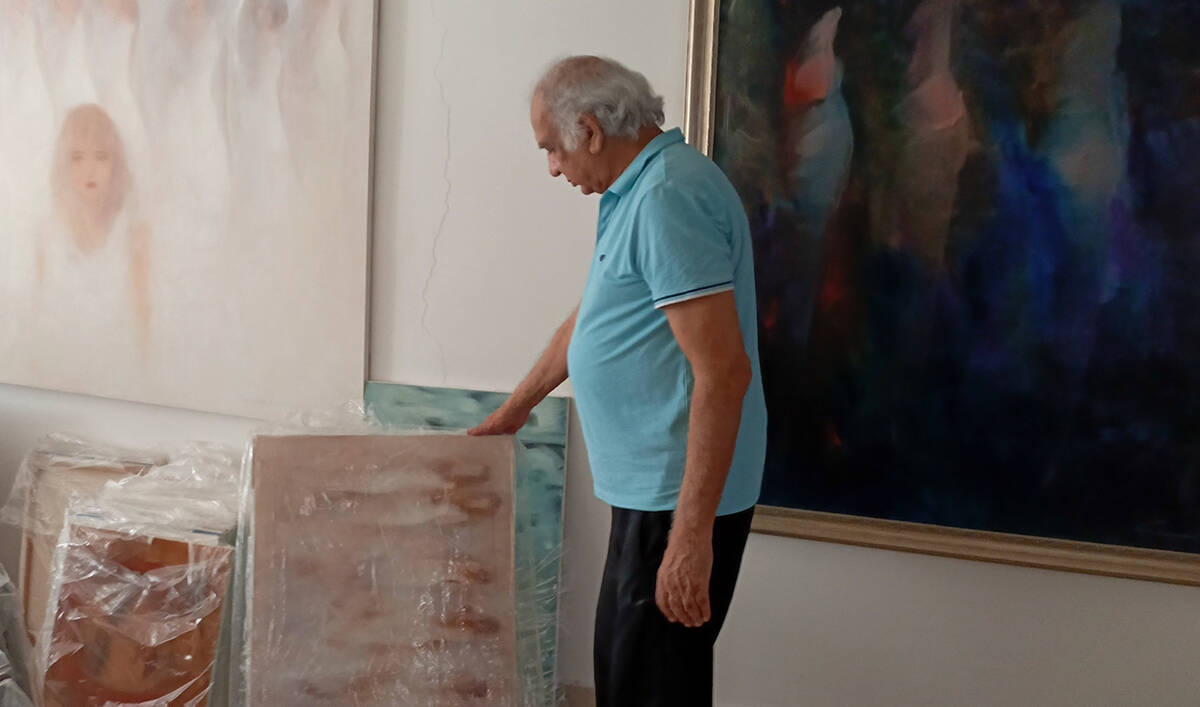
Artist Raja Changez Sultan looks at a painting at his home studio in Islamabad, Pakistan, on September 24, 2025. (AN Photo)
Asked what advice he would offer young Pakistani artists, Sultan was direct.
“Never look for shortcuts. If they can avoid shortcuts, they’ll be solving half the problem of life,” he said. “And no artist needs an ego. If you want to face your worst enemy, put an ego in front of you and say this is who you are and you’ll find yourself in trouble.”
His closing words echo his life’s philosophy:
“Whatever you take up, stick with it ... Be true to that particular field and put your absolute very best in it without any shortcuts. Value what others do and do what you value.”


