Macron, Jordanian crown prince discuss partnerships in Paris

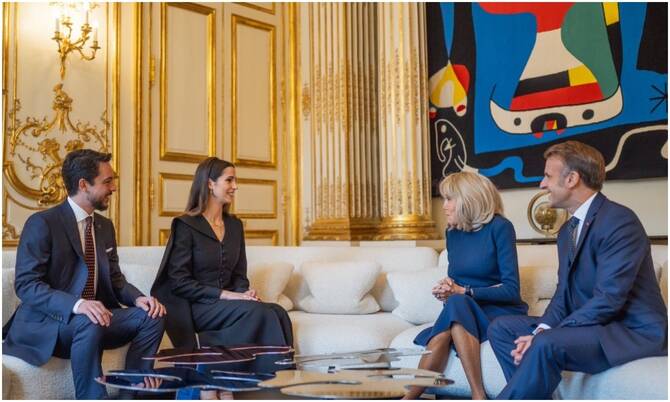
French President Emmanuel Macron, with First Lady Brigitte Macron, and the Jordanian Crown Prince Hussein, with Princess Rajwa, during their meeting at the Elysee Palace in Paris. (Petra)
Short Url
Updated 08 October 2025
Follow

Macron, Jordanian crown prince discuss partnerships in Paris

  • Meeting addressed support for Syria and Lebanon to maintain their stability, sovereignty and territorial integrity
  • Princess Rajwa, Brigitte Macron attended part of the meeting at the Elysee Palace in Paris

LONDON: French President Emmanuel Macron met Jordanian Crown Prince Hussein at the Elysee Palace on Wednesday to discuss ties between France and Jordan, along with recent regional developments.

The two sides discussed ways to enhance cooperation and reviewed existing partnerships, according to Petra news agency.

The crown prince relayed King Abdullah’s gratitude for French efforts to end the war in Gaza and its role in rallying international support for the recognition of the state of Palestine.

He highlighted France’s role in fostering partnerships between the private sectors of both countries and its support for the Aqaba-Amman Water Desalination Project.

The meeting also addressed support for Syria and Lebanon to maintain their stability, sovereignty and territorial integrity, promoting calm in the region and reaching comprehensive peace between Palestinians and Israelis.

Princess Rajwa and French First Lady Brigitte Macron attended part of the meeting, Petra added.


IMF approves reviews, unlocks $240m in funding for Jordan

Updated 55 min 38 sec ago
Follow

IMF approves reviews, unlocks $240m in funding for Jordan

  • The decision allows Jordan to draw about $130 million under the EFF and about $110 million under the RSF

AMMAN: The International Monetary Fund’s executive board has completed the fourth review of Jordan’s Extended Fund Facility and the first review under the Resilience and Sustainability Facility, unlocking immediate access to about $240 million to support the kingdom’s economic program.

The decision allows Jordan to draw about $130 million under the EFF and about $110 million under the RSF, bringing total disbursements under the IMF arrangement to about $733 million.

In a statement issued on Saturday, the IMF said Jordan’s economy “remains resilient,” supported by sound macroeconomic policies and strong international backing.

Growth accelerated to 2.7 percent in the first half of 2025 and is expected to reach about 3 percent in the coming years, driven by major investment projects, deeper regional integration and continued structural reforms.

Inflation remains anchored at about 2 percent, while the current account deficit is projected to narrow to below 5 percent of GDP over the medium term. The IMF also noted that Jordan’s banking sector is stable and international reserves remain strong.

Fiscal performance continues to align with program targets, underpinned by robust revenue collection and disciplined current spending. The authorities remain committed to reducing public debt to 80 percent of GDP by 2028 through gradual fiscal consolidation, while protecting social and development spending and reducing losses at public utilities.

The IMF said progress under the RSF is ongoing, with reforms addressing vulnerabilities in the water and electricity sectors and strengthening health emergency preparedness. All reform measures scheduled for the current review have been completed.

Commenting after the board discussion, IMF Deputy Managing Director Kenji Okamura said Jordan’s continued macroeconomic stability amid persistent external headwinds reflects the authorities’ commitment to sound policies, supported by strong international assistance.

He said growth continues to recover, inflation remains low and reserve buffers are strong, stressing the importance of maintaining prudent fiscal and monetary policies amid regional tensions and global uncertainty.

Okamura added that accelerated structural reforms are essential to foster job-rich growth, improve the business environment, enhance labour market flexibility, tackle youth unemployment and low female labour force participation, and attract private investment.

He also underlined the importance of sustained donor support to help Jordan manage external challenges and the economic cost of hosting large numbers of refugees, while noting that progress under the RSF would help address long-term vulnerabilities and strengthen balance-of-payments stability.