

Belarus frees protest leader Kolesnikova, Nobel winner Bialiatski

1 / 2
Belarusian oppositional Maria Kolesnikova gestures inside a bus after release, amid Russia’s attack on Ukraine, in an undisclosed location in Ukraine, in this handout picture obtained on Dec. 13, 2025. (Reuters)
2 / 2
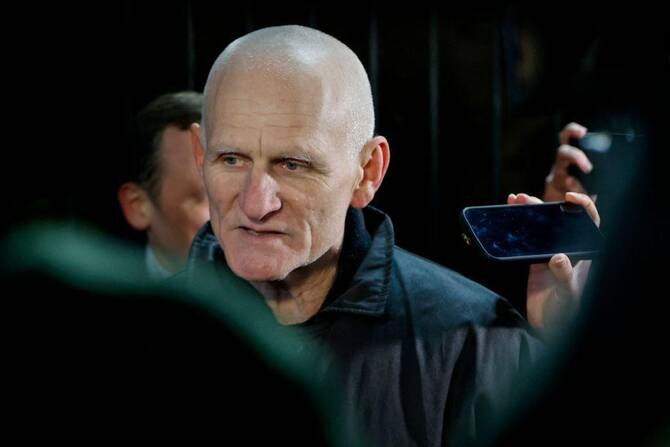
Belarusian Nobel Prize winner Ales Bialiatski speaks to journalists at the US embassy after he was released in Vilnius, Lithuania on Dec. 13, 2025. (AFP)
Short Url
Updated 13 December 2025
Follow

Belarus frees protest leader Kolesnikova, Nobel winner Bialiatski

  • The charismatic Kolesnikova was the star of the 2020 movement that presented the most serious challenge to Lukashenko in his 30-year rule
  • Bialiatski — a 63-year-old veteran rights defender and 2022 Nobel Peace Prize winner — is considered by Lukashenko to be a personal enemy

VILNIUS: Belarusian street protest leader Maria Kolesnikova and Nobel Prize winner Ales Bialiatski walked free on Saturday with 121 other political prisoners released in an unprecedented US-brokered deal.
Belarusian President Alexander Lukashenko has locked up thousands of his opponents, critics and protesters since the 2020 election, which rights groups said was rigged and which triggered weeks of protests that almost toppled him.
The charismatic Kolesnikova was the star of the 2020 movement that presented the most serious challenge to Lukashenko in his 30-year rule.
She famously ripped up her passport as the KGB tried to deport her from the country.
Bialiatski — a 63-year-old veteran rights defender and 2022 Nobel Peace Prize winner — is considered by Lukashenko to be a personal enemy. He has documented rights abuses in the country, a close ally of Moscow, for decades.
Bialiatski stressed he would carry on fighting for civil rights and freedom for political prisoners after his surprise release, which he called a “huge emotional shock.”
“Our fight continues, and the Nobel Prize was, I think, a certain acknowledgement of our activity, our aspirations that have not yet come to fruition,” he told media in an interview from Vilnius.
“Therefore the fight continues,” he added.
He was awarded the prize in 2022 while already in jail.
After being taken out of prison, he said he was put on a bus and blindfolded until they reached the border with Lithuania.
His wife, Natalia Pinchuk, told AFP that her first words to him on his release were: “I love you.”

- ‘All be free’ -

Most of those freed, including Kolesnikova, were unexpectedly taken to Ukraine, surprising their allies who had been waiting for all of them in Lithuania.
She called for all political prisoners to be released.
“I’m thinking of those who are not yet free, and I’m very much looking forward to the moment when we can all embrace, when we can all see one another, and when we will all be free,” she said in a video interview with a Ukrainian government agency.
Hailing Bialiatski’s release, the Nobel Committee told AFP there were still more than 1,200 political prisoners inside the country.
“Their continued detention starkly illustrates the ongoing, systemic repression in the country,” said chairman Jorgen Watne Frydnes.
EU chief Ursula von der Leyen said their release should “strengthen our resolve... to keep fighting for all remaining prisoners behind bars in Belarus because they had the courage to speak truth to power.”
Jailed opponents of Lukashenko are often held incommunicado in a prison system notorious for its secrecy and harsh treatment.
There had been fears for the health of both Bialiatski and Kolesnikova while they were behind bars, though in interviews Saturday they both said they felt okay.
The deal was brokered by the United States, which has pushed for prisoners to be freed and offered some sanctions relief in return.

- Potash relief -

An envoy of US President Donald Trump, John Coale, was in Minsk this week for talks with Lukashenko.
He told reporters from state media that Washington would remove sanctions on the country’s potash industry, without providing specific details.
A US official separately told AFP that one American citizen was among the 123 released.
Minsk also freed Viktor Babariko, an ex-banker who tried to run against Lukashenko in the 2020 presidential election but was jailed instead.
Kolesnikova was part of a trio of women, including Svetlana Tikhanovskaya who stood against Lukashenko and now leads the opposition in exile, who headed the 2020 street protests.
She was serving an 11-year sentence in a prison colony.
In 2020, security services had put a sack over her head and drove her to the Ukrainian border. But she ripped up her passport, foiling the deportation plan, and was placed under arrest.
Former prisoners from the Gomel prison where she was held have told AFP she was barred from talking to other political prisoners and regularly thrown into harsh punishment cells.
An image of Kolesnikova making a heart shape with her hands became a symbol of anti-Lukashenko protests.
Bialiatski founded Viasna in the 1990s, two years after Lukashenko became president.


Women fleeing Mali’s conflict say they were sexually assaulted but silence hides many more

Updated 57 min ago
Follow

Women fleeing Mali’s conflict say they were sexually assaulted but silence hides many more

  • Men, women and children have been sexually assaulted by all sides during Mali’s decade-long conflict, the UN and aid workers say

DOUANKARA: The girl lay in a makeshift health clinic, her eyes glazed over and her mouth open, flies resting on her lips. Her chest barely moved. Drops of fevered sweat trickled down her forehead as medical workers hurried around her, attaching an IV drip.
It was the last moment to save her life, said Bethsabee Djoman Elidje, the women’s health manager, who led the clinic’s effort as the heart monitor beeped rapidly. The girl had an infection after a sexual assault, Elidje said, and had been in shock, untreated, for days.
Her family said the 14-year-old had been raped by Russian fighters who burst into their tent in Mali two weeks earlier. The Russians were members of Africa Corps, a new military unit under Russia’s defense ministry that replaced the Wagner mercenary group six months ago.
Men, women and children have been sexually assaulted by all sides during Mali’s decade-long conflict, the UN and aid workers say, with reports of gang rape and sexual slavery. But the real toll is hidden by a veil of shame that makes it difficult for women from conservative, patriarchal societies to seek help.
The silence that nearly killed the 14-year-old also hurts efforts to hold perpetrators accountable.
The AP learned of the alleged rape and four other alleged cases of sexual violence blamed on Africa Corps fighters, commonly described by Malians as the “white men,” while interviewing dozens of refugees at the border about other abuses such as beheadings and abductions.
Other combatants in Mali have been blamed for sexual assaults. The head of a women’s health clinic in the Mopti area told the AP it had treated 28 women in the last six months who said they had been assaulted by militants with the Al-Qaeda affiliated JNIM, the most powerful armed group in Mali.
The silence among Malian refugees has been striking.
In eastern Congo, which for decades has faced violence from dozens of armed groups, “we didn’t have to look for people,” said Mirjam Molenaar, the medical team leader in the border area for Doctors Without Borders, or MSF, who was stationed there last year. The women “came in huge numbers.”
It’s different here, she said: “People undergo these things and they live with it, and it shows in post-traumatic stress.”
Speechless after an assault
The aunt of the 14-year-old girl said the Africa Corps fighters marched everyone outside at gunpoint. The family couldn’t understand what they wanted. The men made them watch as they tied up the girl’s uncle and cut off his head.
Then two of the men took the 14-year-old into the tent as she tried to defend herself, and raped her. The family waited outside, unable to move.
“We were so scared that we were not even able to scream anymore,” the aunt recalled, as her mother sobbed quietly next to her. She, like other women, spoke on condition of anonymity for fear of retaliation, and the AP does not name victims of rape unless they agree to be named.
The girl emerged over a half-hour later, looking terrified. Then she saw her uncle’s body and screamed. She fainted. When she woke up, she had the eyes of someone “who was no longer there,” the aunt said.
The next morning, JNIM militants came and ordered the family to leave. They piled onto a donkey cart and set off toward the border. At any sound, they hid in the bushes, holding their breath.
The girl’s condition deteriorated during the three-day journey. When they arrived in Mauritania, she collapsed.
The AP came across her lying on the ground in the courtyard of a local family. Her family said they had not taken her to a clinic because they had no money.
“If you have nothing, how can you bring someone to a doctor?” the girl’s grandmother said between sobs. The AP took the family to a free clinic run by MSF. A doctor said the girl had signs of being raped.
The clinic had been functioning for barely a month and had seen three survivors of sexual violence, manager Elidje said.
“We are convinced that there are many cases like this,” she said. “But so far, very few patients come forward to seek treatment because it’s still a taboo subject here. It really takes time and patience for these women to open up and confide in someone so they can receive care. They only come when things have already become complicated, like the case we saw today.”
As Elidje tried to save the girl’s life, she asked the family to describe the incident. She did not speak Arabic and asked the local nurse to find out how many men carried out the assault. But the nurse was too ashamed to ask.
Scratch marks are part of story she could not tell
Thousands of new refugees from Mali, mostly women and children, have settled just inside Mauritania in recent weeks, in shelters made of fabric and branches. The nearest refugee camp is full, complicating efforts to treat and report sexual assaults.
Two recently arrived women discreetly pulled AP journalists aside, adjusting scarves over their faces. They said they had arrived a week ago after armed white men came to their village.
“They took everything from us. They burned our houses. They killed our husbands,” one said. “But that’s not all they did. They tried to rape us.”
The men entered the house where she was by herself and undressed her, she said, adding that she defended herself “by the grace of Allah.”
As she spoke, the second woman started crying and trembling. She had scratch marks on her neck. She was not capable of telling her story.
“We are still terrified by what we went through,” she said.
Separately, a third woman said that what the white men did to her in Mali last month when she was alone at home “stays between God and me.”
A fourth said she watched several armed white men drag her 18-year-old daughter into their house. She fled and has not seen her daughter again.
The women declined the suggestion to speak with aid workers, some of whom are locals. They said they were not ready to talk about it with anyone else.
Russia’s Defense Ministry did not respond to questions, but an information agency that the US State Department has called part of the “Kremlin’s disinformation campaign” called the AP’s investigation into Africa Corps fake news.
Wagner has a legacy of sexual abuse
Allegations of rapes and other sexual assaults were already occurring before Wagner transformed into Africa Corps.
One refugee told the AP she witnessed a mass rape in her village in March 2024.
“The Wagner group burned seven men alive in front of us with gasoline.” she said. Then they gathered the women and raped them, she said, including her 70-year-old mother.
“After my mother was raped, she couldn’t bear to live,” she said. Her mother died a month later.
In the worst-known case of sexual assault involving Russian fighters in Africa, the UN in a 2023 report said at least 58 women and girls had been raped or sexually assaulted in an attack on Moura village by Malian troops and others that witnesses described as “armed white men.”
In response, Mali’s government expelled the UN peacekeeping mission. Since then, gathering accurate data on the ground about conflict-related sexual violence has become nearly impossible.
The AP interviewed five of the women from Moura, who now stay in a displacement camp. They said they had been blindfolded and raped for hours by several men.
Three of the women said they hadn’t spoken about it to anyone apart from aid workers. The other two dared to tell their husbands, months later.
“I kept silent with my family for fear of being rejected or looked at differently. It’s shameful,” one said.
The 14-year-old whose family fled to Mauritania is recovering. She said she cannot remember anything since the attack. Her family and MSF said she is speaking to a psychiatrist — one of just six working in the country.
Aid workers are worried about others who never say a thing.
“It seems that conflict over the years gets worse and worse and worse. There is less regard for human life, whether it’s men, women or children,” said MSF’s Molenaar, and broke into tears. “It’s a battle.”