Haiti children displaced by violence nearly double in a year, UNICEF says

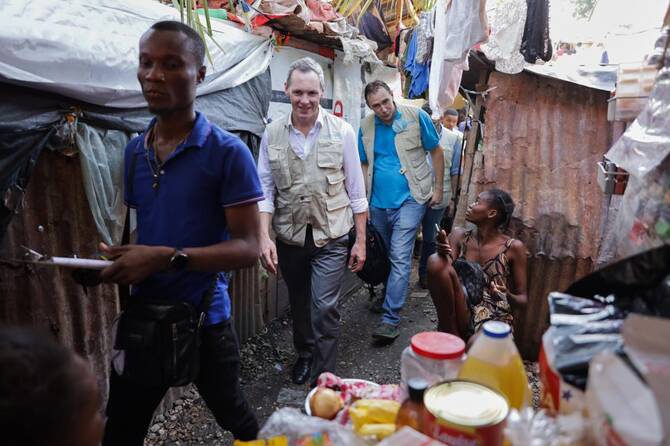
UNICEF Regional Director for Latin America and the Caribbean Roberto Benes, center, visits a shelter for families displaced by gang violence in Port-au-Prince, Haiti, Oct. 7, 2025. (AP)
Short Url
Updated 08 October 2025
Follow

Haiti children displaced by violence nearly double in a year, UNICEF says

  • The agency estimates that over 6 million people now need humanitarian assistance
  • “Children in Haiti are experiencing violence and displacement at a terrifying scale,” said Russell

PORT-AU-PRINCE, Haiti: Spiraling violence in Haiti has displaced 680,000 children, nearly twice as many as a year ago, as armed groups tighten control and public services collapse, UNICEF said on Wednesday.
The agency estimates that over 6 million people — more than half the population, including 3.3 million children — now need humanitarian assistance.

WHY IT’S IMPORTANT
The surge in displacement, combined with deteriorating health and education services and rising gang violence, underscores the growing risks to millions of Haitians, particularly children.

KEY QUOTE
“Children in Haiti are experiencing violence and displacement at a terrifying scale,” said UNICEF Executive Director Catherine Russell.
“Each time they are forced to flee, they lose not only their homes but also their chance to go to school, and simply to be children.”

BY THE NUMBERS
According to UNICEF, more than 1 million children face critical levels of food insecurity. Around 288,500 children under age 5 are projected to suffer from acute malnutrition in 2025. Some 2.7 million people are living in areas controlled by armed groups, while internal displacement has climbed to 246,000 so far this year.
More than 1.3 million people have been forced from their homes, with children increasingly bearing the brunt of the crisis, the agency warned.

CONTEXT
Armed gangs have expanded their control across large parts of Haiti, overwhelming local police forces and pushing humanitarian groups to scale back operations. Last month, the UN Security Council approved a US-backed plan to expand an international security mission deployed to support Haitian authorities. The force, launched more than 15 months ago, remains short on funding, personnel and equipment.

WHAT’S NEXT
UNICEF is urging immediate international funding to expand life-saving aid, including shelter, health care, education and clean water. Its appeal remains severely underfunded, threatening critical programs for Haiti’s children.


Supporters of Venezuelan opposition leader María Corina Machado march in cities worldwide

Updated 07 December 2025
Follow

Supporters of Venezuelan opposition leader María Corina Machado march in cities worldwide

  • Machado went into hiding and has not been seen in public since January

CARACAS: Supporters of Venezuelan opposition leader María Corina Machado demonstrated Saturday in several cities worldwide to commemorate her Nobel Peace Prize win ahead of the prestigious award ceremony next week.
Dozens of people marched through Madrid, Utrecht, Buenos Aires, Lima and other cities in support of Machado, whose organization wants to use the attention gained by the award to highlight Venezuela’s democratic aspirations. The organization expected demonstrations in more than 80 cities around the world on Saturday.
The crowd in Lima carried portraits of Machado and demanded a “Free Venezuela.” With the country’s yellow, blue and red flag draped over their backs or emblazoned on their caps, demonstrators clutched posters that read, “The Nobel Prize is from Venezuela.”
Venezuelan Verónica Durán, who has lived in Lima for eight years, said Machado’s Nobel Peace Prize is celebrated because “it represents all Venezuelans, the fallen and the political prisoners in their fight to recover democracy.”
The gatherings come at a critical point in the country’s protracted crisis as the administration of US President Donald Trump builds up a massive military deployment in the Caribbean, threatening repeatedly to strike Venezuelan soil. Venezuela’s President Nicolás Maduro is among those who see the operation as an effort to end his hold on power, and the opposition has only added to this perception by reigniting its promise to soon govern the country.
“We are living through times where our composure, our conviction, and our organization are being tested,” Machado said in a video message shared Tuesday on social media. “Times when our country needs even more dedication because now all these years of struggle, the dignity of the Venezuelan people, have been recognized with the Nobel Peace Prize.”
Machado won the award Oct. 10 for her struggle to achieve a democratic transition in the South American nation, winning recognition as a woman “who keeps the flame of democracy burning amid a growing darkness.”
Machado, 58, won the opposition’s primary election and intended to run against Maduro in last year’s presidential election, but the government barred her from running for office. Retired diplomat Edmundo González, who had never run for office before, took her place.
The lead-up to the July 28, 2024, election saw widespread repression, including disqualifications, arrests and human rights violations. It all increased after the country’s National Electoral Council, which is stacked with Maduro loyalists, declared him the winner despite credible evidence to the contrary.
González sought asylum in Spain last year after a Venezuelan court issued a warrant for his arrest.
Meanwhile, Machado went into hiding and has not been seen in public since Jan. 9, when she was briefly detained after joining supporters in what ended up being an underwhelming protest in Caracas, Venezuela’s capital. The following day, Maduro was sworn in for a third six-year term.