

Omar Yaghi wins Nobel Prize in Chemistry for metal-organic frameworks

UC Berkeley chemistry professor Omar Yaghi. (Supplied)
Short Url
Updated 08 October 2025
Follow

Omar Yaghi wins Nobel Prize in Chemistry for metal-organic frameworks

  • Yaghi, born in Jordan to Palestinian parents, was granted Saudi citizenship in 2021
  • In 2015 he won the King Faisal International Prize for Science for seminal contributions to molecular architecture

DUBAI: Arab chemist Omar M. Yaghi, a professor at the University of California, Berkeley, has been awarded the 2025 Nobel Prize in Chemistry, sharing the honor with Susumu Kitagawa (Kyoto University) and Richard Robson (University of Melbourne) “for the development of metal-organic frameworks.”

Yaghi, born in Jordan to Palestinian parents, was granted Saudi citizenship in 2021. In 2015 he won the King Faisal International Prize for Science for seminal contributions to molecular architecture.
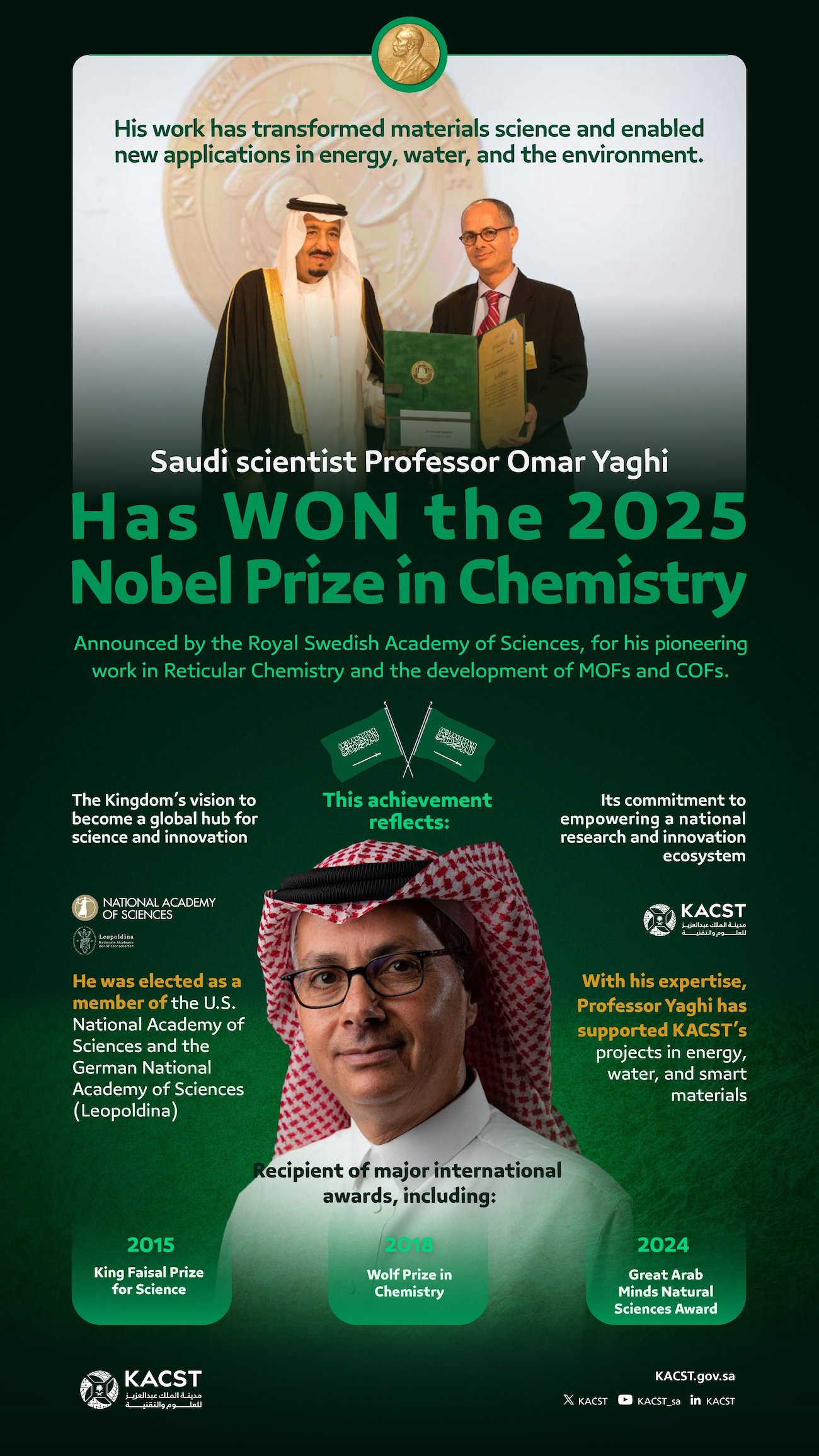
The Royal Swedish Academy of Sciences said the laureates created a new MOF whose vast internal cavities allowed gases and other chemicals to flow in and out. MOFs have opened routes to harvesting water from desert air, capturing carbon dioxide, storing toxic gases and catalyzing reactions, among other uses.

The prize is worth 11 million Swedish kronor ($1.2 million), shared equally by the recipients.

Beyond Berkeley, Yaghi co-directs the King Abdulaziz City for Science and Technology-UC Berkeley Center of Excellence on nanomaterials for clean energy, reflecting extensive research ties with Saudi partners in areas including MOFs and nanocrystals.


Diriyah seminar discusses Saudi water sustainability

Updated 11 sec ago
Follow

Diriyah seminar discusses Saudi water sustainability

RIYADH: The Ministry of Environment, Water and Agriculture recently participated in the Diriyah Global Seminar under the theme “Sustaining Civilizations: Oases and the Continuity of Heritage.”

During the presentation, the ministry highlighted the evolution of the Kingdom’s water sector, moving from scarcity to sustainability, the Saudi Press Agency reported on Sunday.

This progress, from the early 20th century to today, has established Saudi Arabia as a global leader in desalination, water management, and the expansion of supply and treatment networks.

Abdulaziz Al-Shaibani, deputy minister for water affairs, emphasized water’s cultural and developmental significance and its role in shaping lifestyles in desert environments.

He also reviewed traditional methods of water extraction and irrigation, alongside major institutional transformations in the sector, the SPA added.

Al-Shaibani highlighted the Kingdom’s achievements in 2025 and its targets for 2030, noting that water supplies in 2025 rose to over 16 million cubic meters per day, consolidating Saudi Arabia’s position as the world’s largest producer of desalinated water.

The sector has also recorded two new Guinness World Records, bringing the total to 11, further affirming its global leadership in desalination technologies, the SPA reported.

Moreover, the Kingdom operates the world’s largest water transmission and storage system, with capacities exceeding 18.5 million cubic meters per day for transmission and over 29 million cubic meters for storage.