


ISLAMABAD: Nearly 2,000 Pakistanis have returned home from Iran via Pakistan’s southwestern Balochistan province, Chief Minister Sarfraz Bugti said on Thursday, as provincial authorities remain on high alert amid the conflict in the Middle East.
Iran has been rocked by joint US and Israeli strikes since Feb. 28 that killed Supreme Leader Ayatollah Ali Khamenei. It has responded by retaliatory missile attacks targeting American military bases across the Gulf.
The escalation has disrupted air travel, heightened military activity along Iran’s southern coastline and turned strategic locations such as Bandar Abbas, near the Strait of Hormuz that supplies roughly 20 percent of global oil, into flashpoints.
Hundreds of Pakistani students this week fled Iran due to escalating hostilities spilling across key population centers, forcing them to abandon studies and undertake perilous overland journeys back home.
“In view of the ongoing tense situation in Iran, the entire relevant machinery of the Balochistan government is fully on high alert and activated,” Bugti said in an X post on Thursday.
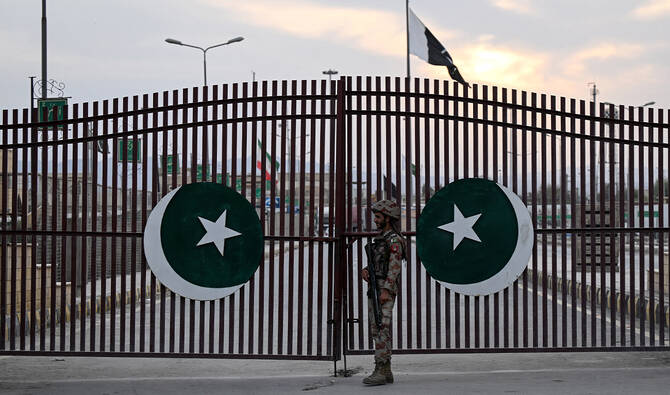
“The influx of Pakistanis along with foreigners through the Pakistan-Iran border continues, and they are being provided with all possible facilities and necessary assistance at the Taftan border,” he continued. “So far, a total of 1,979 individuals have entered Pakistan via the Taftan border, including 37 diplomats.”
However, Tahir Andrabi, a Pakistani foreign office spokesman, confirmed that nearly 1,200 Pakistanis had so far returned from Iran since the hostilities began.
Returning Pakistani students described sirens, incoming missile attacks, outgoing missile launches and the constant fear of further escalation.
The students’ journey home has proved arduous. From Bandar Abbas, they had to travel east through Iran’s Sistan-Baluchestan province to the Gabd-Rimdan border crossing into Balochistan. The route, normally a commercial corridor, has become a key evacuation pathway for the roughly 35,000 Pakistanis currently residing in Iran.
“I cannot put those scenes into words,” said Misbah Hussain, a 22-year-old medical student from Pakistan’s coastal district of Badin, describing the attacks near her hostel at the Hormozgan University of Medical Sciences in the Iranian coastal city of Bandar Abbas.
“Missiles landed a short distance from where we were staying,” she said, “and continued during our journey back. We could see missiles hitting along the way. There were moments when we felt we might not survive.”
Officials estimate that some Pakistani students still remain in Iran. With airspace disruptions and ongoing hostilities, they face the difficult decision of staying in a volatile environment or risking long overland travel to reach safety.


